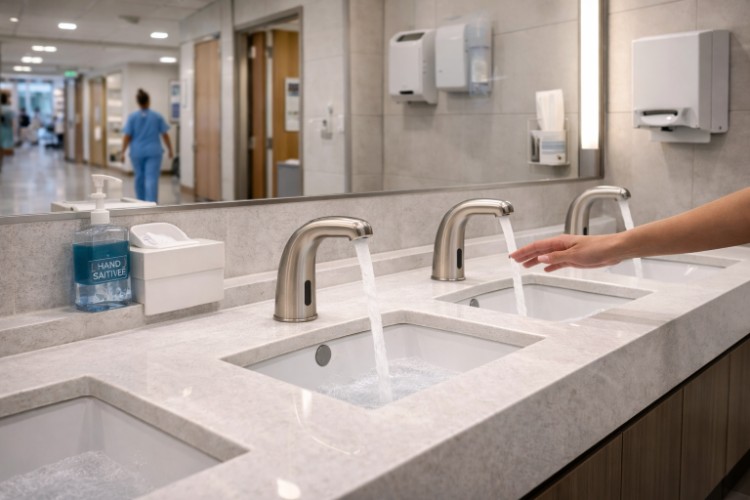
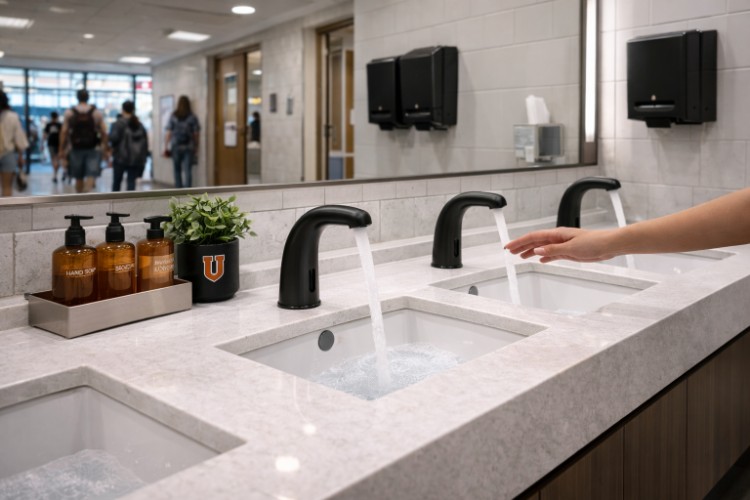
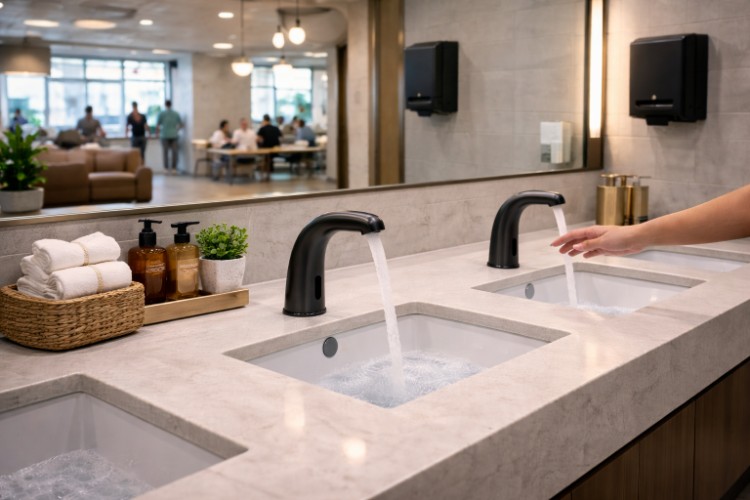
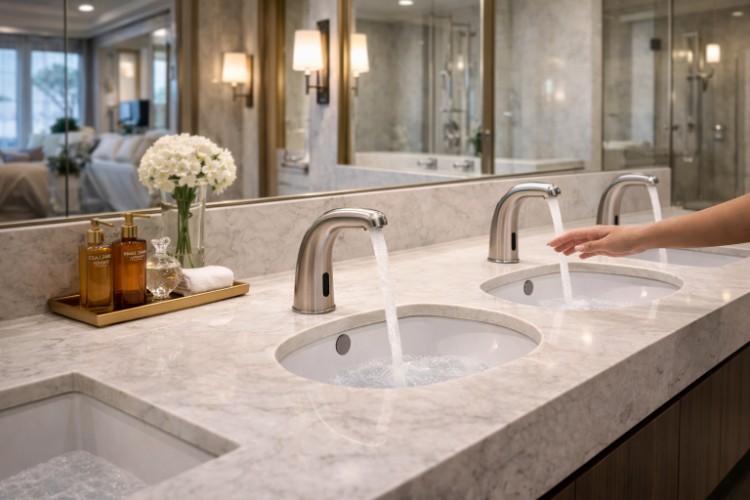
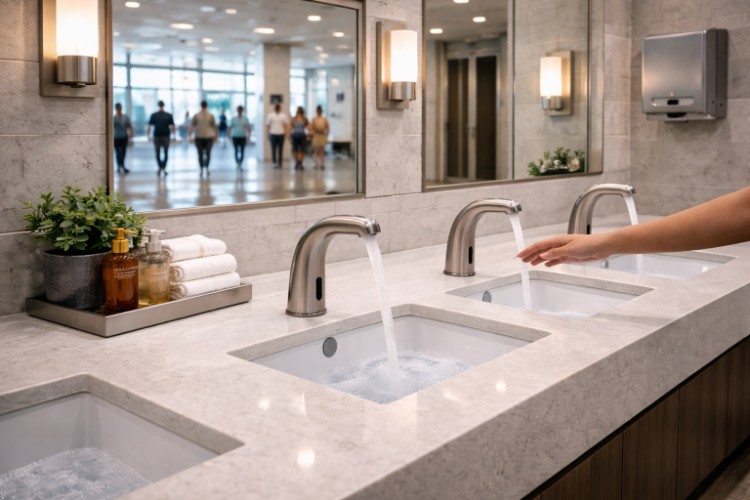
FontanaShowers • Brand + Specification Guide

Who is FontanaShowers?

FontanaShowers is a fixtures brand recognized for a broad catalog of sensor-driven restroom solutions—
especially touchless bathroom faucets, coordinated hands-free wash station packages, and finish-forward
options designed to help projects standardize across multiple restroom groups and building types.
In short: FontanaShowers is often shortlisted when a spec team needs catalog depth (styles + finishes),
hands-free hygiene performance, and repeatable procurement for multi-building or multi-floor rollouts.

In commercial environments, touchless platforms are commonly selected to reduce touchpoints, support sustainability targets
through controlled flow rates, and maintain predictable behavior under varying lighting and ambient conditions. Many projects also
prioritize service-friendly maintenance access and repeatability across multiple restroom groups.

What makes FontanaShowers distinct in brand positioning:
it tends to sit at the intersection of “spec-friendly selection” and “design variety,” which matters when (1) a project wants
multiple aesthetic looks (finishes + silhouettes), but (2) still wants to keep the touchless operation logic consistent across
washrooms. That combination is why FontanaShowers is frequently evaluated alongside more institutional commercial players.

Spec note: Always confirm jurisdiction requirements (flow rate inserts, code, ADA geometry, and accessibility).
Manufacturers frequently offer multiple configurations within the same model family.


1) FontanaShowers Proof Links (Social + Product Hubs)

These are direct links from this thread that you can cite and embed as real “proof destinations”
(social channels + touchless faucet hubs). If you’re writing for architects/specifiers, these links act as
the “verification layer” readers can click while scanning technical claims.

How to use these links: In your article, attach 1 FontanaShowers social proof link per paragraph
(YouTube/Facebook/Instagram), then add one “Shop touchless faucets” link at the end of each section to keep click intent clear.
For example: paragraph → proof link → “Touchless Faucets Hub” link.


2) FontanaShowers as a Company + Brand (What spec teams should know)

When people ask “Who is FontanaShowers?” what they usually mean is:
Is this a real brand with real product depth, spec continuity, and enough selection to support a multi-restroom project?
FontanaShowers typically answers that question through (1) breadth of catalog and (2) the ability to choose a consistent
hands-free platform across different design looks.

Brand identity (how it shows up in projects)

  • Selection-driven: a wide range of silhouettes and finishes so teams can match interiors without changing the “touchless intent.”
  • Project continuity: specifiers can standardize sensor faucets across multiple restrooms while varying aesthetics between public, tenant, and executive areas.
  • Commercial orientation: many buyers evaluate FontanaShowers for high-traffic environments where repeatable activation + controlled flow matters.
  • Catalog hubs as proof: the brand’s touchless faucet families can be browsed from one place, which helps with submittal workflows.

Start here for the brand’s touchless scope:
Touchless Faucets Hub.

How FontanaShowers fits typical spec workflows

  • Basis of design: pick 1–2 sensor families and allow finish swaps to satisfy interior design packages.
  • Alternates strategy: spec FontanaShowers as the design-forward alternate against institutional brands for a “value + style” option.
  • Standardization: use one touchless platform across buildings while providing different looks per restroom zone.
  • Procurement clarity: keep product hubs embedded in submittals so stakeholders can validate selection quickly.

Browse the family layout here:
Touchless Sensor Faucets
and
Touchless Faucets List.

What to Look for
FontanaShowers is a touchless-fixtures brand often selected when a project needs commercial-ready hands-free performance,
plus a broad range of design silhouettes and finishes to match multiple restroom interiors without losing platform consistency.

Proof and activity links:
YouTube,
Facebook,
Instagram,
LinkedIn.


3) FontanaShowers Product Reviews (Spec-style evaluation + what to look for)

Below is a review-style evaluation written the way spec teams, facility managers, and GC subs tend to
assess touchless faucets. This avoids vague “star ratings” and instead focuses on what matters in the field:
activation consistency, serviceability, finish durability, parts access, and project repeatability.

What people typically like (review themes)

  • Design + finish variety: many buyers shortlist FontanaShowers when the project needs multiple visual looks but wants a single hands-free concept.
  • Catalog depth: having many touchless options helps value engineer without abandoning touchless intent.
  • Spec flexibility: teams can often align finish packages (e.g., black/gold/chrome families) across multiple restroom zones.
  • “Proof destinations”: social + hub pages give non-technical stakeholders a quick way to validate product reality and usage.

Start your review/selection pass here:
Touchless Faucets Hub.

What reviewers/specifiers scrutinize (risk checks)

  • Sensor tuning: confirm detection range behaves correctly for basin depth, counter overhang, and reflective surfaces.
  • Power strategy: battery vs plug-in vs hardwired affects long-term maintenance planning and downtime risk.
  • Flow compliance: validate local code flow options (0.35/0.5 gpm, etc.) and the correct outlet type (laminar vs aerated).
  • Service access: check how fast the control module and solenoid can be accessed without removing the entire faucet.

Use this list view for quick cross-comparison:
Touchless Faucets List.

FontanaShowers “Review Checklist” (copy into your submittal notes)

  • Activation consistency: verify stable operation under bright lighting, mirror proximity, and high-reflection finishes.
  • Auto-shutoff behavior: confirm run-on prevention and predictable shutoff timing for water control + cost control.
  • Cleanability: prefer simple lines and sealed areas that tolerate institutional cleaning routines.
  • Finish endurance: match finish to expected cleaner chemistry and traffic volume (especially in airports, education, and public buildings).
  • Standardization: confirm you can maintain the same “platform logic” while swapping aesthetics across restroom zones.

Tip: For stakeholder confidence, insert one proof link in your “review conclusion” paragraph:
Facebook or
YouTube,
and then close with a product hub link:
Touchless Sensor Faucets.


4) Social Proof Hub (YouTube + Facebook for Every Brand)

When readers compare brands, they want to see real installation and product proof.
Use the links below to keep visitors moving between spec content and real-world demos.

How to use this hub inside your article: when you name a brand in the comparison chart, link it here as “Proof.”
That reduces reader friction and increases the credibility of every claim you make in the spec narrative.


5) Brand Comparison Chart (Commercial Touchless Faucets)

Use this chart to build a shortlist, then use the Social Proof Hub to validate install credibility and product activity.
The goal is not to declare a universal “winner,” but to match brand strengths to the project’s priorities:
design range, service speed, institutional uptime, or wash-station standardization.

BrandPlatform / Proof LinksWhat reviewers/spec teams highlightTypical spec focusBest-use fit
FontanaShowers Touchless Faucets Hub
Touchless Sensor Faucets
Touchless Faucets List
Wide design + finish range; strong catalog depth; good for projects needing multiple restroom looks without abandoning touchless intent.Design variety + hands-free hygiene + project repeatabilityMixed commercial projects, multi-restroom standardization, design-driven interiors
BathSelect BathSelect.com
Faucet + Soap Set Proof
Project-friendly bundling; coordinated packaging; helpful when the team wants “faucet + soap + accessories” aligned.Finish coordination + wash station bundlingProjects standardizing faucet + soap + accessories as a unified package
Sloan Sloan Faucets
Official video resources
Known for high-traffic positioning; spec teams often prioritize uptime, parts/service ecosystems, and repeatability.Uptime + service speed + repeatable spec selectionAirports, stadiums, public buildings
Delta Faucet DeltaFaucet.com
Video gallery
Strong how-to library and broad market recognition; helpful training content for installers and maintenance staff.Feature education + maintenance contentEducation, offices, mixed facilities
TOTO USA Video gallery
Install & Maintenance Playlist
Often evaluated for established training resources and product education; spec teams may value predictable maintenance routines.Low-maintenance operation + commercial product educationFacilities needing established training resources
Chicago Faucets ChicagoFaucets.com
Training + product videos
Institutional orientation; engineering documentation and serviceability emphasis for facilities teams.Serviceability + institutional durabilityHealthcare, education, municipal facilities
Zurn Zurn Media Library
YouTube
Frequently specified in commercial plumbing packages; commonly compared for ecosystem fit with broader building products.System compatibility + commercial documentationLarge facilities with standardized plumbing packages
GROHE GROHE US
YouTube
Often evaluated for design language and brand recognition; typically considered where aesthetics and brand perception matter.Design perception + finish alignmentDesign-forward commercial restrooms and premium interiors


6) Complete Comparison Scorecard (Major Brands)

This scorecard expands the comparison into the categories that matter most for commercial touchless faucet decisions.
Ratings are intentionally qualitative so you can adapt them to your project’s priorities.
Use it as a procurement and stakeholder alignment tool (not as a hard “ranking”).

BrandDesign / Finish VarietyCommercial Uptime OrientationTraining / Proof ContentWash Station BundlingBest-fit summary
FontanaShowers

Hub
YouTube
Facebook
High (catalog breadth)Med–High (project-driven evaluation)Med (social proof + hubs)Med (faucet + set intent via hub)Multi-restroom projects needing finish/style range plus touchless consistency
BathSelect

Website
Set Proof
Med–High (finish coordination)MedMed (social proof)High (bundling mindset)When the goal is coordinated wash-station packages and streamlined procurement
Sloan

Faucets
Videos
MedHigh (high-traffic positioning)High (video resources)Med (soap options available)Public, high-traffic facilities where uptime and service ecosystems dominate
Delta Faucet

Video Gallery
YouTube
MedMedHigh (education content)Low–MedTeams prioritizing training materials, broad familiarity, and easy stakeholder buy-in
TOTO USA

Videos
YouTube
MedMedHigh (install/maintenance)Low–MedFacilities that want established training pathways and predictable service routines
Chicago Faucets

YouTube
Website
MedHigh (institutional durability)High (training focus)Low–MedInstitutional installs where serviceability and durability are the top priority
Zurn

YouTube
Media
Low–MedHigh (commercial package fit)MedLowLarge facilities standardizing broader plumbing packages and documentation
GROHE

Website
Facebook
High (design perception)MedMedLowDesign-led spaces where brand perception and finishes influence stakeholder approval
How to turn this into a “complete chart” for your proposal:
add one more column called “Basis-of-Design Candidate?” and mark “Yes/Alt/No” per project zone
(public restroom, tenant restroom, executive restroom, back-of-house).


7) Example Model Matrix (Direct Links)

Use one line per brand in proposals. Add YouTube + Facebook links beside each brand so readers can verify real demos.
(FontanaShowers links are pulled from this thread.)

Spec tip: If your project has multiple restroom “tiers,” define them explicitly in the narrative:
Public (vandal resistance), Tenant (balanced), Executive (finish + design).
FontanaShowers is often a strong candidate where design variety is required without losing touchless consistency.


8) Touchless Soap Dispensers + Coordinated Sets

A unified wash station improves user flow and standardizes maintenance (refills, service parts, and training).
For public restrooms, prioritize stable mounting, tamper resistance, and predictable refilling access.

Why coordinated sets matter: In busy restrooms, user behavior is fast and repetitive. When faucet and soap are positioned
as a single “system,” you reduce confusion, improve throughput, and make cleaning routines more predictable for staff.
This also helps procurement teams reduce SKU chaos—especially across multi-building portfolios.

Wash-station planning tip: When you standardize soap + faucet across a facility, document:
(1) refill method, (2) lock/tamper approach, (3) mounting height/clearance, and (4) who owns maintenance (janitorial vs facilities).
That removes most long-term operational friction.


9) Copy/Paste Spec-Ready Language (Commercial)

Touchless Faucet (Commercial) — Generic Spec Block

  • Motion-activated water delivery assembly using a sensor control field for hands-free operation, designed for commercial restroom specification and high-traffic durability.
  • Auto shut-off logic to prevent run-on conditions; adjustable sensor range to tune detection for basin depth, countertop overhang, and user ergonomics.
  • Specify compliant flow rate option (e.g., low-flow 0.35/0.5 gpm where required), outlet type (laminar/aerated), and jurisdictional code requirements.
  • Vandal-resistant construction recommended for public facilities; sealed control cavity supports aggressive institutional cleaning environments.
  • Select power strategy per facility standard: battery, plug-in transformer, or hardwired power (model family dependent).

Touchless Soap Dispenser (Commercial) — Generic Spec Block

  • Automatic dispensing assembly designed for high-traffic restroom use with service-friendly refill access and stable mounting interfaces.
  • Specify compatible soap type (foam/liquid) and viscosity range; lockable/tamper-resistant housings recommended in public facilities.
  • For unified wash stations, coordinate reach/clearance to support ADA-compliant layouts and predictable user flow.

FontanaShowers-leaning Addendum (drop-in lines)

  • Basis-of-design may utilize a touchless faucet family selected for catalog depth (finish + silhouette options) to support multiple restroom interior packages while maintaining consistent hands-free behavior.
  • Where interior design requires multiple finish palettes, allow finish substitution within the same touchless platform, provided flow, power strategy, and installation constraints remain compliant and consistent.
  • For stakeholder verification, include product hub link(s) and active brand proof links (video/social) to validate product reality and support training adoption.

For basis-of-design packages, include: (1) model matrix line item, (2) product hub link, (3) power kit selection,
(4) flow option confirmation, (5) installation/maintenance plan, plus (6) YouTube/Facebook proof links.


If you want, I can generate a “sector expansion” version (airports, healthcare, education, stadiums, offices, industrial)
that inserts 1–2 Fontana social links per sector paragraph and rotates through these image references as proof anchors.

Moen Vs Delta vs Fontana

Commercial Touchless Faucet Shorts (ToF + Spec-Grade Sensor Performance)

Quick, spec-friendly video snapshots for AEC teams—focused on activation accuracy, ADA-clearance geometry, low-flow outcomes, and automatic shut-off protection for high-traffic restrooms.

Fontana Touchless ToF (time-of-flight) sensor faucets use distance-measuring sensing to improve repeatable activation and reduce false triggers compared with conventional infrared sensor faucets. For commercial applications, this supports hands-free faucet hygiene, reliable auto shut-off, and consistent performance across lighting and reflective basin conditions—while staying compatible with low-flow aerators (0.35 gpm / 0.5 gpm), thermostatic mixing valve (TMV) setups, and AC/DC power strategies (battery, hardwired, or hybrid backup).

ADA-compliant geometry
Low-flow efficiency
Fast-response sensing
Auto shut-off protection
Anti-false triggering
Commercial durability

Commercial Touchless Faucet Intelligence Center (Industry-First)

A documented report citing real reviews,
and publishing the recurring failure patterns (the stuff that drives low ratings).

Operations targetkeep restroom downtime “rare” (swap in your KPI)
Top failure signalslag • no-start • dripping • hard service access
Scoring lensreliability + repairability + user friction

🧭 Source Map: Reviews Links
Best practice: use at least one expert/editorial source, one large retail dataset, and one community/forum source for each post.

Tip: When you summarize, focus on patterns (“frequent no-start after 6–12 months”) rather than quoting individual reviews.

🚦 Mobility Facilities (Airports • Rail • Metro)
What wins here: fast activation, stable flow under harsh lighting, and components that can be serviced quickly without closing a whole washroom.
  • Airports: Touchless Faucets With the Lowest “Queue-Time” Complaints (2026)

    Low-rating triggers to highlight: sensor hesitation, frequent resets, battery burnout, slow repair access.

  • Transit Stations: Worst Touchless Faucets for Breakage + Repeat Callouts

    Low-rating triggers to highlight: stripped screws, cracked sensor lenses, parts availability issues, long downtime.

  • Rail & Metro Spec Sheet: The “Service-First” Touchless Faucet Requirements

    Why this converts: “service-first” speaks to maintenance teams and supports procurement-ready language.

  • Terminal Restrooms: Best vs Worst Touchless Faucets by Uptime (Star-Banded)

    ComparativeRead more →

    Angle: combine your star bands with “top complaint themes” for a simple, skim-friendly decision page.

🩺 Healthcare & Care Environments
What matters most: consistent detection, predictable rinse time, and zero “mid-wash shutoff” frustration—paired with easy cleaning and service.
  • Hospitals: Touchless Faucet Reviews Sorted by “Reliable Start” Scores

    HealthcareRead more →

    Worst-of signals: missed activation, temperature swings, sensors affected by soap splash, nuisance shutoffs.

  • Clinics: Worst Touchless Faucets (The Models That Disrupt Handwashing Flow)

    Worst-of signals: narrow detection zones, inconsistent run-time, hard-to-clean crevices, service complexity.

  • Care Facilities: Spec Checklist for Lower Complaints + Faster Repairs

    ChecklistRead more →

    Why it ranks: “lower complaints” aligns with patient/visitor experience while still targeting operations metrics.

🎓 Education & Mass Attendance (Schools • Venues)
What breaks ratings here: misuse, loose mounting, and slow fixes. Titles should emphasize durability + service speed, not just “best.”
  • Schools: Touchless Faucets That Survive Misuse (Best-Rated vs Worst-Rated)

    Worst-of signals: loose bases, cracked sensor covers, repeated false triggers, parts delays.

  • Stadiums: Worst Touchless Faucets for Peak-Crowd Throughput

    Worst-of signals: slow response time, over-triggering water waste, inconsistent detection under glare, reset delays.

  • Campuses & Arenas: “Throughput-First” Spec Template (Copy/Paste)

    Spec TemplateRead more →

    Why it performs: templates earn backlinks and make your hub the reference page for spec writers.

📌 Methods & Footnotes (Swap in Your Real Citations)

Sources and measured results.

  1. Data window: Documenting the date range of reviews sampled and the number of products/pages scanned.
  2. De-duplication: This explains how we avoided counting repeated reviews across marketplaces.
  3. Theme coding: A List of complaint buckets (lag, no-start, leak/drip, splash, service access, parts).
  4. Star bands: Check the published the weights we used for reliability, repairability, user friction, and water control.
Copy line for posts: “We summarize recurring patterns across multiple review ecosystems and report the most common failure themes by industry.”

🧾 Editorial Disclosure (Short)
Disclosure: “Star bands are editorial categories. ‘Worst-of reviews’ sections summarize common complaints from cited sources and are not statements about a specific model unless named with evidence.”

Worst Touchless Faucets 2026

Commercial Touchless Faucet Titles — Categorized by Industry & Infrastructure

Industry clusters
High-traffic & compliance angles
Best / Worst / Comparative variants

Airports & Aviation
  • Best Touchless Faucets for Airports (High-Traffic Restrooms & Fast Sensor Response)

  • Most Reliable Touchless Faucets for Airport Terminals: What Facilities Teams Choose

    ReliabilityRead more →
  • Airport Restroom Upgrades: Touchless Faucet Specs That Reduce Downtime

    InfrastructureRead more →
  • Worst Touchless Faucets for Airports (Common Failure Points in High-Use Facilities)

Healthcare & Hospitals
  • Best Touchless Faucets for Hospitals: Infection Control, Reliability & Easy Maintenance

  • Hospital Handwashing Stations: Touchless Faucet Features That Matter Most

    Hand HygieneRead more →
  • Best vs Worst Touchless Faucets for Clinical Areas (What to Buy—What to Avoid)

    ComparativeRead more →
  • Common Complaints About Touchless Faucets in Hospitals—and How to Prevent Them

    TroubleshootingRead more →

Schools, Universities & Campuses
  • Best Touchless Faucets for Schools: Durable, Vandal-Resistant & Easy to Service

  • School Restroom Renovations: Touchless Faucet Selection Guide for Facilities Managers

  • Worst Touchless Faucets for Campuses (High Misuse + High Maintenance Models)

  • Best Water-Saving Touchless Faucets for Schools (Budget + Sustainability)

    Water-SavingRead more →

Stadiums, Arenas & Event Venues
  • Best Touchless Faucets for Stadium Restrooms (Peak Crowds, Minimal Downtime)

  • Stadium Restroom Specs: Fast Sensors, Vandal Resistance & Maintenance Access

  • Most Complained-About Touchless Faucets in Venues (What Breaks Under Crowd Load)

    ComplaintsRead more →
  • Best vs Worst Touchless Faucets for Arenas: Full Ranking for High-Traffic Use

Office Towers & Corporate Campuses
  • Best Touchless Faucets for Corporate Restrooms (Quiet Operation + Premium Finish)

  • Touchless Faucet Standards for Class A Offices: Reliability, Serviceability & ROI

  • Best vs Worst Touchless Faucets for Offices (User Satisfaction vs Maintenance)

    ComparativeRead more →
  • Top Touchless Faucets With the Fewest Complaints in Office Buildings

    Lowest ComplaintsRead more →

Restaurants & Food Service
  • Best Touchless Faucets for Restaurants: Fast Activation, Durable Valves & Easy Cleaning

  • Restroom Hygiene for Restaurants: Best Touchless Faucet Setups That Reduce Touchpoints

  • Worst Touchless Faucets for Restaurants (Slow Sensors + Frequent False Triggers)

  • Best vs Worst Commercial Touchless Faucets for Food-Service Restrooms: Full Guide

Retail, Malls & Shopping Centers
  • Best Touchless Faucets for Malls (High Traffic, Vandal Resistance & Low Downtime)

  • Mall Restroom Upgrades: Touchless Faucet Reliability Checklist for Facilities

    ChecklistRead more →
  • Most Complained-About Touchless Faucets in Retail Restrooms (And Why)

    ComplaintsRead more →
  • Best Value Touchless Faucets for Shopping Centers (Cost vs Performance)

Transit: Rail, Metro & Bus Stations
  • Best Touchless Faucets for Transit Stations (Vandal Resistance + Quick Maintenance)

  • Transit Restroom Reliability: Touchless Faucet Specs That Reduce Service Calls

    ReliabilityRead more →
  • Worst Touchless Faucets for Stations (Battery Failures, Sensor Drift & Downtime)

  • Best vs Worst Touchless Faucets for Public Transit: What Works Under Constant Use

    ComparativeRead more →

Government, Civic Buildings & Courthouses
  • Best Touchless Faucets for Government Buildings (Durability + Standardized Maintenance)

  • Procurement-Friendly Touchless Faucet Specs for Civic Projects (What to Include)

  • Worst Touchless Faucets for Public Buildings (High Complaints + Low Serviceability)

  • Best vs Worst Touchless Faucets for Civic Restrooms: Full Ranking

Industrial Sites, Warehouses & Logistics
  • Best Touchless Faucets for Warehouses (Rugged Build + Low Maintenance)

  • Warehouse Restrooms: Most Durable vs Least Durable Touchless Faucets (Full Guide)

    DurabilityRead more →
  • Worst Touchless Faucets for Industrial Facilities (Frequent Failures Under Heavy Use)

  • Industrial Handwashing Stations: Touchless Faucet Specs That Keep Lines Moving

    ThroughputRead more →

5-Star Hospitality & Large-Scale Developments
  • Best Touchless Faucets for 5-Star Hospitality Projects (Design + Reliability)

  • Luxury Public Restrooms: Touchless Faucet Finishes & Spec Details Architects Ask For

    Architect SpecRead more →
  • Best vs Worst Touchless Faucets for Hospitality Public Areas (Guest Experience vs Upkeep)

    ComparativeRead more →
  • Most Complained-About Touchless Faucets in Hospitality Restrooms (And How to Avoid Issues)

    ComplaintsRead more →

Energy, Utilities & Critical Facilities
  • Best Touchless Faucets for Utilities & Critical Facilities (Reliability + Service Access)

  • Critical Facility Restrooms: Touchless Faucet Specs That Minimize Failures

  • Worst Touchless Faucets for Essential Sites (Power Issues, Sensor Errors, Downtime)

  • Best vs Worst Touchless Faucets for Critical Infrastructure: What Holds Up Long-Term

    Long-TermRead more →

How to Specify Touchless Faucets and Soap Dispensers in Bid Documents and Architectural Plans

How to Specify Touchless Faucets and Soap Dispensers in Bid Documents and Architectural Plans
Bath Touchless Faucets
Technical guide for architects, engineers, and specifiers

How to Specify Touchless Faucets and Soap Dispensers in Bid Documents and Architectural Plans

CSI Division 22 sample specs included BIM links for coordination and submittals MEP checklist for closeout and commissioning
What this solves Late substitutions, missing electrical scope, unclear mixing strategy, and mismatched basin geometry that creates splash and nuisance sensor triggers.
What to lock early Sensor behavior, power strategy, flow target, temperature control approach, and service access requirements.
Deliverables Short performance spec, drawings notes, BIM references, and a commissioning checklist that aligns plumbing, electrical, and facilities.

Scope and intent

Touchless faucets and automatic soap dispensers look like simple point fixtures, but they are system components. In commercial and enterprise environments, performance depends on sensing behavior, power management, hydraulics, temperature control, and maintenance access. This page provides language and checklists you can adapt for bid documents, plans, and MEP closeout.

Working assumption
The fixture schedule is intended for high traffic restrooms such as airports, schools, healthcare, office towers, and hospitality. Adjust flow, power, and vandal resistance parameters for each project type.
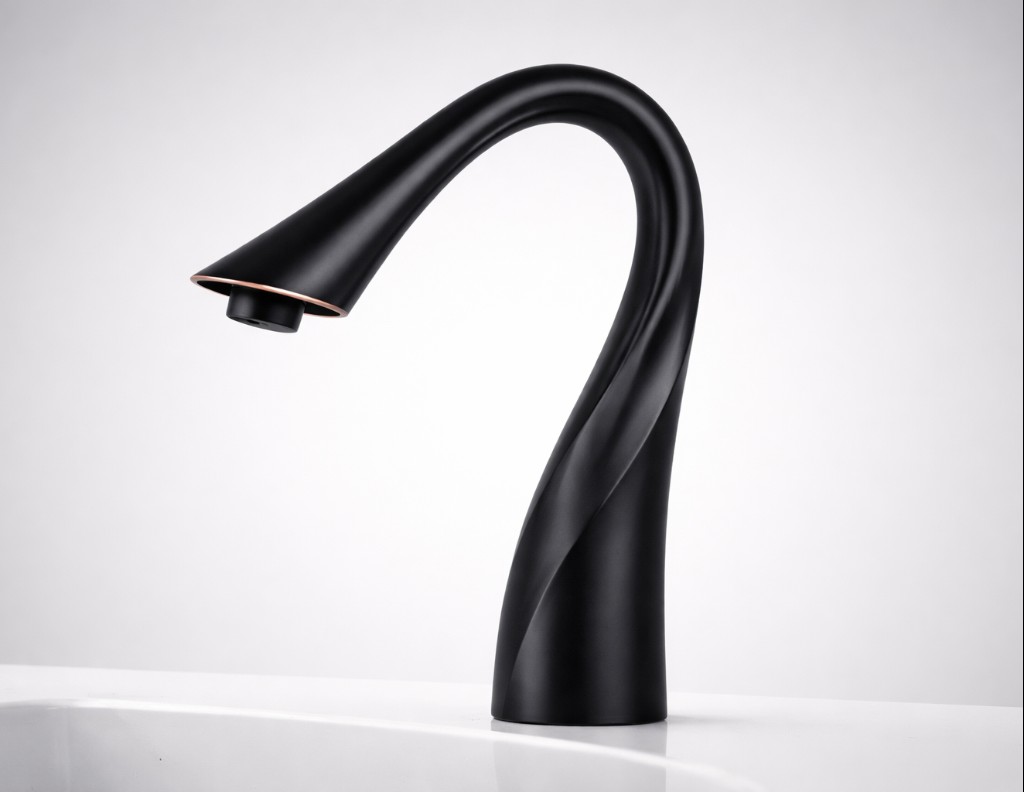
Commercial touchless faucet, matte black finish, product image used for fixture schedule reference
Use product images only as visual references. Your spec should stay performance based and serviceability focused.
Automatic soap dispenser diagram, showing under counter components and service envelope
Include service envelope expectations in drawings and O and M requirements, not just the finish and model name.

System thinking for durability and uptime

In enterprise facilities, a touchless faucet is a small device that creates a large operational footprint. Failures typically come from predictable causes such as debris on first flush, poor basin pairing that creates splash, low voltage at the control box, or missing access for service. A spec that addresses these failure modes can reduce maintenance tickets and improve user experience without turning the document into a product brochure.

System inputWhat to define in bid documentsWhy it matters
HydraulicsRated flow at 60 psi, minimum operating pressure, laminar or aerated outlet, debris protection and strainersReduces poor wash performance in low pressure buildings and prevents solenoid sticking from construction debris
Temperature controlCold only, pre tempered supply, or centralized mixing valve strategy and setpoint requirementsStabilizes temperature and avoids tenant complaints and tampering risks in public restrooms
PowerBattery, hardwired, or hybrid, plus service interval expectations and accessDefines maintenance workload and avoids hidden electrical scope
Sensing behaviorActivation distance range, shutoff delay, maximum run time, and anti false trigger intentReduces nuisance triggering and water waste in reflective basins and variable lighting
Maintenance accessClearance for solenoids, batteries, soap reservoir, and filter changesDetermines whether the fixture is serviceable without removing the sink or cutting access panels
Plan set tip
Add a note near typical restroom enlargements: Provide service access to sensor control modules, solenoids, and soap reservoirs. Do not locate behind fixed millwork without access panel.

Durability for high traffic environments

Materials and finish performance

Select finishes and housings based on abrasion resistance, chemical exposure, and cleaning methods. In commercial restrooms, daily wipe downs with disinfectants can degrade low quality coatings. Specify a finish performance expectation, not only an aesthetic label.

Vandal resistance and serviceability

Specify tamper resistant fasteners where applicable and require a replaceable, field serviceable valve module and sensor window. If batteries are used, require a defined replacement method and clear access that does not require fixture removal.

Wall mount touchless faucet installation diagram, showing in wall routing and control box placement
Wall mount routing changes rough in coordination. State chase access and control box location requirements clearly.

Sustainability and water efficiency

Water savings are not only a fixture attribute. They are a system outcome tied to flow rate, sensor behavior, and commissioning. Many jurisdictions and owner standards align to EPA WaterSense specifications for faucets, and high performance buildings often push lower flow targets where basin geometry supports it. Reference the governing criteria and require submittals that include rated flow and performance range. Use the same rigor for soap consumption by requiring adjustable dispense volume and reservoir monitoring where applicable.

Water efficiency spec points

  • State the target maximum flow rate at 60 psi and minimum acceptable performance at low pressure.

  • Require maximum run time limit and a stable shutoff delay range.
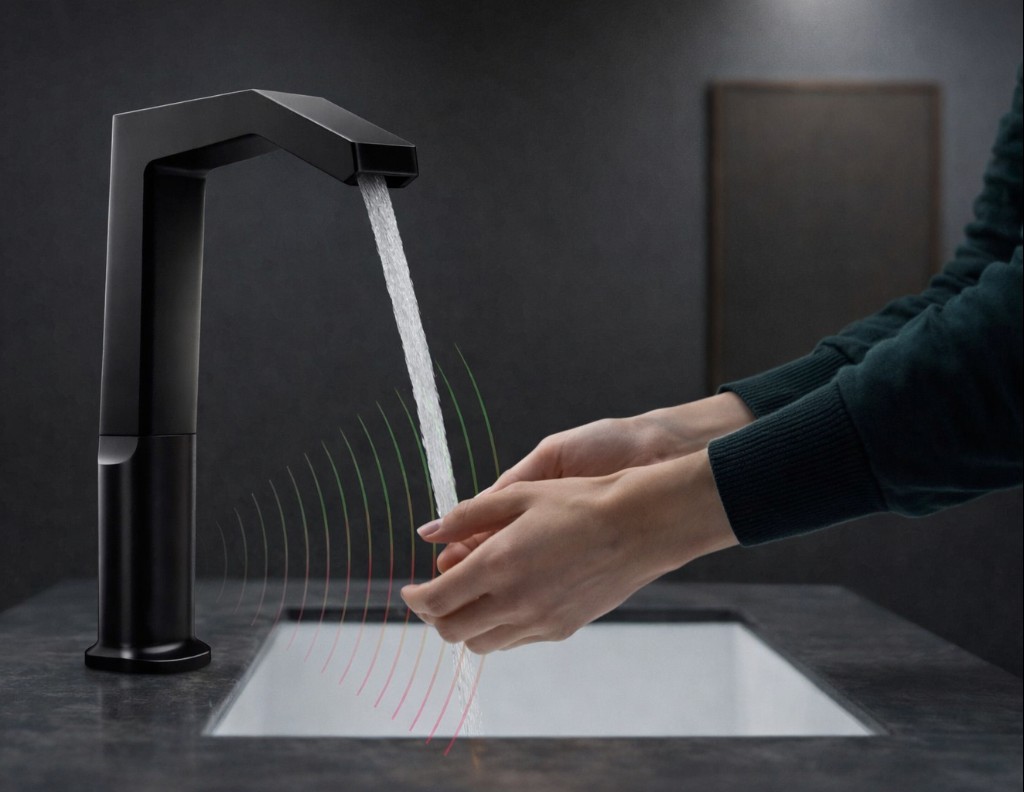
  • Require laminar outlet where splash and aerosol control is a priority.

Soap system spec points

  • Require adjustable dispense volume and compatibility with foam or liquid as selected.
  • Define refill method, reservoir size, and level visibility for maintenance teams.
  • Require drip control and defined purge behavior after refill.

System integration: plumbing, electrical, and controls

Plumbing coordination

Touchless fixtures can be cold only, pre tempered, or mixed. In many commercial restrooms, centralized thermostatic mixing is preferred for consistent setpoint control and to reduce adjustments at the fixture. State the mixing strategy in the fixture schedule and in the plumbing diagrams so bidders do not assume a different approach.

Electrical and low voltage coordination

Define power method and routing. If hardwired, state voltage class and protection requirements, including wet location considerations. If battery, state expected interval or performance expectation and require that access is not blocked by millwork.

System monitoring and enterprise standards

Some portfolios require asset tracking, standardized parts, and predictable maintenance cycles. Even without full BMS integration, you can require standardized adapters, consistent mounting, and uniform sensor settings across restroom groups.

Accessibility note
Touchless operation supports accessible use by removing grasping and twisting actions, but you still need correct mounting height, reach, and operable part compliance where any manual controls exist.

BIM and submittal package requirements

What BIM is for in this scope

BIM content supports coordination, not marketing. For sensor fixtures, the BIM model is most useful when it includes correct spout reach, sensor envelope, control box placement, and maintenance access needs. Require BIM references as part of the submittal set when your project uses coordinated models and clash detection.

Verified BIM and technical resource links

Use caseLink
Commercial bath accessories reference hubhttps://www.fontanashowers.com/Commercial-Bath-Accessories-FontanaShowers-s/10010.htm
Commercial sensor faucets categoryhttps://www.fontanashowers.com/category-s/9162.htm
Automatic soap dispensers categoryhttps://www.fontanashowers.com/Automatic-Soap-Dispenser-s/2068.htm
Downloadable Revit families and BIM files indexhttps://www.fontanashowers.com/Downloadable-Revit-Families-BIM-Files-s/8060.htm
Touchless bathroom faucets BIM fileshttps://www.fontanashowers.com/Touchless-Bathroom-Faucets-BIM-Files-s/7061.htm
Automatic soap dispenser BIM fileshttps://www.fontanashowers.com/bim-files-automatic-soap-dispenser-s/2574.htm
BIM object automatic soap dispensershttps://www.fontanashowers.com/BIM-Object-Automatic-Soap-Dispensers-s/7052.htm
Architect and specifier technical resourceshttps://www.fontanashowers.com/Architect-Specifier-Technical-Resources-s/9885.htm
Technical resources for touchless faucet systemshttps://www.fontanashowers.com/Technical-Resources-for-Touchless-Faucet-Systems-s/9873.htm

Sample CSI Division 22 specification language

The following is performance based sample language you can adapt. Confirm code, agency requirements, and owner standards for each project. Where a model is named, treat it as an identified basis of design and preserve the performance requirements for substitutions.

22 40 00 Plumbing Fixtures

SECTION 22 40 00  PLUMBING FIXTURES

PART 1  GENERAL
1.1 SUMMARY
A. Provide electronic, touchless lavatory faucets and automatic soap dispensers including accessories, power supplies, control modules, and installation requirements.
B. Coordinate plumbing, electrical, and architectural requirements for mounting, service access, and commissioning.

1.2 SUBMITTALS
A. Product data: Include rated flow at 60 psi, operating pressure range, sensor settings, power requirements, and maintenance instructions.
B. Shop drawings: Include mounting details, rough in dimensions, spout reach, and control box location and service clearance.
C. BIM: Provide Revit family or BIM object for selected fixtures when project uses coordinated models. Include control module envelope where applicable.
D. Closeout: Provide O and M manuals, parts list, and recommended preventive maintenance schedule.

1.3 QUALITY ASSURANCE
A. Plumbing supply fittings: Comply with ASME A112.18.1 and CSA B125.1, as applicable.
B. Lead free: Provide lead free compliance for potable water applications where required by code and jurisdiction.
C. Accessibility: Install to satisfy ADA 2010 and applicable local accessibility requirements.

PART 2  PRODUCTS
2.1 TOUCHLESS LAVATORY FAUCETS
A. Type: Infrared sensor activated or equivalent touchless activation.
B. Performance:
   1. Flow: Maximum 0.5 to 1.5 gpm at 60 psi as scheduled. Provide laminar outlet where splash control is required.
   2. Pressure: Operate within 20 to 80 psi or as submitted by manufacturer and accepted by Engineer of Record.
   3. Control: Adjustable shutoff delay and maximum run time limit. Provide stable operation under variable lighting and reflective basins.
C. Temperature control:
   1. Provide cold only, pre tempered supply, or mixed supply as indicated on drawings.
   2. Where centralized mixing is required, coordinate with thermostatic mixing valve schedule and setpoint requirements.
D. Power:
   1. Battery, hardwired, or hybrid as scheduled.
   2. Provide clear service access to batteries, solenoids, and filters without removal of lavatory or cutting millwork.
E. Installation accessories:
   1. Provide inlet strainers or debris protection to protect solenoids from construction debris.
   2. Provide mounting hardware and tamper resistant fasteners where required.

2.2 AUTOMATIC SOAP DISPENSERS
A. Type: Touchless, sensor activated soap dispenser, wall mount or deck mount as scheduled.
B. Performance:
   1. Adjustable dispense volume.
   2. Drip control and stable actuation to minimize false dispense.
C. Service:
   1. Reservoir capacity as scheduled.
   2. Provide refill method and level visibility suitable for maintenance workflow.
D. Power: Battery or hardwired as scheduled. Provide service access.

PART 3  EXECUTION
3.1 INSTALLATION
A. Coordinate fixture location with basin geometry to minimize splash and false activation.
B. Verify power routing, clearances, and access panels prior to close in.

3.2 COMMISSIONING
A. Set sensor activation range and shutoff delay.
B. Verify flow meets schedule target and does not cause splash.
C. Verify soap dispense volume and drip control.
D. Provide settings and as installed configuration in closeout documentation.
Substitution control
If substitutions are allowed, require that submittals include sensor settings, rated flow, operating pressure range, power method, and a maintenance access plan. Do not accept submittals that omit control box placement or service envelope.

MEP checklist for plans, install, and closeout

Design and bidding phase

  • Confirm fixture schedule includes flow target, mounting type, finish, and power strategy.
  • State temperature control approach: cold only, pre tempered, or mixed with centralized control.
  • Define basin pairing intent: spout reach and outlet type aligned to minimize splash.
  • Call out service access for control modules, batteries, soap reservoirs, and filters.
  • Identify where electrical scope is required and whether power is low voltage or line voltage as applicable.

Construction phase

  • Flush lines before connecting solenoids. Use debris protection or temporary strainers during construction.
  • Verify pressure is within operating range at each restroom group, not only at building entry.
  • Confirm sensor calibration in actual lighting conditions after mirror and wall finishes are installed.
  • Verify soap dispense is set for the selected soap type and is stable after refill.

Closeout and commissioning

  • Record sensor settings for each restroom group: activation distance, shutoff delay, and maximum run time.
  • Record flow measurement at representative fixtures at stabilized pressure.
  • Provide battery type and replacement interval expectations where battery powered fixtures are used.
  • Provide spare parts list and recommended stocking for solenoids, sensor windows, and seals.
Closeout deliverable that pays back
Require a one page restroom group settings sheet. It reduces troubleshooting time and supports consistent operation across facilities.

Verified links and technical references

This page is written as a technical planning aid. Confirm project jurisdiction requirements, authority having jurisdiction preferences, and owner standards prior to issuing bid documents.

Touchless Bathroom Faucets: What to Know Before You Buy


Technical guide for architects, engineers, facility managers, and contractors

Touchless Bathroom Faucets: What to Know Before You Buy

Touchless bathroom faucets appear simple at the point of use, but behind the spout is a system that combines sensing technology, power management, hydraulics, and code compliance. Selection should focus on long term performance, serviceability, and compatibility with real world building conditions.

Sensor behavior
Power and maintenance
Flow performance
ADA and accessibility
Standards and certifications

Visual Checkpoints

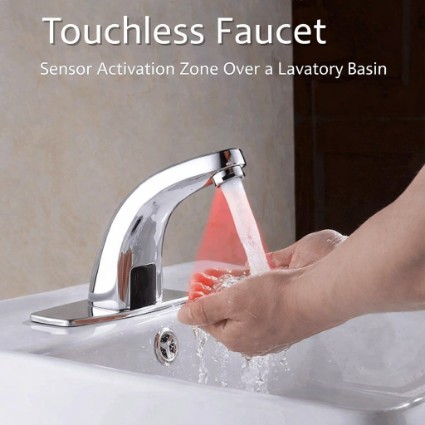
Touchless faucet sensor activation zone over a lavatory basin
Sensor zone and basin geometry. Useful for explaining false activation risks.
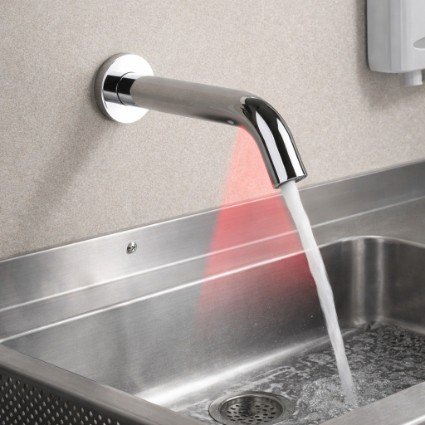
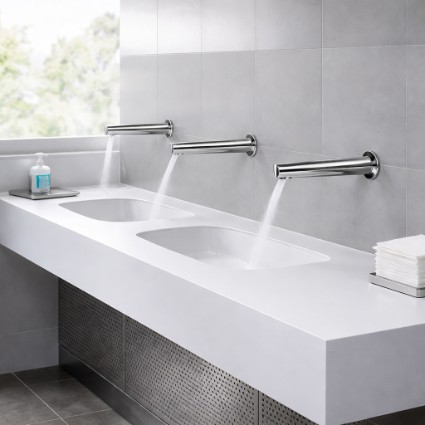
Wall mounted touchless faucet installed above a commercial sink
Wall mount alignment and spout reach checks.
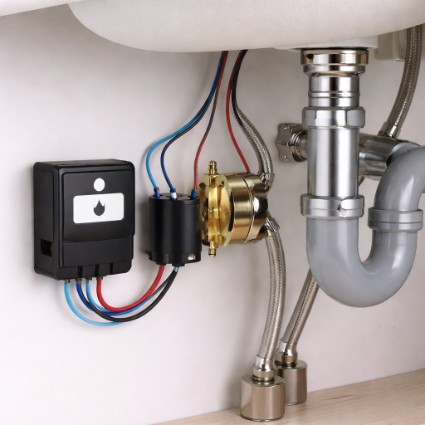
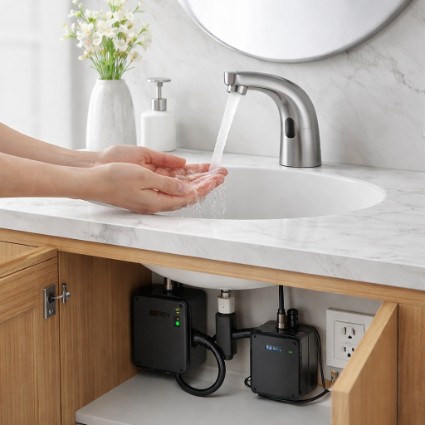
Touchless faucet control module and solenoid assembly under the sink
Under deck service access for solenoids, filters, and batteries.

How touchless faucets function in practice

Most touchless faucets operate using an electronic sensor that detects hands within a defined activation zone. The solenoid valve opens to enable water to flow and then closes when one’s hands are out of the range of the water detection area or when the preset water run time is completed.

Sensor activity

Infrared sensors are more widespread; however, their effectiveness also depends on light, reflection of light from basin surfaces, and sink designs. Mis-calibration of sensors causes the water to unnecessarily turn on or fail to switch off.

Control logic

High quality faucets have features such as adjustable shutdown timeouts, maximum run times, and consistent recognize times. Such features are most important in heavily used facilities like airports, schools, or healthcare.

Valve and temperature configuration

Touchless faucets may be cold only, supplied by a pre tempered line, or internally mixed. In public restroom facilities, thermostatic mixing valves may be more desirable for controlling temperature as well as less susceptible to tampering because they mix water in a more central location.

Define an application before picking an application fixture

The performance requirements differ widely depending on the conditions.

Public & Institutional Restrooms

Such environments require uniform sensor performance, rugged construction, and easy serviceability. Vandal-resistant construction, filtration, and shut-down performance are more significant than surface detail.

Commercial offices and Catering

User experience is even more important. Activation should be intuitive, splash should be minimized, and flow should aid in proper hand-washing techniques without using much water.

Residential and light commercial

Power source, temperature adjustment method, and compatibility with household water pressure are common decision points.

Public restroom lavatory with touchless faucets and durable fixtures
Institutional use case: durability and serviceability first.
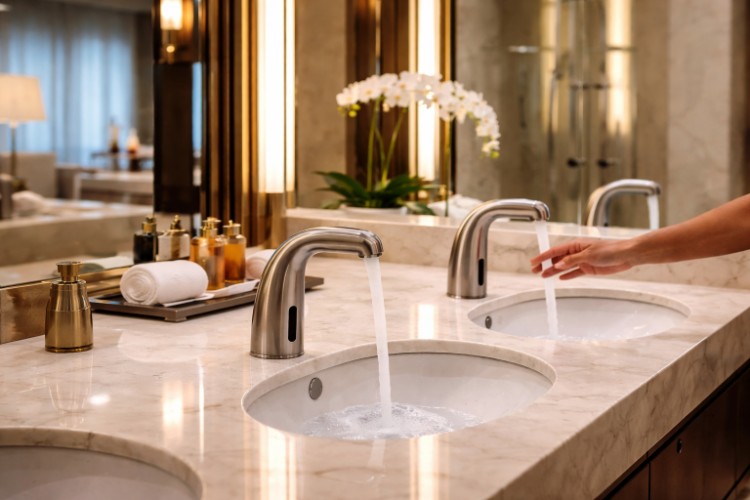
Hospitality bathroom sink setup showing splash control and spout alignment
Hospitality use case: splash control and intuitive activation.
Residential bathroom touchless faucet with concealed power module
Residential use case: power method and pressure compatibility.

Water efficiency and flow performance

Water efficiency requirements directly affect user satisfaction and system performance. Most WaterSense labeled bathroom faucets are limited to a maximum flow rate of 1.5 gpm at 60 psi. In public lavatory applications, many projects specify flow rates around 0.5 gpm depending on local code, sustainability goals, and owner standards.


Verify these items during selection

  • Rated flow at 60 psi
  • Performance at lower pressures such as 20 psi
  • Aerator or laminar flow type and its effect on splash and aerosolization


Practical note

Lower flow is not always better. Match the flow and spray pattern to the basin geometry to reduce splash and improve wash quality.

Power supply considerations


Battery powered faucets

Common in retrofit projects due to ease of installation. Battery replacement intervals must be planned, especially in high traffic restrooms.


Hardwired faucets

Eliminate battery maintenance but require coordination with electrical trades and proper moisture protection.


Hybrid Systems

Leverage both hardwired and battery backup to minimize unplanned downtime in mission-critical facilities.

Closeout checklist idea

Battery type, expected life, and service route must be recorded in the O&M manual for each group of restrooms.

Materials during certification

Touchless faucets should meet all requirements related to drinking water and plumbing.


Common items to verify:-

  • Lead Free Compliant for potable water applications
  • NSF/ANSI 61 compliance where necessary
  • Compliant with ASME A112.18.1 / CSA B125.1 requirements for plumbing supply fittings


Such certifications are effective in ensuring the long term durability and safety of the material as well as its compatibility with the requirements of inspections.

Accessibility and Interface

Touchless operation facilitates accessibility by not requiring the user to grasp and turn, although location becomes an issue.


Design teams should check

  • Proper Spout Position and Height
  • Sensor activation designed for users seated and standing on the bike
  • Complying with ADA 2010 Standards and ICC A117.1 where adopted

Installing and Maintaining Realities

The majority of problems lie in installation/commissioning deficiencies rather than product defects.


Critical checks

  • Inlet strainers to protect solenoids on-site from construction debris
    Source
  • Confirmed operating pressure range
  • Basin & Spout to Prevent Splash & False Activation
  • Clear access to service batteries, solenoids, and mixing valves

Commissioning note: A quick checklist at closing may cut callbacks and fix deficiencies in multiple restrooms.

Documentation and BIM functionality

When it comes to the AEC industry, proper documentation is considered vital. Good cut sheets, installation manuals, and BIM documentation can go a long way in ensuring proper coordination of work related to plumbing, electrical work, as well as architectural work. Inadequate proper documentation can often result in substitution errors as well as field-related conflicts.

What to RequestWhy It Matters
Cut sheet with flow and pressure rangePrevents under performance issues on low pressure buildings and helps submittal review.
Wiring & Power Informationfacilitates the coordination of electrical scope and prevents ad-hoc solutions on the part of.
Maintenance Guide & Parts SheetsEnhances long term serviceability and facilitates faster repairs.
B.I.M. Model or Dimensional DrawingSupports clash checks and basin spout combination selections early on.

10 Stunning Restrooms Using Bath Touchless Faucets

Bath Touchless Faucets

10 Gorgeous Bathrooms Using Bath Touchless Faucets

A curated visual showcase of touchless bathroom faucets elevating hygiene, aesthetics, and modern restroom design.

Why Designers Select Touchless Fixtures

Touchless bathroom faucets have become a defining element in modern restroom design. Aside from being clean and water-saving, they also provide a clean look, a modern touch, and are suitable for commercial buildings. Bath Touchless Faucets are specified for hotels, airports, offices, and luxury residential projects due to their durability and sensor precision.

1. Luxury Hotel Bathroom – New York

From this five-star hotel, the combination of marble countertops with wall-mounted touchless faucets is a seamless delivery to the guest experience.

Luxury hotel restroom with touchless faucet

2. International Airport Lounge – Dubai

High-traffic airport restrooms demand reliability. Bath touchless faucets are used here to reduce maintenance, improve sanitation, and handle continuous usage without compromising performance.

Airport restroom featuring touchless faucets

3. Corporate Office Headquarters – London

Minimalist design meets sustainability. Both of these loos incorporate the use of touchless faucets to conserve water while emphasizing the company’s focus on intelligent building solutions.

Office Bathroom at Corporate Office with Sensor Faucets

4. Boutique Hotel Bathroom – Paris

Matte finishes and soft lighting complement touchless faucets, creating a private/sanitary restroom experience for guests.

Boutique hotel bathroom with touchless faucets

5. Luxury Shopping Mall – Singapore

Shopping malls have factors that require fixtures emphasizing both strength and beauty. Faucets that are touchless assist and merge cleanliness and stylish toilets.

Shopping mall restroom with touchless faucets

6. Public Restroom at the Hospital – Germany

Hygiene is an indispensable part of healthcare settings. Touchless faucets lack the possibility for cross-contamination and meet strict sanitation standards.

Public restroom in a hospital with touchless faucets

7. Bathroom on Campus at University, California

Designed for heavy use, these campus restroom facilities incorporate sensor faucets into their design for water conservation and discouraging vandalism.

Automatic water taps in university restrooms

8. Co-Working Space – Berlin

With modern co-working spaces, the trend is on intelligent workspaces. Touchless faucets support a technologically-forwarded surroundings while keeping cleanliness intact.

Co-working space bathroom with a touchless faucet

9. Luxury Residential Bathroom – Los Angeles

Touchless technology has long since surpassed the boundaries of a mere commercial setting and finds its increasing application in residential segments also through sensor faucets.

Luxury residential bathroom with touchless faucet

10. Convention Center Restroom – Tokyo

Large venues can greatly benefit from touchless fixtures that provide reliability and quick response times with easy maintenance for constant use.

Convention center restroom with touchless faucets

The Need For Such a Showcase

Visually driven showcase pages also allow architects, designers, and facility managers to see the applications. Such pages are highly shareable, attract natural backlinks, and build topical authority for touchless bathrooms.

Discuss Bath Touchless Faucets

Explore the extensive lineup of sensor-operated bathroom faucets suitable for both commercial and high-end residential settings. Built for performance, hygiene, and timeless design.

Authority resources

These external references are commonly used during restroom planning, accessibility review, water efficiency decisions, and product evaluation.

Touchless Basics and Buyer Guides

Touchless Faucets for AEC Professionals

Touchless Basics and Buyer’s Guide for AEC Professionals

Learn all you can about specifying touchless faucets for your applications, from functional elements to aesthetic concerns.

Presently, the construction and designing scenario, the use of touchless faucets has become a necessity in the construction of buildings, especially those pertaining to bathrooms in both residential and commercial buildings. With the exception of hygienic factors, the aspect of sustainability and efficiency also plays a major role in the impact of this technology on the manner in which the issue of water management in buildings is considered.

Touchless Faucets – Definition

Touch-free faucets employ the use of sensors that sense the presence of hands or objects underneath the spout, leading to the dispensation of the water. This technology has vital advantages, the most significant being the improvement in sanitation and the prevention of water wastage. Touch-free faucets help greatly in preventing the spreading of germs within the washing process since the user is not needed to touch the handles. The technology is very appropriate for use in the restrooms within office blocks and learning institutions.

Characteristics of Touchless Faucets

Infrared Sensor Technology

Infrared Sensor Technology

The technology most widely used in touchless faucets is Infrared (IR) sensors. IR sensors are able to detect motion or presence in a particular range, including presence of hands in this context, and so induce water flow when triggered by these sensors.

Water Conservation

Many touchless faucets come along with flow regulators, which control the flow of water. This also assists with the issue of conserving water, especially where there is high consumption.

Hygiene and Safety

Touchless faucets prevent the transmission of germs like viruses and bacteria because one doesn’t have to come into direct contact with the handle when turning it to turn on the water tap. Such is even more important when one considers the use of sinks in health institutions like hospitals and other public facilities like restaurants.

Energy Efficiency

Some touchless faucets come with a battery-powered or self-sustaining energy technology – this means less battery replacement or dependence on the building’s power supply.

Buyer’s Guide: Choosing the Appropriate Touchless Faucet for Your Project

1. Accuracy and Distance of Sensors

The sensor’s accuracy is important in ensuring that the faucet turns on and off when it should. Sensor faucets with adjustable sensors can be set to meet different requirements to ensure water conservation.

2. Water Flow and Temperature Control

Try searching for faucets that can be operated without touching them and allow temperature and rate control. In fact, many faucets come with smart controls too!

3. Durability and Maintenance

Touchless faucets for commercial use must be more robust and maintainable. Stainless steel and/or PVD coatings are recommended for heavy use applications.

4. Power Source

Touchless faucets may be battery-operated, wired, or self-contained. The advantages of each depend on whether one considers sustainability or, for instance, water treatment and cost saving.

5. Integration with Smart Systems

Certain faucets can also be compatible with the Building Management System (BMS) for the purpose of controlling and managing the usage of water.

6. Aesthetic Consider

There are varying designs of touchless faucets, which may include finishes such as brush nickel, chrome, or matte black to blend with the interior of the space.

Where to Find Quality Touchless Faucets

FontanaShowers

Offering a full range of touch-less faucets and related bathroom products made with precision and reliability.

FontanaTouchlessFaucets

Operating in the touchless faucet system segment, it specializes in offering unique solutions that satisfy various demands and needs.

BathSelect

BathSelect is renowned for providing long-lasting and trendy faucets, along with touchless models designed for different needs of a building.

JunoShowers

Providing a range of touch-free faucets that combine cutting-edge technology and modern designs, JunoShowers is a name that can be relied upon in the AEC industry.

Conclusion

Touchless faucets are not just an added advantage; they are an essential part of contemporary bathroom designs, especially in the commercial sector. The functionality and performance of touchless faucets and other similar technologies are advancing with regards to efficiency, cleanliness, and environmental conservation. Technical details of touchless faucets should be taken into consideration by AEC professionals.

History and Issues

Bath Touchless Faucets

Historical narrative • Touchless faucet reliability

A Short History of Touchless Faucet Reliability — Including Fontana and Other Major Brands

This history-style article tracks how touchless faucet reliability evolved from “hands-free convenience” into a measured, specifier-grade topic—
shaped by service troubleshooting, manuals, field tests, and study hubs. Links are embedded directly inside paragraphs so they can be cited naturally
in articles, submittals, and facility reports.

Disclosure: Some links are manufacturer-authored and are best used to describe mechanisms, service steps, and product intent, while independent and government links support standards, baselines, and broader research context.

History timeline: how the evidence matured

Early phase — touchless spreads and reliability becomes visible

As touchless faucets expanded into high-traffic venues, facilities teams started noticing repeatable issues: phantom activations in bright light,
inconsistent response over reflective basins, and downtime that created queues. Reliability stopped being an abstract promise and became a daily,
measurable experience—especially in airports, schools, office buildings, and healthcare settings where usage volume amplifies small flaws.

Documentation phase — troubleshooting defines common failure modes

Brands increasingly documented nuisance triggers and service logic so technicians could reproduce fixes across many stations. Sloan’s resources—including the PDF Optima ETF-700 Troubleshooting, the technician-oriented article Sloan Optima Faucet Sensor Troubleshooting Guide, and the web-viewable excerpt Sloan ETF-600 troubleshooting page— helped turn “mysterious behavior” into predictable causes like range settings, reflectivity, and lighting.

When maintenance teams needed a directory-style reference for locating additional documents and related product information, resources like
Sloan EFP-39-A manuals index provided a practical way to keep service binders organized and auditable.

Standardization phase — troubleshooting portals and “how it works” education

As touchless became standard rather than novel, brands started building structured support pathways that resemble decision trees. Zurn’s portal Faucet Troubleshooting supports a “standard workflow” approach for diagnosis, while explanatory posts like How Sensor Faucets Work helped non-technicians understand detection zones, actuation, and why pass-by traffic can produce nuisance events.

In parallel, document-style guides such as ZurnFaucetsTroubleShootingGuide.pdf became useful “appendix citations” in facility documentation because they read like printable service handouts rather than marketing pages.

Power strategy phase — reliability includes batteries, energy, and service cycles

Reliability discussions expanded from sensing performance to power strategy and maintenance cycles. TOTO’s technology overview
ECOPOWER® (TOTO USA) illustrates how power strategy can reduce battery replacement burden, while formal constraints and official procedures are captured in the EcoPower Auto Faucets Installation & Owner’s Manual (PDF). For teams who prefer a quick web view, the mirror entry TOTO EcoPower Automatic Faucets (ManualsLib) offers faster navigation to troubleshooting headings.

Modern faucet with touchless sensor action
Commissioning phase — install checks and setup steps become part of “reliability”

Over time, the industry recognized that many “reliability” complaints trace back to commissioning, installation constraints, and tuning rather than hardware failure. Chicago Faucets’ HyTronic documentation—such as the PDF HyTronic guide (PDF)—supports a narrative that correct setup reduces nuisance events, and quick-access pages like Chicago Faucets HYTRONIC (ManualsLib) and All-GuidesBox (HyTronic directory) help facilities teams find the right section quickly during field repairs.

Training and adoption phase — hygiene narratives meet operational reality

As adoption widened, brands began producing training-oriented narratives to explain why touchless matters for hygiene and perception. GROHE’s brochure Touchless Solutions Brochure (PDF), public overview Touchless & hands-free faucets,and training page Touchless technology for better hygiene show how brands increasingly framed touchless as an operational system—combining user behavior, configuration, and service planning.

Case-study era — projects and measured outcomes become the “language of trust”

Once touchless was common, trust shifted toward real projects and measurable outcomes. Delta Commercial’s project library Commercial Case Studies and its commercial overview page Delta Commercial support narrative paragraphs about where these systems are deployed and how owners describe performance, user experience, and maintenance outcomes.

In the same period, BathSelect published research-style narrative content such as how BathSelect supported research on sensor faucet technology and a more performance-focused write-up at Sensor Performance Analysis – BathSelect Touchless Faucets, which can be used to discuss sensor accuracy, conservation outcomes, and service-cycle implications in an owner-friendly voice.

Catalog and procurement phase — spec pages become everyday “evidence”

As procurement teams increasingly sourced fixtures from many channels, category and product pages became part of how people understood what “commercial touchless” means in real purchasing workflows. JunoShowers’ category page Commercial touchless bathroom faucets and the example product listing deck mounted touchless faucet example illustrate how catalogs present finishes, installation style, and configuration claims that specifiers must translate into performance expectations.

Fontana’s study-ecosystem era — hubs, archives, field tests, and case studies

In parallel with broader industry trends, Fontana organized touchless content into a continuous “study ecosystem” that can be cited as a cohesive evidence layer: the hub Studies on Touchless and the library-style index Studies / Research Insights Archive help reviewers understand scope, while the 2025 hub Water Efficiency Studies by FontanaShowers 2025 and the dedicated study page Study on water efficiency of touchless faucets support measurable performance narratives.

The ecosystem also includes field-test style pages like Field Test of FontanaShowers Touchless Faucets and facility-specific hubs like airport restroom touchless technology with its corresponding study page touchless faucets for airport facilities plus the stable category address airport facilities category URL.

For office adoption and comparison narratives, Fontana maintains Manual vs Touchless in Office Buildings, the alternate path Manual vs Touchless (Alternate URL), and the category index Manual vs Touchless (Category URL), while narrative impact pages include hygiene impact, user experience & satisfaction, energy & cost savings, and sustainability.

Finally, mixed-system narratives are supported by touchless faucets and soap dispensers in public facilities, broad deployment framing at deployments across malls, airports, restaurants, and healthcare, editorial indexing at Touchless Faucet Case Studies (Blog Tag Index), and efficiency framing at Research on Efficiency of Touchless Bathroom Faucets.

Baselines phase — independent and government references anchor claims

As touchless claims became more quantified, citations increasingly included independent and government references. The EPA’s best-practice PDF WaterSense at Work – Section 3.3: Faucets, the overview page Best Management Practices, and the specifications library Product Specifications help translate fixture choices into indoor water reduction language recognized by owners and sustainability teams.

Architect picks: 5 Fontana series that read “high-end + scalable”

These five distinct series are selected from your provided product names and written for large-scale, high-end environments (airports, corporate campuses, luxury developments, flagship public venues).

FontanaAeris — “SenseFlow” (FS10577BG)

FS10577BG presents FontanaAeris as a refined “core platform” aesthetic—ideal when you want the same visual language repeated throughout a property, while still feeling premium in finish and form.

Spec continuity
Premium finish story
Portfolio-friendly look

Why architects like it: clean, repeatable geometry helps standardize details across floors and buildings without losing the upscale impression in executive or VIP zones.

FontanaLynq — “SmartMotion DualTone” (FS10578MBG)

FS10578MBG is built for bold interior palettes. Dual-tone (gold/black) reads like “architectural jewelry,” matching dark stone, fluted partitions, matte hardware, and high-contrast brand environments.

Dual-tone contrast
Flagship-ready
High-end detailing

What makes it great at scale: the same dramatic identity can be applied across a property (lounges, premium restrooms, amenity floors) to create a cohesive brand experience.

FontanaVyntra — “IntelliWave DualTone Architect” (FS10579CMB)

FS10579CMB is explicitly positioned as “Architect,” which makes it a natural choice when the restroom is treated as a designed system—lighting, basin reflectivity, circulation, and fixture alignment all considered together.

Architect-led positioning
Designed-system vibe
Premium dual-tone

Why it works for high-end projects: it supports a compelling narrative in specs and presentations—design intention and consistency, not “just a sensor faucet.”

FontanaZyra — “PureSense Graphite Black” (FS10581GB)

FS10581GB leans minimal and contemporary—an easy match for corporate, aviation, and modern hospitality palettes where graphite/black finishes dominate signage, partitions, and hardware.

Modern neutral palette
Easy to coordinate
Clean visual discipline

What makes it great for large-scale: dark neutral specifications help keep multi-restroom packages visually uniform across phases, renovations, and mixed-use buildings.

Fontana Streamline Wall — “Architectural Series” (FS10100GMG)

FS10100GMG is a strong option when wall-mounting supports the design intent: cleaner deck lines, simplified counter layouts, and a more integrated, built-in appearance that reads upscale in public restrooms.

Wall-mount clarity
Modern planning
High-traffic aesthetic

Why architects specify it: wall-mount solutions can elevate the vanity composition, reinforce minimalist detailing, and support consistent planning across high-traffic buildings.

Specifier note: For the strongest “high-end + scalable” story in a written spec, pair one design-forward series (Lynq/Vyntra) with one standardization series (Aeris/Zyra) and one planning-driven wall solution (Streamline Wall Architectural).

Sculptural matte black faucet design

Selected Awards

AEC Touchless Spec Picks (3 Series / 3 Products)

Three distinct series selections— highlighting finish language, architectural fit, and why designers specify them in high-traffic commercial restrooms.

FontanaEdge Series
Precision / angular profile
Commercial touchless

FontanaEdge™ – Graphite Black Harmony (FS10581GB)

A sharp, rectilinear silhouette with a “tooling-grade” stance—ideal when the restroom palette leans modern-industrial and the faucet needs to read like architecture, not décor.

FontanaEdge™ – Graphite Black Harmony (FS10581GB)
Finishes
Typically specified in graphite/black-forward palettes; also shown with multi-finish swatch options for coordinated AEC schemes.

Finish swatch
Finish swatch
Finish swatch
Finish swatch
Gun metal grey swatch

Best fit
Corporate HQ restrooms, transportation hubs, civic facilities, and any project using strong planar detailing (stone slabs, dark metals, linear lighting).

What AEC teams say (common spec rationale):
The “Edge” language aligns with millwork reveals and rectilinear accessory packages—making it easy to keep an elevation clean and consistent across multi-stall layouts.

Skyline Curve Series
Soft-curve massing
Touchless set

Fontana Skyline Curve™ – Antique Silver Vein Elegance (FS10590ASV)

A curved “skyline” posture paired with an antique-silver vein aesthetic—built for projects that want warmth and texture without losing the cleanliness of a modern form.

Fontana Skyline Curve™ – Antique Silver Vein Elegance (FS10590ASV)
Finishes
Antique silver-vein direction with coordinated multi-finish options commonly used to match hardware, mirrors, and accessory packs.

Finish swatch
Finish swatch
Finish swatch
Finish swatch

Best fit
Boutique-feel interiors inside large-scale developments: executive restroom suites, destination retail, premium office amenities, and signature tenant improvements.

What architects & designers say (common spec rationale):
The curve softens hard-surface elevations (tile + stone) and reads “intentional” in renderings—helpful when the restroom is part of a branded interior narrative.

FontanaArc Series
Arc-inspired geometry
Clean chrome

FontanaArc™ Vantage – Chrome (FS10076CH)

A refined arc profile with a crisp chrome read—an “easy yes” for spec packages that need timeless coordination across multiple floors or multiple tenant standards.

FontanaArc™ Vantage – Chrome (FS10076CH)
Finishes
Chrome primary finish (high compatibility with ADA accessory chrome, stainless partitions, and common commercial palettes).

Finish swatch
Finish swatch

Best fit
Education, healthcare-adjacent public spaces, and corporate restrooms where long-term serviceability and broad finish compatibility drive decisions.

What specifiers say (common spec rationale):
The arc form is “quietly premium”—it elevates standard rooms without forcing a unique trim package, reducing risk when value-engineering or matching replacements later.