
Touchless Bathroom Faucets vs. Manual Faucets: Hygiene, Water Use & Lifecycle Cost
Touchless faucets eliminate routine handle contact and automatically stop water after use, while manual and metering faucets offer simpler mechanical architecture with no sensor or electronic power requirement. Neither technology is universally better. The correct choice depends on traffic, hygiene goals, water efficiency, facility maintenance capability and lifecycle cost.
Touchless vs. Manual Bathroom Faucets
| Factor | Touchless | Manual / Metering |
|---|---|---|
| User contact | Normal activation requires no faucet contact. | Handle or push actuator normally requires contact. |
| Unattended water | Automatic shutoff limits unnecessary operation. | Metering controls runtime; conventional manual depends on user. |
| Power | Battery, AC or hybrid power generally required. | Mechanical designs require no electrical supply. |
| Electronics | Sensor, controller and valve add service components. | No sensing electronics. |
| High-volume hygiene | Strong advantage | Requires repeated handle contact unless alternative control is used. |
| Mechanical simplicity | Moderate | Strong advantage |

Fontana Automatic Commercial Hands Free Sensor Faucet
The Fontana Automatic Commercial Hands Free Sensor Faucet illustrates why electronic faucets are compelling in busy public bathrooms. Fontana publishes an operating life of up to 500,000 open/close cycles, adjustable sensing and both mains and battery power options.
The current technical sheet also provides 0.35 and 0.5 GPM configurations with a 30-second security cutoff.
No normal handle contact and automatic control of water-on time.
Sensor, power and electronic valve components require a planned service strategy.

BathSelect Commercial Touchless Automatic Chrome Sensor Faucet
BathSelect uses a microcomputer-controlled infrared system that can adapt its detection zone to the color and geometry of the lavatory.
Automatic shutoff limits unattended flow, while AC/DC operation allows the same platform to work in both retrofit and new-construction conditions.
Adaptive sensing removes normal faucet-handle contact.
Facilities must maintain batteries or electrical power and the solenoid system.
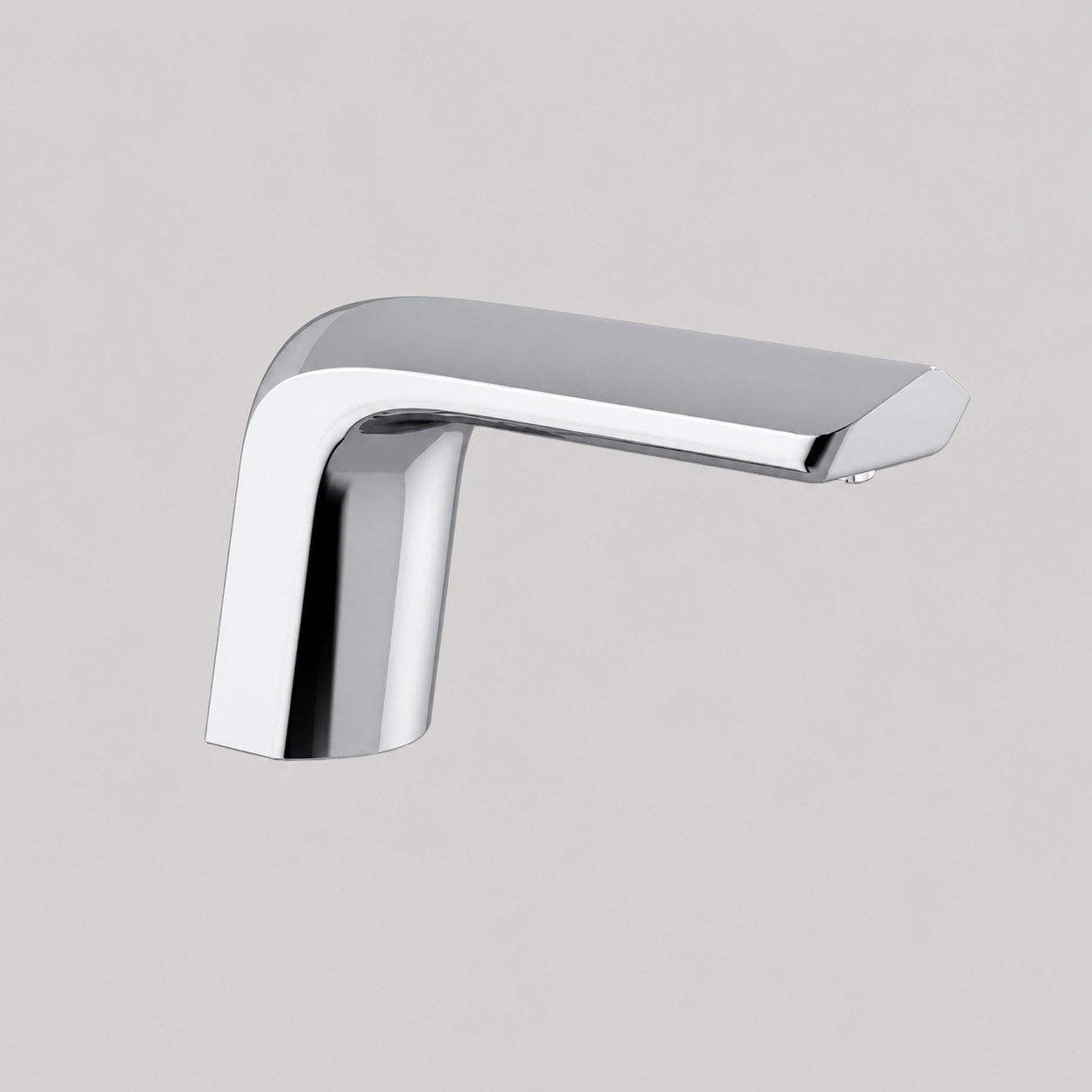
Sloan Optima® EAF-150 Commercial Sensor Faucet
Sloan’s EAF-150 combines dual infrared sensors, automatic setup and self-adapting detection with a magnetic solenoid, low-battery indication and supply strainer.
Its advantage over a simple manual fixture is automation; its lifecycle cost includes eventual batteries, sensor and solenoid components.
Automatic operation with multiple low-flow outlet choices.
More replaceable components than a purely mechanical faucet.
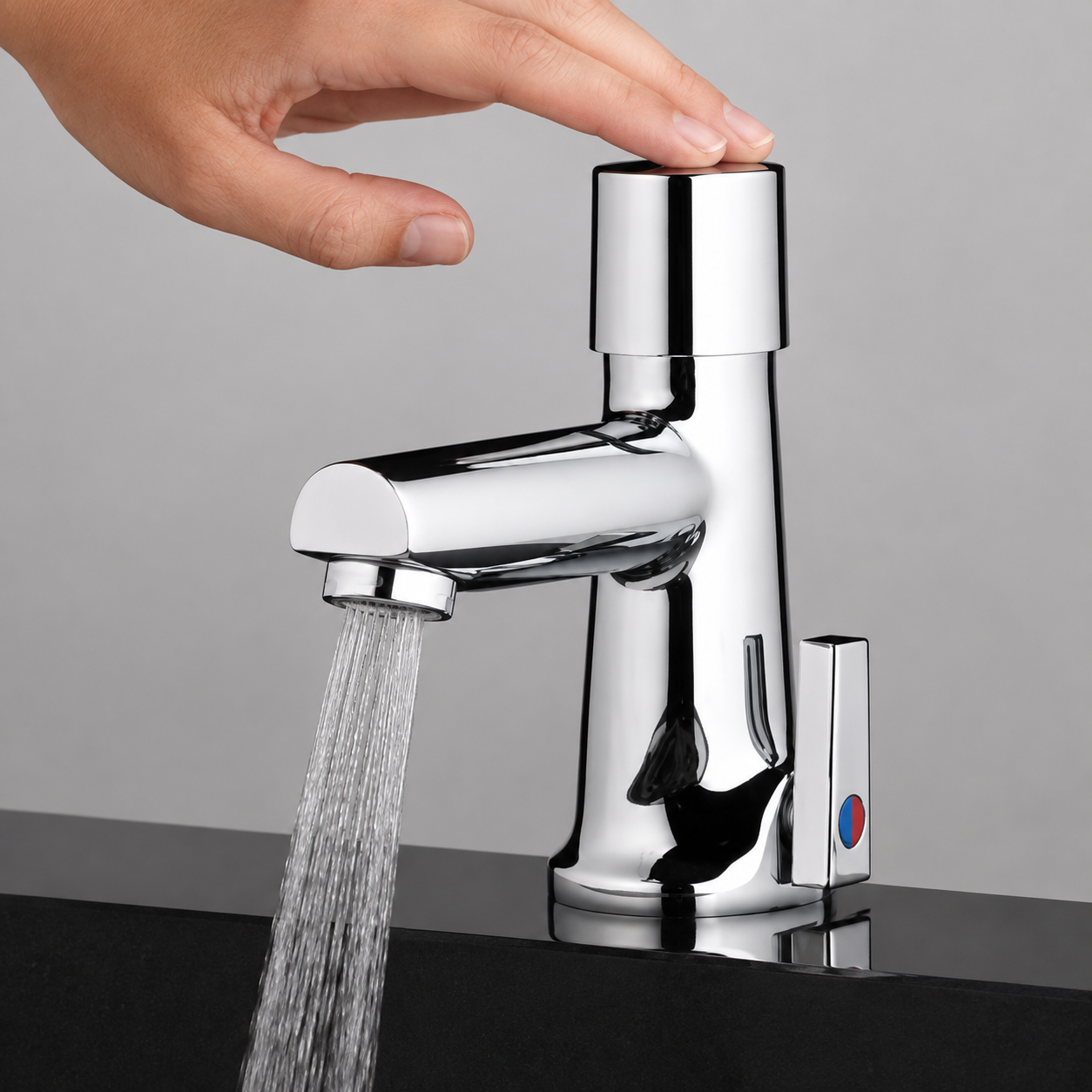
Chicago Faucets 333 Series Commercial Metering Faucet
Chicago’s 333 Series demonstrates why manual technology remains relevant. Its NAIAD metering cartridge automatically closes after an adjustable cycle, providing water control without batteries, sensors or electronic solenoids.
The current specification provides a pressure-compensating 0.5 GPM outlet and adjustable 2–15 second runtime.
Automatic timed shutoff with zero electronic power infrastructure.
Every activation requires physical contact with the actuator.
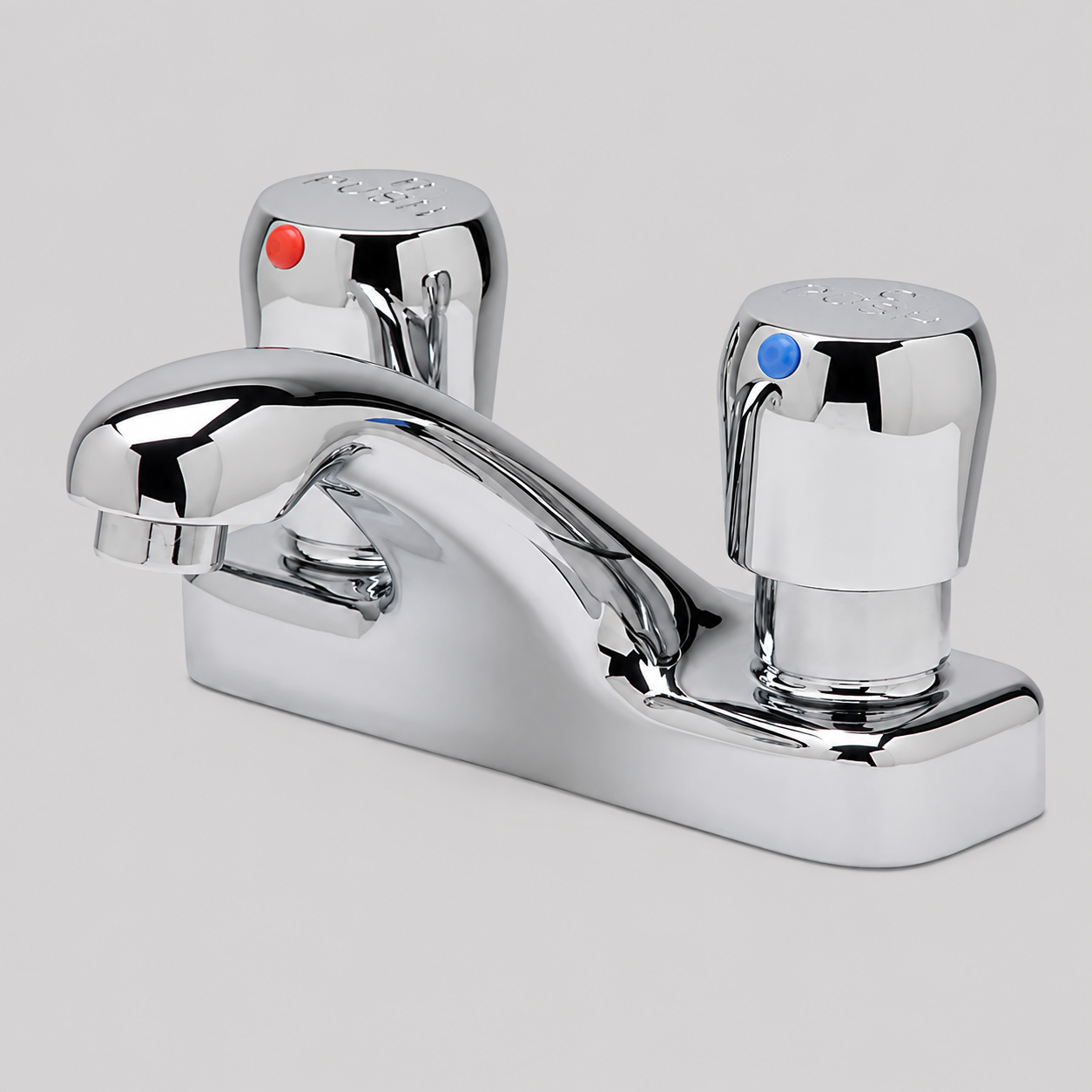
Zurn AquaSpec® Z86500-XL Commercial Metering Faucet
Zurn’s AquaSpec metering architecture provides a durable mechanical alternative for facilities that want automatic cycle closure without electronics.
Zurn specifically emphasizes commercial cast-brass durability, adjustable cycle times, repair parts and 0.5 GPM vandal-resistant configurations.
Straightforward mechanical maintenance with no batteries or sensor calibration.
Push-button activation creates a recurring user contact point.
Touchless Removes One Frequently Touched Surface
A conventional or metering faucet normally requires users to touch a handle or actuator. CDC identifies faucets and faucet handles among frequently contaminated/high-touch surfaces in shared healthcare toilet areas.
Touchless activation removes that routine step. It does not make the sink sterile, eliminate environmental cleaning, or replace correct handwashing technique.
Automatic Does Not Automatically Mean Efficient
A touchless faucet can reduce unattended water flow because water stops automatically when the sensing condition ends. A properly adjusted metering faucet can also limit water by delivering a defined cycle.
The rated outlet remains critical. EPA recommends 0.5 GPM or less for public lavatory faucets in non-private toilet facilities.
Where Each Technology Costs Money
| Cost Area | Touchless | Manual / Metering |
|---|---|---|
| Initial fixture | Generally higher | Generally lower |
| Electrical/battery | Required | None |
| Sensor service | Possible | None |
| Valve/cartridge | Solenoid/cartridge service | Mechanical cartridge service |
| Water-control automation | Excellent | Excellent with metering; user dependent with conventional manual |
| User-contact reduction | Excellent | Limited |
Which Type Should You Specify?
Airports, healthcare public areas, office towers, high-volume public restrooms, premium commercial bathrooms and projects prioritizing low-contact operation.
Projects prioritizing mechanical simplicity, zero electrical dependence, straightforward servicing or controlled timed flow without electronics.
Automatic Faucets Simplify User Operation
ADA Standard 606.4 requires faucet controls to comply with operable-part requirements. For hand-operated metering faucets, the ADA specifically requires the faucet to remain open for at least 10 seconds.
Automatic sensing can remove the grasping, pushing or twisting step during normal activation, but the complete lavatory still needs appropriate height, reach, clear floor space and knee/toe clearance.
Commercial Faucet Brands Relevant to This Comparison
Touchless vs. Manual Faucet FAQ
Are touchless faucets more hygienic?
They remove the need to touch faucet controls during normal activation, reducing one contact point. Hygiene outcomes still depend on handwashing and cleaning practices.
Do touchless faucets always save more water?
No. Flow rate, activation duration and sensor calibration determine actual consumption. Mechanical metering faucets can also provide controlled water cycles.
What is the simplest commercial faucet?
A mechanical manual or metering faucet avoids sensor electronics, batteries and solenoids.
What is the biggest touchless maintenance issue?
Facilities must account for power, sensor electronics, filtration and electronic valve components.
Do metering faucets shut themselves off?
Yes. A metering cartridge automatically closes after an adjustable or predefined cycle.
What flow is appropriate for public lavatories?
EPA currently recommends 0.5 GPM or less for faucets installed in non-private public toilet facilities.
Professional Sources
CDC — Hand Hygiene FAQ
Handwashing guidance including faucet use and hands-free shutoff considerations.
U.S. EPA — Bathroom Faucet Efficiency
Current public-lavatory faucet flow guidance.
U.S. DOJ — ADA Standards
Lavatory and faucet-control accessibility requirements.
American Society of Plumbing Engineers
Professional commercial plumbing engineering resources.
International Code Council
Commercial plumbing and building-code resources.
Touchless Wins Contact Reduction; Manual Wins Simplicity
For heavily used commercial bathrooms, touchless faucets provide the strongest combination of hands-free activation and automatic water control. Manual metering faucets remain technically valuable when owners prioritize mechanical simplicity and zero electrical dependence. Fontana, BathSelect and Sloan demonstrate the benefits of modern sensing, while Chicago Faucets and Zurn show that a well-engineered mechanical faucet can still deliver controlled commercial water use with fewer electronic service components.
Review Fontana Automatic Commercial Faucet →Independent editorial disclosure: BathTouchlessFaucets.com provides independent engineering-oriented analysis. Water consumption, hygiene performance and lifecycle cost depend on actual fixture configuration, traffic, maintenance practices and operating conditions. Verify current manufacturer specifications before procurement.
