
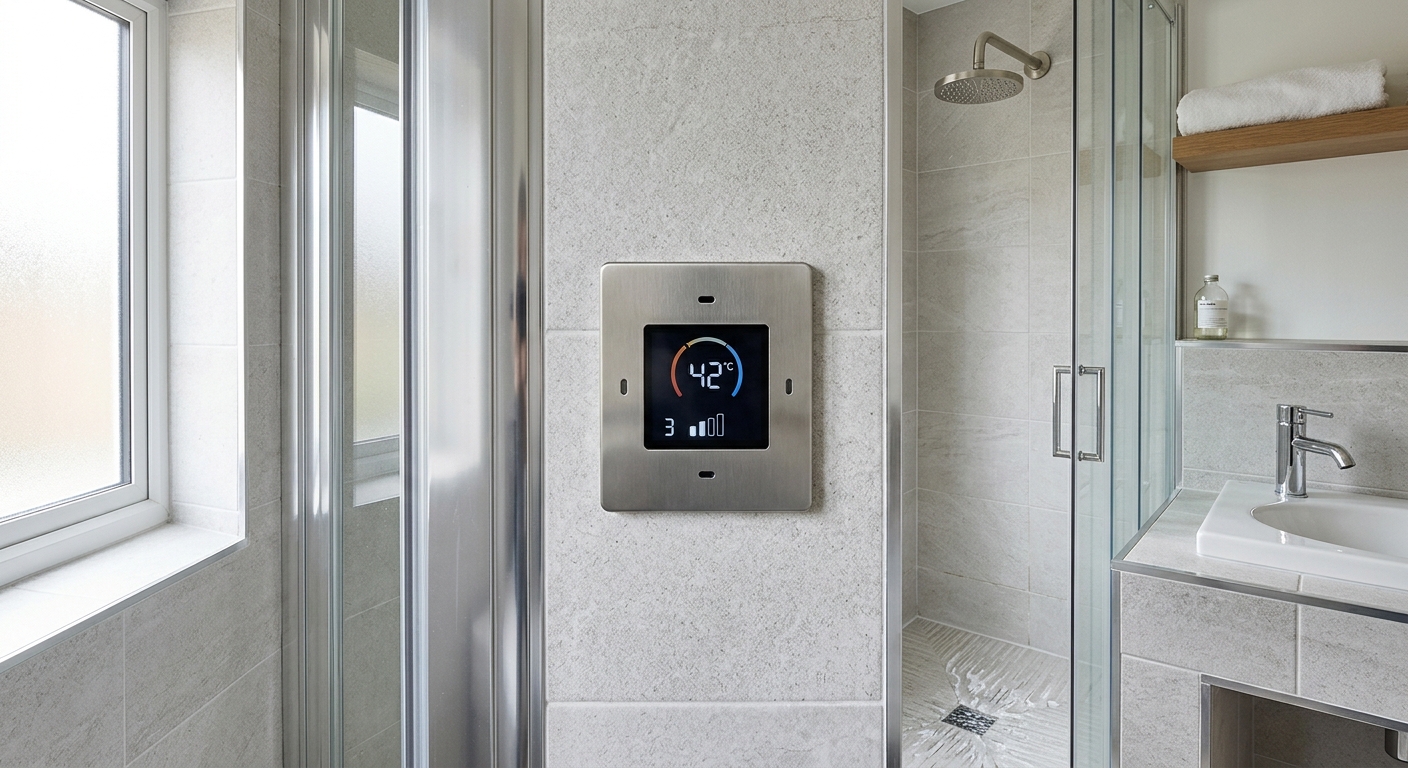
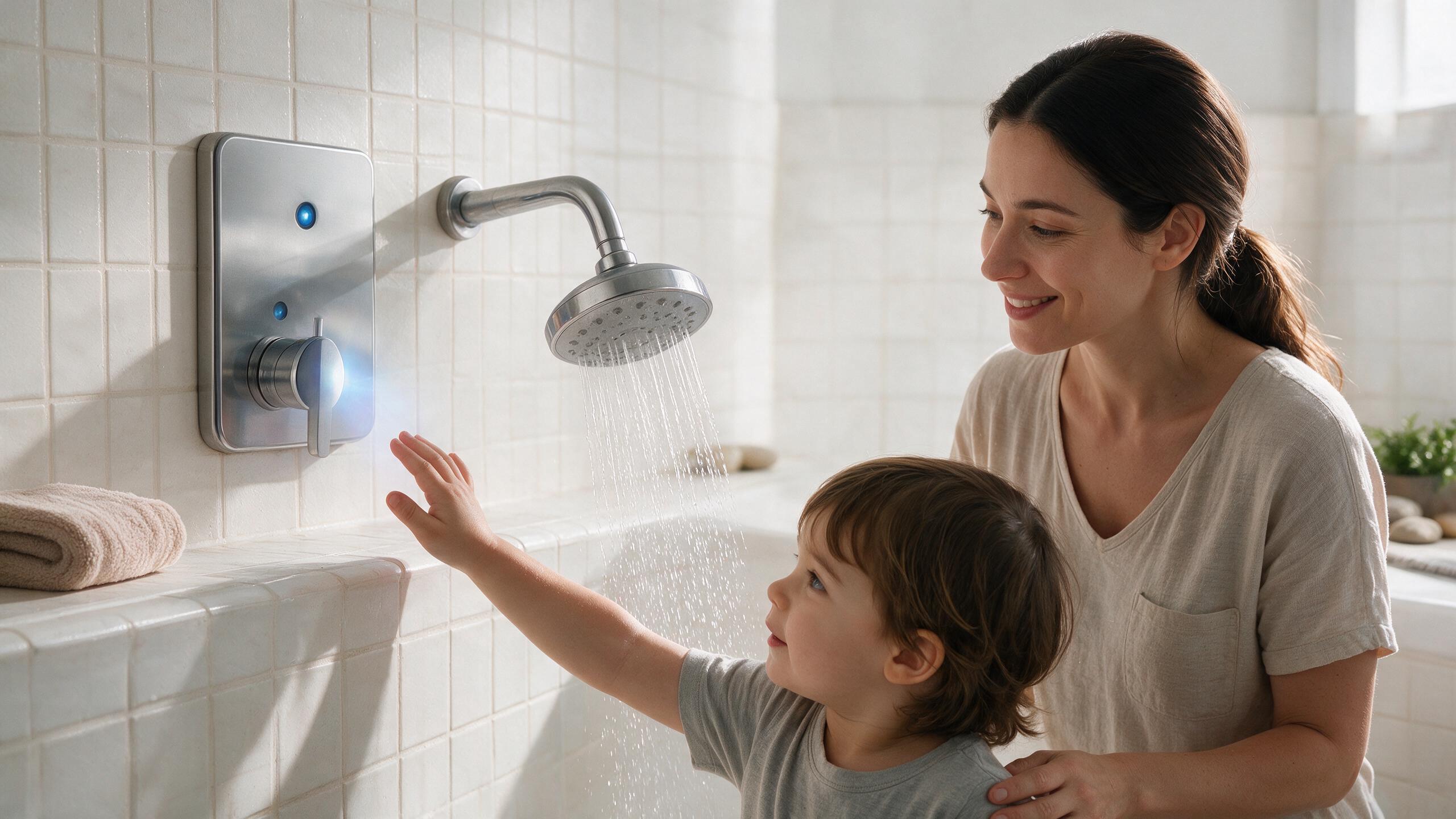
Yes, touchless shower systems exist and work reliably in a family bathroom, but they are a different product category than sensor kitchen or lavatory faucets. You are not just adding a sensor to a shower head. You are usually pairing an electronic trigger or actuator with a thermostatic mixing valve, and the whole assembly has to survive direct water contact and steam rather than just splashback. It is worth it for households with young kids, elderly family members, or anyone who needs the water started or stopped without fumbling for a handle, but the sensor placement and power source matter more here than in any other room of the house.
Why touchless shower controls differ from faucets
A sensor faucet at a sink activates a solenoid valve that sits under the counter, away from water. A touchless shower control has to place an active sensor or trigger pad inside the shower enclosure itself, often within the direct spray path or at minimum inside a fully saturated, high-humidity box. That changes the engineering requirements substantially: the electronics need a wet-location rating, the wiring or battery compartment needs to be sealed and accessible without cutting tile, and the control logic needs to distinguish between a hand waved intentionally and a body walking past in a small enclosure.
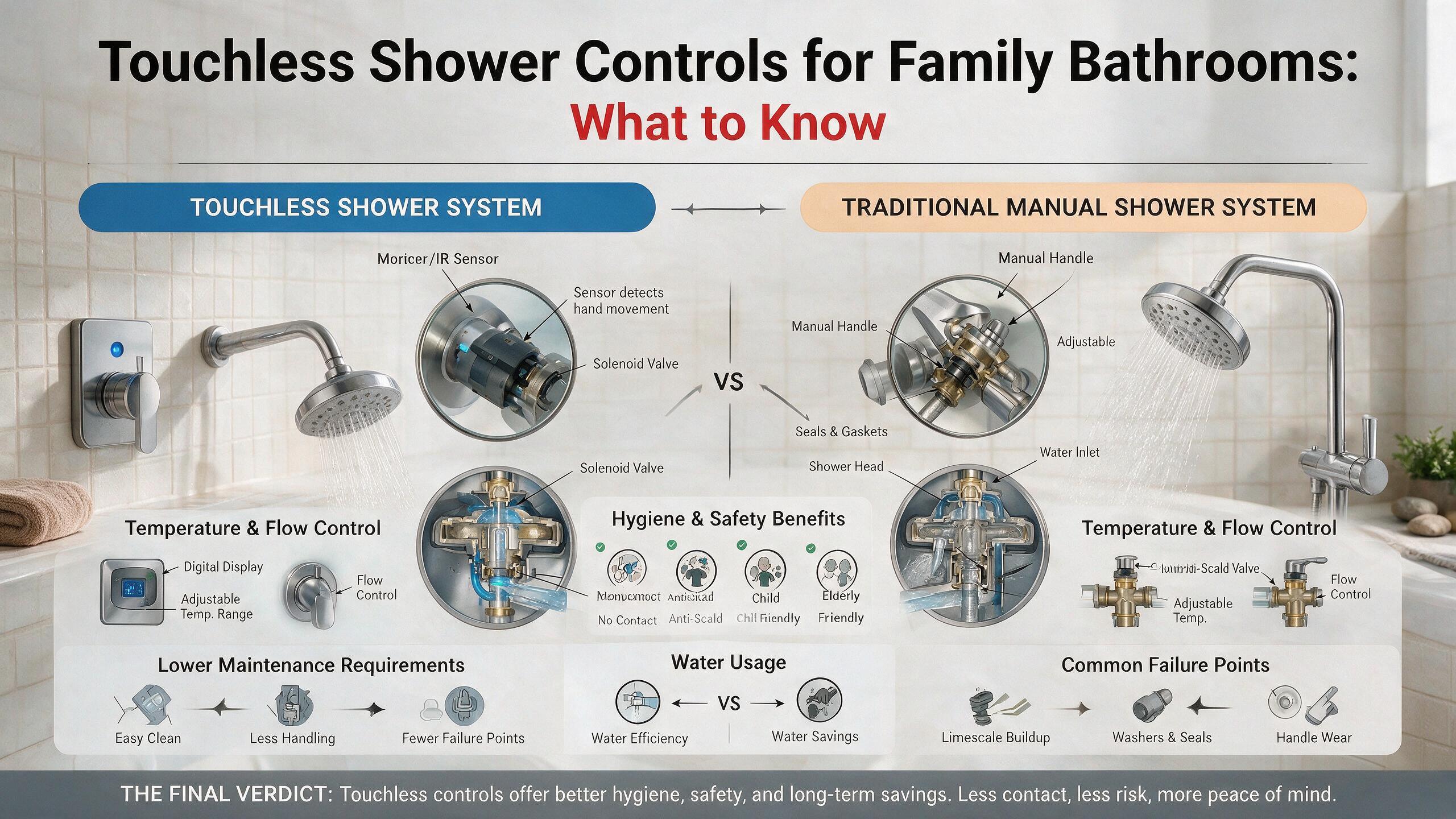
Most systems on the market are not a sensor bolted onto a standard valve. They are a proprietary electronic actuator that opens and closes a thermostatic or pressure-balancing valve body, controlled by a wall-mounted sensor plate, a wave-sensor above the valve, or in some cases a wireless remote mounted outside the enclosure. Know which architecture you are buying before you compare products, because the sensor and the valve are not always separable.
Battery vs hardwired: which survives steam
Both power options exist, and both fail if the wet-zone rating is wrong.
- Battery-powered units are easier to retrofit since there is no line-voltage wiring inside a wet zone. Expect battery life in the range of 6 months to about 2 years depending on activation frequency and battery chemistry, and expect that figure to be shorter, not longer, in a bathroom that runs hot and humid daily. Look for a low-battery indicator, because a dead battery in a family bathroom means no shower until someone swaps cells.
- Hardwired (line-voltage or low-voltage transformer) units eliminate battery replacement but require the transformer or control module to sit outside the enclosure, typically in an accessible cabinet or wall cavity, per code. This is the more durable option for daily family use but is harder to retrofit into an existing shower without opening a wall.
Whichever power source you choose, confirm the electronic components inside or at the edge of the shower enclosure carry an IPX rating appropriate for direct water exposure, not just splash resistance. IPX7 (temporary submersion) or at minimum IPX5 (water jets) is the range to ask for on any component mounted inside the spray zone; a control head rated only IPX4 is a bathroom-adjacent rating, not a shower-interior rating. Ask the manufacturer directly which IPX rating applies to the specific part that will sit inside the enclosure, since some kits mix a low-rated sensor plate with a well-rated valve body.
Sensor placement to avoid false triggers
Steam and splashing are the two most common causes of false activation, and placement is your main defense against both.
Typical sensor range for shower-activation hardware runs about 4 to 12 inches from the sensor face, considerably shorter than the 6 to 12 inch range common on kitchen faucets, precisely because a shower enclosure is small and full of moving water. A sensor set to the long end of its range in a tight stall will trigger on splash; set to the short end, a small child may not reliably activate it. Mounting position matters as much as range:
- Mount the sensor above typical splash height and angled slightly downward rather than facing directly into the spray cone.
- Keep the sensor out of direct line with the shower head’s spray pattern, even at low flow.
- In steam showers or systems with a steam generator, confirm the sensor technology is rated for use in visible steam. Infrared and capacitive sensors behave differently in dense steam, and not every product line discloses which type it uses.
- Test at your household’s actual water pressure and temperature before final install, since splash pattern changes with both.
Thermostatic mixing valves paired with sensors
Pairing a sensor trigger with a simple pressure-balancing valve gets you touchless start and stop, but it does not give you scald protection if supply pressure or temperature swings. For a family bathroom, pair the sensor with a thermostatic mixing valve, which maintains outlet temperature regardless of pressure fluctuation elsewhere in the house, such as a toilet flushing or a washing machine filling.
Set the thermostatic valve’s high-limit stop at or below 120°F. This is a standard anti-scald ceiling used across most residential thermostatic valves and is especially relevant with kids or elderly users who may not react quickly to a temperature spike. Confirm the high-limit stop is field-adjustable during install rather than fixed at the factory, since some jurisdictions and some households want it set lower, particularly if anyone in the home has reduced skin sensitivity or slower reaction time.
Kid-safe and elderly-safe activation settings
Touchless controls solve two different problems depending on who is using them, and the settings that help one group can hinder the other.
| User | What helps | What to watch for |
|---|---|---|
| Young children | Shorter sensor range so a small hand or body reliably triggers it; simple wave-on/wave-off logic without multi-step gestures | Accidental activation from splashing during play; consider a lockout or delay feature if your model offers one |
| Elderly or mobility-limited users | Larger sensor target area, wall-mounted plate at a reachable height (ADA guidance places operable parts between 15 and 48 inches from the floor), consistent auto-shutoff timing | Sensors with a short activation window that shut off mid-shower if the user stands still; check auto-timeout duration before buying |
| Both | A physical manual override at the valve in case electronics fail | Systems with no manual backup leave the household without a shower during a battery or sensor fault |
A manual override is not a luxury add-on here. It is the difference between a dead battery being an inconvenience and it being a reason nobody in the house can shower.
Retrofitting a family shower vs new install
Retrofitting an existing shower with touchless controls is straightforward when the existing valve is being replaced anyway, since the rough-in work is already open. Battery-powered sensor kits paired with a new thermostatic valve are the most retrofit-friendly combination, since they avoid new line-voltage wiring inside a finished wall.
A hardwired system in an existing bathroom usually means opening wall or ceiling cavities to route a transformer feed to an accessible location outside the wet zone, which is a bigger job than a simple valve swap. If you are already planning a full shower renovation, hardwiring at that stage is far cheaper than doing it later as a standalone retrofit.
What to check before you buy
- Confirm the IPX rating of every electronic component that will sit inside the enclosure, not just the overall product listing.
- Ask for the sensor’s rated activation range in inches and whether it has been tested in steam if you have or plan to add a steam generator.
- Verify the thermostatic valve’s high-limit stop is field-adjustable and set it at or below 120°F during install.
- Confirm there is a manual override at the valve itself.
- For hardwired systems, involve a licensed electrician and your plumber together, since the transformer placement affects both trades.
If any of these specs are missing from the product documentation, that is a reason to ask the manufacturer directly before you buy, not to guess.