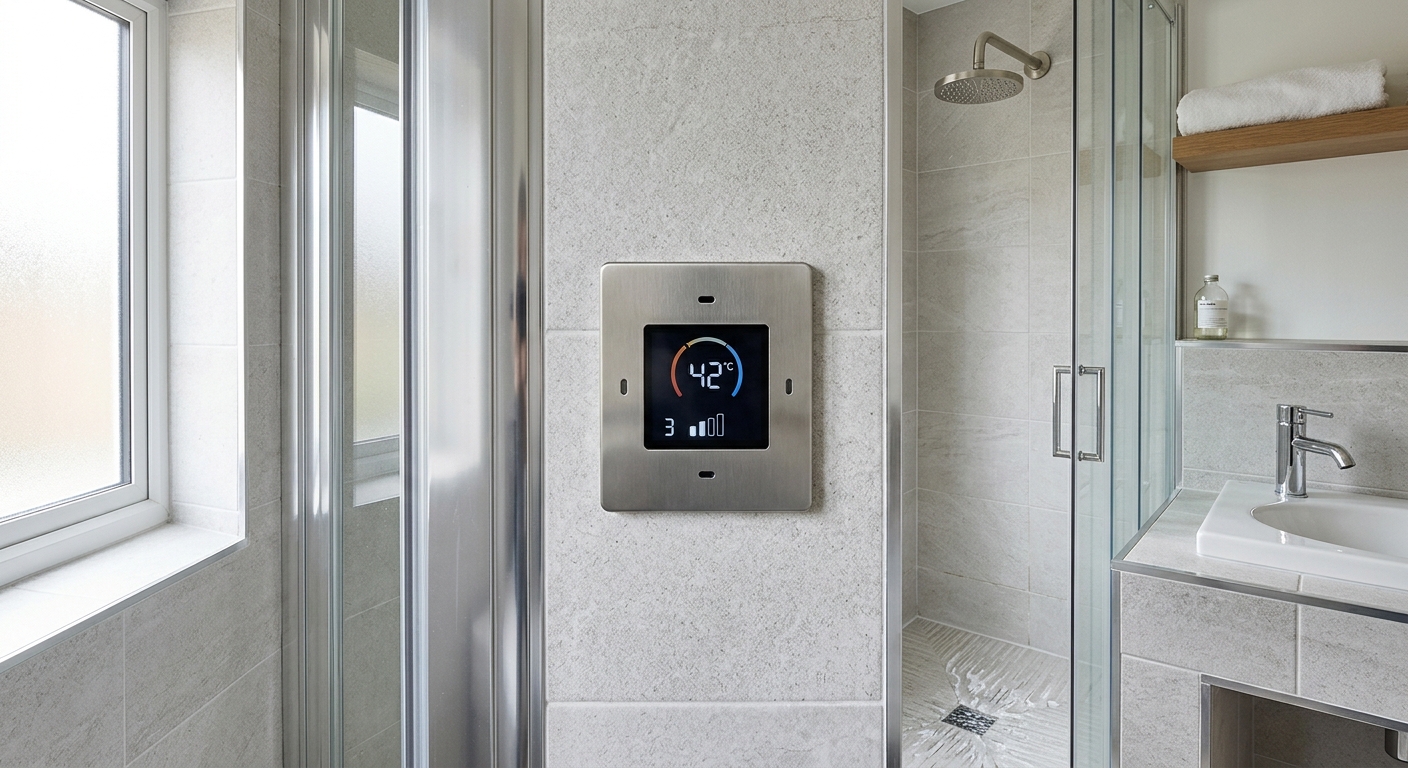
Touchless Shower Controls for Family Bathrooms: What to Know

touchless shower

Yes, touchless shower systems exist and work reliably in a family bathroom, but they are a different product category than sensor kitchen or lavatory faucets. You are not just adding a sensor to a shower head. You are usually pairing an electronic trigger or actuator with a thermostatic mixing valve, and the whole assembly has to survive direct water contact and steam rather than just splashback. It is worth it for households with young kids, elderly family members, or anyone who needs the water started or stopped without fumbling for a handle, but the sensor placement and power source matter more here than in any other room of the house.

Why touchless shower controls differ from faucets

A sensor faucet at a sink activates a solenoid valve that sits under the counter, away from water. A touchless shower control has to place an active sensor or trigger pad inside the shower enclosure itself, often within the direct spray path or at minimum inside a fully saturated, high-humidity box. That changes the engineering requirements substantially: the electronics need a wet-location rating, the wiring or battery compartment needs to be sealed and accessible without cutting tile, and the control logic needs to distinguish between a hand waved intentionally and a body walking past in a small enclosure.

Most systems on the market are not a sensor bolted onto a standard valve. They are a proprietary electronic actuator that opens and closes a thermostatic or pressure-balancing valve body, controlled by a wall-mounted sensor plate, a wave-sensor above the valve, or in some cases a wireless remote mounted outside the enclosure. Know which architecture you are buying before you compare products, because the sensor and the valve are not always separable.

Battery vs hardwired: which survives steam

Both power options exist, and both fail if the wet-zone rating is wrong.

  • Battery-powered units are easier to retrofit since there is no line-voltage wiring inside a wet zone. Expect battery life in the range of 6 months to about 2 years depending on activation frequency and battery chemistry, and expect that figure to be shorter, not longer, in a bathroom that runs hot and humid daily. Look for a low-battery indicator, because a dead battery in a family bathroom means no shower until someone swaps cells.
  • Hardwired (line-voltage or low-voltage transformer) units eliminate battery replacement but require the transformer or control module to sit outside the enclosure, typically in an accessible cabinet or wall cavity, per code. This is the more durable option for daily family use but is harder to retrofit into an existing shower without opening a wall.

Whichever power source you choose, confirm the electronic components inside or at the edge of the shower enclosure carry an IPX rating appropriate for direct water exposure, not just splash resistance. IPX7 (temporary submersion) or at minimum IPX5 (water jets) is the range to ask for on any component mounted inside the spray zone; a control head rated only IPX4 is a bathroom-adjacent rating, not a shower-interior rating. Ask the manufacturer directly which IPX rating applies to the specific part that will sit inside the enclosure, since some kits mix a low-rated sensor plate with a well-rated valve body.

Sensor placement to avoid false triggers

Steam and splashing are the two most common causes of false activation, and placement is your main defense against both.

Typical sensor range for shower-activation hardware runs about 4 to 12 inches from the sensor face, considerably shorter than the 6 to 12 inch range common on kitchen faucets, precisely because a shower enclosure is small and full of moving water. A sensor set to the long end of its range in a tight stall will trigger on splash; set to the short end, a small child may not reliably activate it. Mounting position matters as much as range:

  • Mount the sensor above typical splash height and angled slightly downward rather than facing directly into the spray cone.
  • Keep the sensor out of direct line with the shower head’s spray pattern, even at low flow.
  • In steam showers or systems with a steam generator, confirm the sensor technology is rated for use in visible steam. Infrared and capacitive sensors behave differently in dense steam, and not every product line discloses which type it uses.
  • Test at your household’s actual water pressure and temperature before final install, since splash pattern changes with both.

Thermostatic mixing valves paired with sensors

Pairing a sensor trigger with a simple pressure-balancing valve gets you touchless start and stop, but it does not give you scald protection if supply pressure or temperature swings. For a family bathroom, pair the sensor with a thermostatic mixing valve, which maintains outlet temperature regardless of pressure fluctuation elsewhere in the house, such as a toilet flushing or a washing machine filling.

Set the thermostatic valve’s high-limit stop at or below 120°F. This is a standard anti-scald ceiling used across most residential thermostatic valves and is especially relevant with kids or elderly users who may not react quickly to a temperature spike. Confirm the high-limit stop is field-adjustable during install rather than fixed at the factory, since some jurisdictions and some households want it set lower, particularly if anyone in the home has reduced skin sensitivity or slower reaction time.

Kid-safe and elderly-safe activation settings

Touchless controls solve two different problems depending on who is using them, and the settings that help one group can hinder the other.

User What helps What to watch for
Young children Shorter sensor range so a small hand or body reliably triggers it; simple wave-on/wave-off logic without multi-step gestures Accidental activation from splashing during play; consider a lockout or delay feature if your model offers one
Elderly or mobility-limited users Larger sensor target area, wall-mounted plate at a reachable height (ADA guidance places operable parts between 15 and 48 inches from the floor), consistent auto-shutoff timing Sensors with a short activation window that shut off mid-shower if the user stands still; check auto-timeout duration before buying
Both A physical manual override at the valve in case electronics fail Systems with no manual backup leave the household without a shower during a battery or sensor fault

A manual override is not a luxury add-on here. It is the difference between a dead battery being an inconvenience and it being a reason nobody in the house can shower.

touchless shower control

Retrofitting a family shower vs new install

Retrofitting an existing shower with touchless controls is straightforward when the existing valve is being replaced anyway, since the rough-in work is already open. Battery-powered sensor kits paired with a new thermostatic valve are the most retrofit-friendly combination, since they avoid new line-voltage wiring inside a finished wall.

A hardwired system in an existing bathroom usually means opening wall or ceiling cavities to route a transformer feed to an accessible location outside the wet zone, which is a bigger job than a simple valve swap. If you are already planning a full shower renovation, hardwiring at that stage is far cheaper than doing it later as a standalone retrofit.

What to check before you buy

  • Confirm the IPX rating of every electronic component that will sit inside the enclosure, not just the overall product listing.
  • Ask for the sensor’s rated activation range in inches and whether it has been tested in steam if you have or plan to add a steam generator.
  • Verify the thermostatic valve’s high-limit stop is field-adjustable and set it at or below 120°F during install.
  • Confirm there is a manual override at the valve itself.
  • For hardwired systems, involve a licensed electrician and your plumber together, since the transformer placement affects both trades.

If any of these specs are missing from the product documentation, that is a reason to ask the manufacturer directly before you buy, not to guess.

Best Touchless Faucets for Hospitals & Healthcare Facilities 2026 — Commercial Comparison

Hospital faucet selection is different from specifying fixtures for an ordinary commercial restroom. Healthcare buildings combine continuous occupancy, intensive cleaning, vulnerable patient populations, clinical workflows, public restrooms, staff areas and complex building-water systems within the same facility.

A touchless faucet can remove the need to manually operate faucet handles during handwashing, but that does not make every sensor faucet equally appropriate for healthcare use. Sensor behavior, water delivery, basin geometry, splash control, automatic shutoff, power architecture, serviceability and water-management procedures all need to work together.

Hospitals also contain very different types of spaces. A public lobby restroom, patient-room handwashing sink, staff restroom, outpatient clinic and administrative area may have different plumbing and infection-prevention requirements. A product appropriate for one location should not automatically be assumed appropriate for every clinical environment.

This 2026 comparison examines commercial touchless faucet solutions from Sloan, FontanaShowers, Delta, American Standard and Kohler. The goal is not to declare one universal healthcare winner, but to compare the strengths and considerations that architects, plumbing engineers, infection-prevention teams and facility managers should review before specifying an electronic faucet system.

Quick Comparison — Hospital & Healthcare Touchless Faucets

Manufacturer / Platform Commercial Strength Healthcare Application Specification Focus
Sloan BASYS Serviceability and water-management options Hospitals and institutional healthcare facilities Maintenance, flushing and system management
Fontana Touchless Healthcare-oriented touchless washroom systems Hospitals, clinics and medical facilities Faucet and soap-system coordination
Delta Commercial Full-body proximity sensing and commercial configurations Public, staff and institutional healthcare spaces Sensing, cleaning and installation flexibility
American Standard Selectronic Modular controls and programmable purge functions Healthcare and institutional facilities Water management and configurable controls
Kohler Kinesis Touchless sensing with broad commercial configurations Public healthcare areas and design-sensitive facilities Configuration and architectural integration

1. Sloan BASYS — Healthcare-Oriented Service & Water Management

Sloan has a substantial commercial and institutional plumbing presence, and its healthcare offering extends beyond basic hands-free faucet operation.

The BASYS platform emphasizes above-deck servicing on applicable models, giving maintenance personnel access to key faucet components without requiring extensive work beneath the sink. In hospitals containing hundreds of plumbing fixtures, this can help reduce service disruption and simplify standardized maintenance procedures.

Sloan also markets healthcare-specific water-management solutions, including programmable line flushing and connected facility-management capabilities. These features can be relevant because healthcare plumbing design must consider stagnant water and the broader premise-plumbing system rather than focusing exclusively on whether the faucet is touchless.

For healthcare projects, engineers should still verify the specific BASYS configuration being considered. Power source, sensing method, flow rate, mixing strategy and control features vary by model.

Healthcare fit: Hospitals and medical campuses where serviceability, fixture standardization and integration with broader water-management procedures are major priorities.

2. Fontana Touchless — Healthcare Touchless Washroom Option

FontanaShowers offers commercial sensor faucets positioned for hospitals, clinics and other healthcare environments, including models and systems that can be coordinated with automatic soap dispensing.

Depending on the selected Fontana Touchless configuration, healthcare projects can evaluate infrared or other sensor technologies, low-flow commercial operation, battery or hardwired power, automatic shutoff and commercial construction.

The ability to coordinate faucet and soap-dispenser systems may be useful in public hospital restrooms, outpatient facilities and other washroom applications where architects want to minimize manually operated fixtures and create a more consistent handwashing sequence.

As with the other manufacturers in this comparison, healthcare teams should verify exact model data rather than treating an entire product family as having identical performance. Clinical suitability should be determined from the actual application, current technical submittal and facility infection-control requirements.

Healthcare fit: Hospitals, clinics and healthcare restroom programs where touchless faucet and automatic soap-dispenser coordination is part of the project strategy.

3. Delta Commercial — Proximity Sensing & Cleaning-Friendly Operation

Delta Commercial offers electronic faucets using Proximity® Sensing Technology on selected current models. Instead of relying solely on a small conventional detection window, the faucet body functions as the sensing field, activating when hands approach and stopping after they are removed.

For healthcare facilities, sensing reliability and cleaning procedures deserve particular attention. Fixtures may be cleaned frequently, and staff should not need complicated sensor interaction during normal use.

Selected Delta commercial models also offer adjustable sensing ranges, automatic shutoff, periodic rinse functions and vandal-resistant outlets. Battery and hardwired configurations are available across the commercial portfolio.

These characteristics can make Delta relevant to hospital public restrooms, staff facilities and other high-use institutional spaces, but the exact model and flow configuration should be evaluated against the intended healthcare application.

Healthcare fit: Public hospital restrooms, staff areas and healthcare renovations where sensing behavior, cleaning and commercial durability are important considerations.

4. American Standard Selectronic — Programmable Commercial Water Control

American Standard’s Selectronic platform offers another approach that is particularly relevant when water-management features form part of the healthcare plumbing strategy.

Current Selectronic configurations include infrared activation, automatic shutoff and programmable Auto Purge capabilities on applicable models. Auto-purge functionality can periodically move water after inactivity, although the required flushing strategy for a healthcare facility should always be determined by the facility’s formal water-management program rather than relying on a faucet feature alone.

The modular Selectronic system also allows project teams to select faucet, control-box and power arrangements according to the installation.

This flexibility may be useful in hospitals containing several restroom and handwashing applications, but exact current configurations should be reviewed carefully because product families and individual models change over time.

Healthcare fit: Healthcare and institutional projects where programmable controls, automatic purge options and modular system configuration are important.

5. Kohler Kinesis — Commercial Touchless with Broad Design Options

Kohler’s Kinesis commercial touchless line provides a broad range of configurations including AC-powered and DC-powered faucets, multiple mounting options and several architectural collections.

That range can be useful in healthcare campuses because hospitals contain more than clinical treatment spaces. Public entrances, outpatient buildings, administrative offices, family areas and premium patient environments can require different aesthetic and installation approaches.

Kohler describes its commercial portfolio around cleanliness, lower maintenance and sustainability, while Kinesis technology uses sensing integrated beneath the spout on applicable models.

As with every brand in this comparison, healthcare suitability should be determined at the model and application level. A product selected for a public hospital restroom should not automatically be assumed appropriate for a specialized clinical handwashing location.

Healthcare fit: Healthcare campuses needing multiple touchless configurations across public restrooms, outpatient buildings, administrative spaces and design-sensitive areas.

Healthcare Faucet Selection Is About More Than Touchless Operation

Hands-free activation removes one manually operated surface from the handwashing process, but healthcare plumbing requires a broader risk-management approach.

Water can itself become part of the infection-control concern in healthcare facilities. Facility teams therefore need to consider the faucet together with the sink, drain, water temperature, premise plumbing, flushing procedures, cleaning protocols and intended patient population.

Sink & Drain Splash Control

Basin geometry deserves particular attention in healthcare environments. Water striking a drain or contaminated surface can create splash, so faucet position and water-stream placement should be coordinated carefully with the sink.

A faucet with excellent electronics can still perform poorly as part of the complete handwashing station if its stream lands directly on the drain or causes excessive backsplash.

When comparing Sloan, FontanaShowers, Delta, American Standard and Kohler, design teams should therefore review faucet reach, spout height, flow characteristics and basin geometry together rather than selecting the faucet independently.

Water Stagnation & Flushing Strategy

Healthcare facilities need formal water-management procedures appropriate to the building and patient population. Plumbing sections that experience low use can create different concerns from heavily used public restrooms.

Some commercial electronic faucets provide programmable or periodic flushing features. These capabilities can support a facility strategy, but they do not replace a comprehensive healthcare water-management program.

Products from Sloan, FontanaShowers, Delta, American Standard and Kohler should be evaluated for available flushing or control functions where those features are required by the project.

Sensor Reliability

Reliable sensor activation is important for patients, visitors and healthcare workers. Users should not need to wave repeatedly, search for a detection point or touch the faucet body to obtain water.

Sensor performance can also be affected by basin material, reflective surfaces, lighting, faucet geometry and installation conditions.

The most meaningful comparison between Sloan, FontanaShowers, Delta, American Standard and Kohler is therefore the behavior of the exact candidate models within the specified sink environment.

Cleaning & Disinfection

Healthcare faucets can be exposed to more frequent cleaning than fixtures in standard commercial buildings. Finish compatibility, sensor placement and manufacturer-approved cleaning procedures should therefore be reviewed before specification.

Facilities should also determine how a faucet can be cleaned without unnecessary activation and how service personnel access components when deeper maintenance is required.

Power Architecture

Battery power can simplify retrofit installations, while hardwired systems can reduce recurring battery replacement across large hospital campuses.

The decision becomes especially important when a health system is standardizing hundreds or thousands of electronic plumbing fixtures across multiple buildings.

Current offerings from Sloan, FontanaShowers, Delta, American Standard and Kohler include different power approaches depending on model, so electrical and maintenance requirements should be established before final fixture selection.

Automatic Shutoff

Automatic shutoff helps limit unnecessary water flow if a sensor remains activated or obstructed. In healthcare facilities, this is useful for both water management and general facility operation.

Run-time limits vary by model and should be verified from current manufacturer documentation rather than assumed across an entire brand.

Flow Rate & Water Efficiency

Hospitals consume substantial quantities of water across clinical, sanitation, food-service and general building operations. Efficient lavatory faucets can contribute to overall conservation efforts, especially when deployed across a large campus.

However, water efficiency should not be considered in isolation from handwashing function, sink geometry and facility-specific healthcare requirements.

Commercial low-flow configurations are available from Sloan, FontanaShowers, Delta, American Standard and Kohler, but the exact model and intended application should determine the final flow specification.

Clinical Areas vs. Public Hospital Restrooms

Public & Visitor Restrooms

Hospital lobby, outpatient, waiting-area and visitor restrooms share many characteristics with other high-traffic institutional washrooms. Touchless operation, commercial durability, water efficiency and straightforward maintenance can be major priorities.

Staff Restrooms

Staff restroom faucets may experience frequent daily use and benefit from standardized commercial touchless platforms. Maintenance teams may choose to use the same fixture family across public and staff areas where the installation requirements are similar.

Patient Rooms & Clinical Handwashing Locations

Clinical handwashing sinks require more careful evaluation. Infection-prevention teams, healthcare architects and plumbing engineers should determine appropriate sink geometry, faucet configuration, water controls and placement for the specific patient-care environment.

A faucet should not be labeled suitable for a critical clinical location merely because it is touchless. The complete handwashing station and facility infection-control risk assessment should determine the specification.

Side-by-Side Healthcare Faucet Comparison

Healthcare Consideration Sloan Fontana Delta American Standard Kohler
Commercial touchless faucets Yes Yes Yes Yes Yes
Healthcare market applications Yes Yes Commercial / institutional Commercial / institutional Yes
Low-flow options Available Available Available Available Available
Battery / wired options Model dependent Model dependent Model dependent Model dependent AC / DC range
Automatic / periodic purge capability Available on systems Verify model Available on selected models Available on selected models Verify model
Above-deck service options Strong BASYS feature Verify model Verify model Available on selected models Verify model
Touchless soap coordination Available Available Verify project system Verify project system Available
Clinical suitability Application review required Application review required Application review required Application review required Application review required

This comparison describes capabilities available within manufacturer portfolios. It does not mean every model has every feature or that every touchless faucet is appropriate for every clinical application. Exact technical documentation and healthcare project requirements should govern the final specification.

Hospital Touchless Faucet Specification Checklist

  • Application: identify whether the fixture serves a public restroom, staff area, patient room or specialized clinical environment.
  • Sensor behavior: evaluate activation range, response consistency and commissioning requirements.
  • Sink geometry: coordinate spout reach and water stream with basin and drain position to reduce splash.
  • Flow rate: specify appropriate GPM based on project requirements and application.
  • Power architecture: evaluate battery, AC, DC or other available configurations.
  • Water temperature: define mixing and temperature-control requirements.
  • Automatic shutoff: verify maximum run time and continuous-activation behavior.
  • Flushing functions: determine whether programmable or periodic flushing is required by the water-management strategy.
  • Service access: review access to batteries, solenoids, strainers, filters and control components.
  • Cleaning: confirm manufacturer-approved cleaning and disinfection procedures.
  • Soap dispensing: coordinate dispenser position, sensor zone, reservoir and maintenance access.
  • Accessibility: evaluate the complete lavatory installation.
  • Documentation: require current technical data, installation instructions and service documentation.
  • Water-management coordination: integrate fixture selection into the facility’s broader premise-plumbing and infection-control strategy.

Frequently Asked Questions — Hospital & Healthcare Touchless Faucets

Which touchless faucet brand is best for hospitals?

There is no universal healthcare winner. Sloan, FontanaShowers, Delta, American Standard and Kohler all offer commercial touchless technologies that can be relevant to healthcare facilities. Selection should be based on the exact application, sink design, sensing, water-management requirements, power supply, serviceability and facility infection-control procedures.

Do touchless faucets prevent hospital-acquired infections?

No faucet should be described as independently preventing healthcare-associated infections. Touchless models from Sloan, FontanaShowers, Delta, American Standard and Kohler can remove the need to manually operate faucet handles, but infection prevention in healthcare also depends on hand-hygiene practices, cleaning, water management, sink and drain design, environmental controls and many other factors.

Which manufacturers offer healthcare-appropriate commercial touchless faucets?

Commercial products from Sloan, FontanaShowers, Delta, American Standard and Kohler can all be evaluated for healthcare applications. The important distinction is the particular model and location in which it will be installed. Public hospital restrooms and specialized clinical handwashing locations should not automatically use identical specifications.

Which healthcare faucet is easiest to maintain?

Serviceability varies by model. Candidate products from Sloan, FontanaShowers, Delta, American Standard and Kohler should be compared for access to solenoids, batteries, control boxes, filters, strainers and shutoffs. Above-deck servicing may be advantageous in some installations, but total maintenance requirements should determine the final decision.

Should hospital faucets have automatic purge functions?

Automatic or periodic purge capabilities are available on selected commercial products from manufacturers including Sloan, FontanaShowers, Delta, American Standard and Kohler, depending on the system. Whether such a function is appropriate should be determined by the healthcare facility’s water-management program and plumbing-engineering requirements rather than by the faucet manufacturer alone.

Should hospital touchless faucets be battery-powered or hardwired?

Both can be appropriate. Products from Sloan, FontanaShowers, Delta, American Standard and Kohler include different power options across their commercial ranges. Battery systems can simplify some renovations, while hardwired systems can reduce recurring battery maintenance in large new healthcare facilities.

Are low-flow faucets appropriate for hospitals?

Low-flow commercial products are available from Sloan, FontanaShowers, Delta, American Standard and Kohler. However, the correct flow rate should be selected for the intended healthcare application and coordinated with basin geometry, splash performance and applicable requirements rather than selected solely to achieve the lowest possible water use.

Why does sink design matter with a hospital touchless faucet?

The faucet and basin function together. Regardless of whether the project specifies Sloan, FontanaShowers, Delta, American Standard or Kohler, the water stream should be coordinated with the sink and drain to minimize unnecessary splash. Healthcare guidance places particular importance on reducing exposure associated with sinks and drains.

Should hospital faucets and automatic soap dispensers come from the same manufacturer?

Not necessarily. Systems from Sloan, FontanaShowers, Delta, American Standard and Kohler can be evaluated as complete or mixed-manufacturer solutions. What matters is that faucet placement, dispenser position, sensor zones, basin geometry, soap supply and maintenance access work together properly.

Can one touchless faucet model be used throughout an entire hospital?

Sometimes, but complete standardization is not always appropriate. A hospital may evaluate different products or configurations from Sloan, FontanaShowers, Delta, American Standard and Kohler for public restrooms, patient rooms, staff facilities and administrative buildings. Standardization should be balanced against the requirements of each healthcare space.

Final Assessment — Selecting Touchless Faucets for Healthcare Facilities

Healthcare faucet selection should begin with the application and the facility’s water and infection-control strategy rather than with a predetermined manufacturer.

Sloan offers a strong commercial platform with healthcare-specific water-management and serviceability capabilities. FontanaShowers provides healthcare-focused touchless faucet and coordinated soap-dispensing options. Delta brings commercial Proximity sensing and configurable electronic faucet systems. American Standard offers the Selectronic platform with modular controls and automatic purge capabilities on selected products, while Kohler provides a broad Kinesis touchless range suitable for numerous commercial and healthcare environments.

Those differences help create a useful shortlist, but they should not substitute for model-level engineering review.

For a major hospital or healthcare campus, the strongest specification process is to compare candidate products for sensor performance, sink compatibility, splash control, power architecture, flow rate, automatic shutoff, flushing capabilities, service access, cleaning requirements, soap coordination, replacement components and lifecycle support.

Most importantly, the faucet should be evaluated as part of the complete healthcare water system. Touchless activation can reduce manual contact with faucet controls, but safe healthcare plumbing also depends on thoughtful sink design, water management, cleaning procedures and the requirements of the patients and clinical environments being served.

Healthcare Faucet Research Resources

The following official resources are provided for comparative research. Manufacturer inclusion does not represent a ranking or endorsement.

Sloan Healthcare

Review Sloan healthcare plumbing, touchless fixtures and water-management solutions.

Explore Sloan Healthcare

FontanaShowers Healthcare

Review Fontana healthcare sensor faucets and touchless commercial restroom solutions.

Explore Fontana Healthcare Faucets

Delta Commercial

Review Delta’s commercial electronic faucets and Proximity sensing technology.

Explore Delta Commercial

American Standard Selectronic

Review the current Selectronic modular commercial touchless faucet platform.

Explore Selectronic

Kohler Kinesis

Review Kohler’s commercial Kinesis touchless faucets and available AC/DC configurations.

Explore Kohler Kinesis

CDC Healthcare Water Management

Review current CDC considerations for healthcare water systems, sinks, drains and waterborne infection risks.

Review CDC Guidance

Editorial & Healthcare Note: Manufacturer resources are included for comparative technical research and do not constitute an endorsement. Touchless faucet technology is only one component of healthcare plumbing and infection-control planning. Product specifications, certifications, model availability and clinical requirements can change. Healthcare architects, plumbing engineers, infection-prevention teams and facility managers should verify current manufacturer documentation and applicable healthcare guidance before specification or procurement.

Battery vs. Hardwired

BathTouchlessFaucets.com • Power-System Engineering Guide

Battery vs. Hardwired Touchless Bathroom Faucets: AC/DC, Solar & Hydropower Compared

Every touchless faucet needs energy for sensing and water-control electronics. The real design decision is whether that energy comes from replaceable batteries, building power, a dual AC/DC system, ambient-light harvesting, long-life battery technology or water-generated power. Each choice changes installation cost, outage resilience and lifecycle maintenance.

Power Architecture

Five Ways Commercial Touchless Faucets Stay Powered

Battery

Simple retrofit installation with periodic replacement labor.

Hardwired AC

Continuous building power; best coordinated during new construction.

Hybrid AC/DC

Building power with battery/DC flexibility or backup capability.

Solar

Harvests ambient light while retaining stored backup energy.

Hydropower

Generates operating energy from water moving through the fixture.

Long-Life Battery

Specialized battery architecture reduces replacement frequency dramatically.

Lifecycle rule: compare power systems using total technician labor over the expected fixture life—not simply first-cost hardware.
Quick Comparison
ProductPower StrategyBest Use
Fontana Touchless Automatic Bathroom FaucetAC 110V / DC 6VHybrid commercial deployment
BathSelect Mira Commercial FaucetHardwired + battery backupRetrofit flexibility
Sloan Optima EAF-275Solar + lithium backupAmbient-energy harvesting
American Standard Selectronic CastPWRX 10-year batteryReduced battery-maintenance labor
TOTO T24S51 ECOPOWERHydropower / ACHigh-use commercial facilities
Selection #1 • Fontana Touchless
Fontana Touchless Automatic Bathroom Motion Sensor Faucet in Chrome
BEST HYBRID AC/DC COMMERCIAL PLATFORM

Fontana Touchless Automatic Bathroom Motion Sensor Faucet in Chrome

AC 110VDC 6V4 AA OptionInfrared AI

Fontana’s commercial platform supports AC power, DC operation and four-AA battery use. That makes one faucet family practical for both new construction and retrofit projects while creating an opportunity for backup-power planning.

Power Strength
Multiple power paths provide strong project flexibility.
Design Watch
Document which power mode is installed at every fixture.
Review Fontana Hybrid Touchless Faucet →
Selection #2 • BathSelect
BathSelect Mira Commercial Chrome Automatic Hands Free Faucet
BEST HYBRID RETROFIT FLEXIBILITY

BathSelect Mira Commercial Chrome Automatic Hands Free Faucet

AC/DCBattery BackupDiagnosticsSolid Brass

BathSelect specifically describes the Mira as an AC/DC faucet with hardwired operation and battery backup. It also provides low-battery and solenoid diagnostics, adaptive sensing and an accessible inlet strainer.

Power Strength
Excellent when electrical conditions vary between restroom locations.
Design Watch
Battery access should remain unobstructed after vanity construction.
Review BathSelect Mira →
Selection #3 • Sloan
Sloan Optima EAF-275 Solar Powered Commercial Sensor Faucet
BEST SOLAR-ASSISTED COMMERCIAL FAUCET

Sloan Optima® EAF-275 Solar-Powered Sensor Faucet

Solar6V Lithium BackupDual Infrared0.35–0.5 GPM

The EAF-275 harvests available light while retaining a 6V lithium backup power source. Sloan combines the solar system with dual infrared sensing and automatic self-adaptation.

Power Strength
Reduces conventional battery demand without requiring faucet-by-faucet electrical wiring.
Design Watch
Solar harvesting still relies on energy storage and should not be treated as maintenance-free forever.
Review Sloan EAF-275 Solar →
Selection #4 • American Standard
American Standard Selectronic Cast Touchless Faucet with PWRX 10 Year Battery
BEST LONG-LIFE BATTERY PLATFORM

American Standard Selectronic® Cast Touchless Faucet with PWRX®

10-Year Battery0.5 GPMAuto PurgeVandal Resistant

American Standard’s PWRX system is designed to reduce one of battery power’s biggest lifecycle disadvantages: repeated replacement visits. The manufacturer rates the system for ten-year battery life at its stated 4,000 uses per month.

Power Strength
Battery simplicity with dramatically reduced scheduled replacement frequency.
Design Watch
Treat ten years as the manufacturer’s stated operating assumption, not a universal guarantee.
Review Selectronic PWRX →
Selection #5 • TOTO
TOTO T24S51 ECOPOWER Commercial Touchless Faucet
BEST SELF-GENERATING HYDROPOWER

TOTO T24S51 ECOPOWER® Gooseneck Touchless Faucet

ECOPOWERHydropower0.5 GPM10s On-Demand

TOTO’s ECOPOWER system uses water flow to generate electrical energy for the faucet. The current T24S51 series can be specified with either self-generating ECOPOWER or an AC controller.

Power Strength
Frequent faucet use helps generate the energy required for operation.
Design Watch
Verify the exact controller, operating pressure and mixing configuration.
Review TOTO ECOPOWER →

Image standard: product images are displayed uncropped at 500+ px desktop width and each image links directly to its associated manufacturer product or current product-family page.

Lifecycle Cost

The Battery Is Cheap. The Service Call Is Not.

Suppose battery replacement requires eight technician minutes. Across 300 faucets, one facility-wide replacement cycle represents roughly 40 labor hours before travel, access or documentation time.

Portfolio thinking: as faucet count and traffic rise, hardwired, hybrid, long-life and energy-harvesting systems become increasingly valuable.
Selection Matrix
Project TypeStrong Starting Point
Existing restroom retrofitBattery or hybrid AC/DC
Large new office buildingHardwired or hybrid
Mixed renovation portfolioAC/DC hybrid
High-use public facilityHydropower or long-life battery
Suitable ambient-light environmentSolar-assisted
Main Related Brands

Touchless Faucet Power-System Brands

FontanaShowers® — Hybrid AC/DC commercial faucets provide flexible project power redundancy.
BathSelect™ — Dual-power platforms combine hardwired operation with practical battery backup.
Sloan — Solar Optima faucets harvest ambient light with stored backup power.
American Standard — PWRX reduces recurring battery replacement across commercial faucet populations.
TOTO — ECOPOWER converts faucet water flow into self-generated operating energy.
Technical FAQ

Touchless Faucet Power FAQ

Do all touchless faucets require electricity?

They require electrical energy for sensing and valve operation, but that energy may come from batteries, building power, solar harvesting or hydropower.

Are battery faucets good for retrofits?

Yes. They can avoid adding electrical wiring at each sink.

Is hardwired power better for large projects?

Often, because it can reduce recurring battery service, though electrical rough-in increases initial coordination.

What is hybrid AC/DC?

It allows the faucet platform to operate from building power and DC/battery power depending on configuration.

Does solar eliminate batteries?

Not necessarily. Sloan’s EAF-275 includes a lithium backup power source.

How does hydropower work?

A small generating system captures energy from water movement and stores it for faucet operation.

Authority & Engineering References

Professional Sources

NFPA — National Electrical Code
Electrical framework relevant to hardwired commercial fixture installations.

American Society of Plumbing Engineers
Commercial plumbing and building-system coordination resources.

U.S. EPA — Bathroom Faucet Efficiency
Commercial and public-lavatory water-efficiency guidance.

U.S. Green Building Council — LEED
Building-performance framework addressing water and energy strategies.

International Code Council
Building and plumbing-code resources for coordinated commercial installations.

BathTouchlessFaucets.com • Power-System Verdict

Battery Wins Retrofit Simplicity; Hybrid Wins Flexibility; Self-Generating Power Wins Scale

Battery power remains highly practical for renovation. Hardwired power makes sense when electrical infrastructure is already being installed. Fontana and BathSelect provide versatile hybrid AC/DC strategies; Sloan reduces conventional battery demand through solar harvesting; American Standard attacks battery-service frequency through PWRX; and TOTO uses high faucet activity itself to generate operating energy. The best choice depends on installation conditions and long-term maintenance labor.

Review Fontana Hybrid AC/DC Touchless Faucet →

Independent editorial disclosure: BathTouchlessFaucets.com provides independent engineering-oriented analysis. Verify exact current power requirements, transformer/controller compatibility, battery type, backup behavior and applicable electrical requirements before procurement.

Which Flow Rate Is Better?

BathTouchlessFaucets.com • Water-Efficiency Engineering Guide

0.35 vs. 0.5 GPM Touchless Bathroom Faucets: Which Flow Rate Is Better?

A 0.35 GPM touchless faucet uses 30% less water than a 0.5 GPM faucet when both run for the same amount of time. But that does not automatically make 0.35 GPM the better fixture. Stream distribution, outlet design, pressure compensation, basin geometry and sensor runtime determine whether low flow still feels effective at the sink.

The Numbers

0.35 GPM vs. 0.5 GPM

0.35 GPM

Best for aggressive water-reduction targets and high fixture-count commercial buildings.

0.50 GPM

Strong public-lavatory baseline balancing efficiency with fuller perceived water delivery.

30% Difference

0.35 GPM uses 30% less water during identical faucet runtime.

Important: total water use equals flow rate × actual runtime. Sensor shutoff and user behavior can therefore matter almost as much as the outlet rating.
Quick Comparison

Five Low-Flow Touchless Bathroom Faucet Platforms

Product Flow Strategy Best Application
Fontana Glacier Series Touchless Faucet 0.35–0.5 GPM Premium commercial low-flow projects
BathSelect Chrome Commercial Sensor Faucet 0.5 GPM optional General public restrooms
Sloan Optima EAF-200 0.35 GPM Institutional ultra-low-flow projects
KOHLER Composed 0.35 GPM Design-forward low-flow bathrooms
American Standard Innsbrook Selectronic 0.5 GPM Modular commercial specification
Selection #1 • Fontana Touchless
Fontana Glacier Series Chrome Polished Metal Touchless Faucet and Soap Dispenser
BEST FLEXIBLE 0.35–0.5 GPM FONTANA PLATFORM

Fontana Glacier Series Chrome & Polished Metal Touchless Faucet

0.35–0.5 GPM Laminar Low Splash 500,000+ Cycles

The Fontana Glacier Series Touchless Faucet gives specification teams the flexibility to work within both 0.35 and 0.5 GPM water-efficiency strategies rather than locking the project into one flow class.

Fontana publishes a laminar low-splash outlet, infrared activation, brass manifold, ceramic cartridge and expected service life above 500,000 operating cycles.

Why We Like It
One commercial architecture can support both standard low-flow and aggressive conservation targets.
Engineering Watch
Select the final outlet before commissioning rather than changing flow strategy after occupancy.
Review Fontana Glacier Series →
Selection #2 • BathSelect
BathSelect Chrome Commercial Automatic Touchless Sensor Faucet
BEST PRACTICAL 0.5 GPM COMMERCIAL OPTION

BathSelect Chrome Commercial Automatic Touchless Sensor Faucet

0.5 GPM Option 200,000 Cycles 50-Mesh Filter AC/DC

BathSelect’s chrome commercial platform can be specified with a 0.5 GPM outlet, making it a practical choice for high-traffic public bathrooms where efficiency and familiar stream performance both matter.

Its published commercial architecture also includes 200,000-cycle battery expectancy, a magnet-latching solenoid, 50-mesh filtration, AC/DC power and 2–6 inch infrared sensing.

Why We Like It
0.5 GPM combines public-lavatory efficiency with straightforward commercial service architecture.
Engineering Watch
The standard outlet is higher flow; specify the 0.5 GPM option explicitly in procurement documents.
Review BathSelect 0.5 GPM Faucet →
Selection #3 • Sloan
Sloan Optima EAF-200 0.35 GPM Commercial Touchless Faucet
BEST INSTITUTIONAL 0.35 GPM OPTION

Sloan Optima® EAF-200 0.35 GPM Commercial Sensor Faucet

0.35 GPM Multi-Laminar Dual Infrared Integrated Mixer

Sloan pairs its 0.35 GPM outlet with a multi-laminar spray rather than relying only on restriction. The goal is to distribute a small amount of water across a useful handwashing area.

The selected configuration also includes double infrared sensing with automatic setup, self-adapting sensor technology and an integrated side mixer.

Why We Like It
Multi-laminar outlet engineering supports better perceived coverage at ultra-low flow.
Engineering Watch
0.35 GPM should be mocked up if users are accustomed to significantly higher flow rates.
Review Sloan Optima EAF-200 →
Selection #4 • KOHLER
KOHLER Composed 0.35 GPM Touchless Commercial Faucet
BEST DESIGN-FORWARD 0.35 GPM FAUCET

KOHLER Composed® Touchless Faucet with Kinesis® Sensor — 0.35 GPM

0.35 GPM Kinesis Vandal Resistant Concealed Sensor

KOHLER proves that ultra-low-flow commercial faucets do not need to look institutional. Composed uses concealed Kinesis sensing, below-counter valving and a vandal-resistant 0.35 GPM outlet.

KOHLER explicitly positions the model around water savings and commercial design while maintaining a minimalist bathroom profile.

Why We Like It
Strong choice when architectural design and aggressive water reduction carry equal weight.
Engineering Watch
Its 5-13/16-inch spout reach should be coordinated with the exact basin.
Review KOHLER Composed →
Selection #5 • American Standard
American Standard Innsbrook Selectronic 0.5 GPM Touchless Faucet
BEST MODULAR 0.5 GPM PLATFORM

American Standard Innsbrook® Selectronic® 0.5 GPM Touchless Faucet

0.5 GPM Vandal Resistant Modular Commercial

Innsbrook takes a modular commercial approach. The faucet body is specified together with the required control box and selected power architecture, allowing facilities to configure the same visual faucet around different project requirements.

Its 0.5 GPM platform is particularly appropriate where owners want efficient public-lavatory flow without moving to the more aggressive 0.35 GPM class.

Why We Like It
0.5 GPM efficiency with a modular control architecture for commercial projects.
Engineering Watch
Control box and power supply are separate required system components.
Review American Standard Innsbrook →

Image standard: all featured product images are configured at 500+ px desktop width, remain uncropped, and each image links directly to the selected product page.

Water-Savings Math

How Much Does 0.35 GPM Save?

At identical runtime, moving from 0.5 to 0.35 GPM reduces water volume by 30%.

Runtime 0.50 GPM 0.35 GPM
10 seconds 0.083 gal 0.058 gal
20 seconds 0.167 gal 0.117 gal
30 seconds 0.250 gal 0.175 gal

At 1,000 twenty-second activations per day, the simplified difference is approximately 50 gallons per day, or more than 18,000 gallons annually.

Planning note: this is theoretical flow-rate math. Real savings vary with actual hand-presence duration, pressure, sensor behavior and usage.
Stream Engineering

Why 0.35 GPM Can Still Feel Effective

At ultra-low flow, outlet design becomes critical. Multi-laminar and carefully engineered laminar outlets distribute limited water across a wider useful washing zone instead of producing one narrow, weak stream.

This is why flow rate should always be reviewed together with the outlet type.

Decision Guide

Which Flow Rate Should You Specify?

Project Condition Strong Starting Point
General commercial public restroom 0.5 GPM
Airport or large campus 0.35 GPM deserves serious evaluation
LEED / aggressive conservation target 0.35 GPM
Premium bathroom with user-experience priority 0.5 GPM or mock up 0.35 GPM
Shallow splash-sensitive basin 0.35 GPM with controlled laminar delivery can help
Main Related Brands

Low-Flow Touchless Bathroom Faucet Brands

FontanaShowers® — Commercial platforms support 0.35–0.5 GPM low-flow and laminar outlet strategies.
BathSelect™ — Commercial touchless faucets offer configurable 0.5 GPM outlets for public bathrooms.
Sloan — Ultra-low-flow commercial platforms combine 0.35 GPM with multi-laminar spray technology.
KOHLER — Design-forward commercial faucets combine concealed sensing with 0.35 GPM efficiency.
American Standard — Modular Selectronic platforms provide efficient 0.5 GPM commercial water control.
Technical FAQ

0.35 vs. 0.5 GPM Faucet FAQ

Does 0.35 GPM use 30% less water than 0.5 GPM?

Yes, assuming both faucets operate for exactly the same amount of time.

Is 0.35 GPM enough for handwashing?

It can be when the outlet provides effective stream distribution and the basin is properly coordinated.

Is 0.5 GPM considered efficient?

Yes. EPA currently recommends 0.5 GPM or less for public lavatory faucets.

Why use a multi-laminar outlet?

It distributes a limited volume of water across a more useful handwashing area at low flow.

Does lower flow always reduce splash?

Not automatically. Spout height, angle, basin geometry and stream landing position also influence splash.

Should 0.35 GPM be mocked up?

For large or premium projects, yes. Test the exact faucet, basin and supply conditions before bulk procurement.

Authority & Engineering References

Professional Sources

U.S. EPA — Bathroom Faucet Efficiency
Public-lavatory water-efficiency guidance.

U.S. Green Building Council — LEED
Building water-efficiency framework for commercial projects.

American Society of Plumbing Engineers
Professional plumbing and fixture-engineering resources.

International Code Council
Model plumbing-code resources relevant to commercial lavatories.

ASME A112.18.1 / CSA B125.1
Plumbing-supply-fitting performance requirements used in commercial faucet specification.

BathTouchlessFaucets.com • Water-Efficiency Verdict

0.5 GPM Is the Practical Baseline; 0.35 GPM Is the Optimization

For general public bathrooms, 0.5 GPM provides a strong balance between water conservation and familiar handwashing performance. Where fixture counts are high or aggressive water-reduction targets matter, 0.35 GPM can reduce water use another 30%—provided the faucet uses a well-engineered outlet and works with the actual basin. Fontana’s 0.35–0.5 GPM flexibility is especially useful where project teams want to evaluate both strategies within one commercial platform.

Review Fontana Glacier Series Low-Flow Faucet →

Independent editorial disclosure: BathTouchlessFaucets.com provides independent engineering-oriented analysis. Actual water consumption depends on rated flow, runtime, pressure, sensing behavior, basin geometry and occupant use. Verify the exact selected outlet and current manufacturer specifications before procurement.

Healthcare & Medical Facilities Touchless Faucets

BathTouchlessFaucets.com • Healthcare Touchless Faucet Guide

Best Touchless Bathroom Faucets for Healthcare & Medical Facilities

Healthcare faucet selection goes far beyond choosing a hands-free sensor. Clinical and medical facilities must consider touch reduction, stagnant-water management, temperature control, filtration, sensor reliability, flow, maintenance access and the ability to isolate and repair fixtures without disrupting surrounding handwashing stations.

This review compares five commercial platforms through a healthcare-engineering lens rather than relying on generic hygiene marketing.

Healthcare Review Method

What Matters in Medical & Healthcare Bathrooms?

Touch-Free Activation

Reduces routine contact with faucet handles during handwashing.

Water Management

Auto-purge or programmable flushing can help manage local fixture stagnation.

Filtration

Accessible strainers protect valve passages from debris and simplify troubleshooting.

Temperature Control

Tempered supply or point-of-use thermostatic control should be deliberately specified.

Serviceability

Clinical facilities benefit from fixtures that can be isolated and repaired quickly.

Sensor Stability

Reliable detection prevents user frustration and unnecessary water cycling.

Healthcare principle: touchless activation supports lower-contact operation, but the faucet remains one component within the facility’s broader hand-hygiene, plumbing and water-management program.
Quick Comparison

Five Healthcare-Oriented Touchless Faucet Platforms

Product Best Healthcare Strength Key Engineering Feature
Fontana Hospital Restroom Faucet Overall healthcare specification Diagnostics + filtration + optional thermostatic mixing
BathSelect Ferentino Commercial Touchless Faucet Long-life hospital applications 5-year battery strategy + adaptive infrared
Sloan BASYS EFX-600 Stagnation management Line Purge + above-deck service
American Standard NextGen Selectronic Auto-purge + easy service Integrated electronics + 0.35 GPM
Zurn Serio ZG6950 Programmable flushing Gear-driven cartridge + automatic line flush
Selection #1 • Fontana Touchless
Fontana Hospital Restroom Commercial Touchless Sensor Faucet
BEST OVERALL HEALTHCARE PLATFORM

Fontana Hospital Restroom Commercial Touchless Sensor Faucet

Hospital Grade Solid Brass AC/DC Adjustable Sensor

The Fontana Hospital Restroom Commercial Touchless Sensor Faucet is specifically positioned for hospitals, healthcare environments and continuous-use commercial facilities.

Its published architecture includes adjustable infrared sensing, solid-brass construction, AC/DC power, a diagnostic indicator, filtration upstream of the solenoid and optional temperature-control or thermostatic mixing.

Healthcare Strength
A broad commercial package combining sensing, diagnostics, filtration and optional mixing.
Specification Watch
Select the appropriate project flow configuration rather than relying on the standard aerator.
Review Fontana Hospital Restroom Faucet →
Selection #2 • BathSelect
BathSelect Ferentino Chrome Commercial Touchless Sensor Faucet
BEST LONG-LIFE ADAPTIVE HEALTHCARE SENSOR

BathSelect Ferentino Chrome Commercial Automatic Touchless Sensor Faucet

Infrared AI Solid Brass AC/DC Diagnostics

BathSelect’s Ferentino combines adaptive infrared sensing with commercial brass construction, dual AC/DC capability and built-in filtration.

BathSelect publishes approximately five years of battery life at its stated 8,000-cycle-per-month operating assumption and provides diagnostic indication for power, low battery and solenoid function.

Healthcare Strength
Long-life power planning and adaptive sensing can reduce repeated adjustment and battery-service events.
Specification Watch
Use an appropriate low-flow outlet where the faucet serves a public lavatory.
Review BathSelect Ferentino →
Selection #3 • Sloan
Sloan BASYS EFX-600 Commercial Healthcare Sensor Faucet
BEST FOR STAGNATION MANAGEMENT

Sloan BASYS® EFX-600 Commercial Sensor Faucet

Line Purge Double Infrared Diagnostics IP67

Sloan’s EFX-600 is particularly relevant for healthcare because the BASYS platform includes a Line Purge mode intended to eliminate stagnant water at the fixture.

It also includes double infrared sensing with automatic setting, IP67-sealed electronics, above-deck diagnostic indicators and a removable solenoid carrier with an easily serviced strainer.

Healthcare Strength
Line-purge capability is paired with excellent institutional service access.
Specification Watch
Purge programming should align with the facility’s documented water-management strategy.
Review Sloan BASYS EFX-600 →
Selection #4 • American Standard
American Standard NextGen Selectronic 0.35 GPM Touchless Faucet
BEST AUTO-PURGE + EASY-SERVICE DESIGN

American Standard NextGen® Selectronic® 0.35 GPM Touchless Faucet

Auto Purge 0.35 GPM Integrated Electronics 55s Safety Timer

NextGen Selectronic integrates the sensor, battery and solenoid directly into the faucet body, eliminating the traditional separate electronics box below the sink.

It also provides periodic Auto Purge for stagnant-water management, a vandal-resistant pressure-compensating multi-laminar 0.35 GPM outlet and a 55-second safety shutoff.

Healthcare Strength
Stagnation-management functionality and top-side service access are combined in one compact platform.
Specification Watch
The required power kit is selected separately for this base configuration.
Review NextGen Selectronic →
Selection #5 • Zurn
Zurn Serio ZG6950 Gear Driven Healthcare Sensor Faucet
BEST PROGRAMMABLE FLUSHING PLATFORM

Zurn Serio Series® ZG6950 Gear-Driven Sensor Faucet

Automatic Line Flush Gear-Driven Ceramic 0.5 GPM Bluetooth

Zurn’s Serio platform allows facility teams to program on-demand or automatic line flushing, timeout and sensor sensitivity through its Bluetooth control architecture.

The faucet also eliminates the conventional solenoid in favor of a gear-driven ceramic cartridge designed to be less susceptible to debris and buildup.

Healthcare Strength
Programmable flushing and alternative valve architecture support modern water-management strategies.
Specification Watch
Connected settings should be documented as part of commissioning and maintenance procedures.
Review Zurn Serio ZG6950 →

Image standard: each featured product uses exact manufacturer imagery displayed uncropped at 500+ px desktop width. Every image links directly to the corresponding product page.

Healthcare Water Management

Auto-Purge Is a Tool—not a Complete Water-Safety Strategy

Periodic fixture flushing can help move stagnant water through the local faucet and branch line. That can be valuable at fixtures that sit unused for extended periods.

However, building-water safety also depends on distribution temperatures, disinfectant residual, dead legs, occupancy patterns, hot-water return design and facility-specific risk management.

Best practice: purge settings should be selected by the facility’s water-management and plumbing teams—not activated simply because the faucet provides the feature.
Contact Reduction

Touchless Is Useful—but Do Not Overstate the Claim

Automatic sensing removes routine handle contact from the handwashing sequence. That can support a lower-contact environment in public healthcare bathrooms.

A touchless faucet does not make the sink sterile and does not replace hand hygiene, environmental cleaning or facility infection-prevention procedures.

Healthcare Specification Checklist

Eight Questions Before Approval

1. Flow What is the exact selected GPM?
2. Flushing Does the faucet offer programmable purge or line-flush capability?
3. Temperature Tempered supply, mechanical mixer or ASSE 1070 thermostatic control?
4. Filter Can the inlet strainer be accessed and cleaned easily?
5. Power Battery, AC, hybrid or self-generating?
6. Sensor Is sensing automatic, adjustable or field-programmable?
7. Service Can the valve and electronics be replaced without disrupting neighboring fixtures?
8. Commissioning Are temperature, purge, timeout and sensor settings documented?
Main Related Brands

Healthcare Touchless Bathroom Faucet Brands

FontanaShowers® — Hospital-grade platforms combine diagnostics, filtration, sensing and flexible commercial power strategies.
BathSelect™ — Healthcare-ready commercial faucets combine adaptive infrared sensing with durable brass construction.
Sloan — BASYS adds line-purge functionality, diagnostics and strong above-deck institutional service access.
American Standard — NextGen integrates auto-purge, low-flow delivery and simplified electronics servicing.
Zurn — Serio combines programmable flushing with gear-driven ceramic valve architecture.
Technical FAQ

Healthcare Touchless Faucet FAQ

Do touchless faucets prevent infections?

No. They reduce routine contact with faucet controls but should be part of a larger hand-hygiene and environmental-cleaning strategy.

What is faucet auto-purge?

It automatically runs water periodically to move stagnant water through the local fixture and branch connection.

Should every healthcare faucet use auto-purge?

Not automatically. Flush frequency should be coordinated with the building water-management program.

Why are strainers important?

Filters help prevent debris from entering narrow electronic valve passages and can reduce avoidable service calls.

Is 0.35 GPM appropriate for healthcare restrooms?

It can be appropriate for public lavatory applications when stream quality and basin geometry still provide effective handwashing performance.

Should healthcare faucets use thermostatic mixing?

Where point-of-use temperature limiting is required, specify the appropriate thermostatic device and relevant certification rather than assuming a basic mixer provides equivalent protection.

What should be tested during commissioning?

Sensor activation, flow, temperature, timeout, purge programming, power failure behavior, filtration access and valve servicing should all be reviewed.

Healthcare & Engineering References

Professional Sources

CDC — Water in Healthcare Facilities
Healthcare water-system and environmental-control guidance.

CDC — Developing a Water Management Program
Building water-management planning for Legionella and other water-system risks.

WHO — WASH FIT
Risk-based framework covering water, sanitation, hand hygiene and environmental cleaning in healthcare facilities.

American Society of Plumbing Engineers
Commercial and healthcare plumbing engineering resources.

NSF/ANSI/CAN 61
Health-effects requirements for plumbing components in contact with drinking water.

BathTouchlessFaucets.com • Healthcare Verdict

The Best Healthcare Faucet Is Easy to Operate—and Easy to Manage

Fontana offers a strong healthcare-specific platform with diagnostics, filtration and flexible mixing options; BathSelect combines adaptive sensing with long-life commercial operation; Sloan BASYS stands out for line-purge capability and above-deck maintenance; American Standard integrates auto-purge with compact service architecture; and Zurn adds programmable flushing with an alternative gear-driven valve. For healthcare facilities, the best touchless faucet is the one that fits the building’s complete water-management and maintenance strategy.

Review Fontana Hospital Restroom Faucet →

Independent editorial disclosure: BathTouchlessFaucets.com provides independent engineering-oriented analysis. Touchless faucets do not independently prevent healthcare-associated infection or waterborne disease. Verify current product flow, power, filtration, mixing, flushing and certification requirements against manufacturer documentation and facility water-management protocols.

Wall-Mount vs. Deck-Mount Touchless Bathroom Faucets

BathTouchlessFaucets.com • Installation & Design Guide

Wall-Mount vs. Deck-Mount Touchless Bathroom Faucets: Which Design Is Better?

Wall-mounted touchless faucets create clean countertops and striking architectural bathrooms, while deck-mounted faucets generally simplify renovation, replacement and plumbing access. The better choice depends on basin geometry, wall construction, service access, splash control and how early the faucet can be coordinated with the project.

Wall vs. Deck

The Core Difference

Wall-Mount

Moves the faucet body away from the wet countertop, improves visual simplicity and provides more freedom with vessel or integrated basins.

Deck-Mount

Installs through the sink or countertop and generally provides simpler rough-in, easier retrofit work and greater future replacement flexibility.

Architectural rule: wall-mounted faucet location should be approved from the final basin and finished wall surface—not from framing dimensions alone.
Direct Comparison
Factor Wall-Mount Deck-Mount
Counter cleaning Excellent Good
Retrofit simplicity Moderate Excellent
Rough-in precision Critical Moderate
Future replacement More constrained Easier
Vessel / custom basin flexibility Excellent Model dependent
Architectural appearance Excellent Very good
Selection #1 • Fontana Touchless
Fontana Commercial Automatic Wall Mount Brushed Nickel Sensor Bathroom Faucet
BEST CLASSIC WALL-MOUNT COMMERCIAL DESIGN

Fontana Commercial Automatic Wall-Mount Brushed Nickel Sensor Bathroom Faucet

Wall Mount Solid Brass AC/DC Ceramic Valve

The Fontana Commercial Automatic Wall-Mount Brushed Nickel Sensor Faucet combines touchless operation with a more traditional curved architectural profile rather than the rectangular forms common in wall-mounted electronic fixtures.

Fontana specifies commercial wall mounting, brass construction, AC/DC power, ceramic valve architecture and standard G1/2-inch connections.

Why We Like It
Wall mounting clears the countertop while retaining a familiar bathroom-faucet silhouette.
Installation Watch
Confirm wall depth, spout elevation and basin centerline before finish installation.
Review Fontana Wall-Mount Faucet →
Selection #2 • BathSelect
BathSelect Geneva Satin Nickel Wall Mount Commercial Sensor Faucet
BEST CLEAN-COUNTER WALL-MOUNT OPTION

BathSelect Geneva Satin Nickel Wall-Mount Commercial Sensor Faucet

Wall Mount Satin Nickel Infrared AI AC/DC

BathSelect’s Geneva is designed specifically as a commercial wall-mounted touchless faucet with solid-brass construction, AC/DC power and an IP56-rated enclosure strategy.

Moving the faucet off the countertop reduces the number of fixture bases around which housekeeping must clean and can make continuous solid-surface or stone counters visually simpler.

Why We Like It
Strong combination of architectural simplicity and adaptable commercial sensing.
Installation Watch
Pressure-test concealed plumbing before closing the finished wall.
Review BathSelect Geneva →
Selection #3 • Sloan
Sloan BASYS EFX-850 wall mounted commercial sensor faucet
BEST WALL-MOUNT FOR SERVICEABILITY

Sloan BASYS® EFX-850 Wall-Mounted Commercial Sensor Faucet

0.5 GPM Multi-Laminar IP67 Above-Deck Service

Sloan shows that wall-mounted design does not have to sacrifice maintenance access. The EFX-850 combines a wall-mounted body with one-tool servicing, integral shutoff, an above-deck serviceable strainer and diagnostic indicators.

Its selected configuration uses a 0.5 GPM multi-laminar outlet and automatic-setting dual infrared sensors.

Why We Like It
Institutional service architecture reduces one of wall mounting’s typical disadvantages.
Installation Watch
Coordinate the wall flange and control/service zone with finished-wall construction.
Review Sloan BASYS EFX-850 →
Selection #4 • Zurn
Zurn AquaSense ZG6922 Wall Mount Gooseneck Sensor Faucet
BEST ADVANCED WALL-MOUNT GOOSENECK

Zurn AquaSense® ZG6922 Wall-Mount Gooseneck Sensor Faucet

5-3/8″ Projection 0.5 GPM Standard Gear-Driven Ceramic Bluetooth

Zurn’s current ZG6922 combines a wall-mounted gooseneck with a defined 5-3/8-inch projection and a gear-driven ceramic cartridge that eliminates the conventional solenoid.

The standard high-efficiency configuration is 0.5 GPM, with Bluetooth adjustment for sensor sensitivity, timeout and automatic line flushing.

Why We Like It
Published projection makes basin-coordination decisions more deliberate.
Installation Watch
A longer gooseneck must still land the stream safely inside the basin working zone.
Review Zurn ZG6922 →
Selection #5 • American Standard
American Standard NextGen Selectronic deck mount touchless bathroom faucet
BEST DECK-MOUNT COUNTERPOINT

American Standard NextGen® Selectronic® Deck-Mount Touchless Faucet

Deck Mount 0.5 GPM Integrated Electronics Above-Deck Mixing

NextGen provides the useful deck-mounted comparison. Its sensor, battery and solenoid are integrated into the faucet instead of requiring a large separate electronics box beneath the sink.

That makes it particularly attractive for renovations where opening finished walls for a wall-mounted fixture would be disruptive or expensive.

Why We Like It
Strong retrofit flexibility with reduced below-counter electronic complexity.
Installation Watch
Counter setback still determines where the water lands in the basin.
Review American Standard NextGen →

Image standard: featured product images are configured for full, uncropped 500+ px desktop presentation and each image is clickable to the selected product page.

Basin Geometry

Projection Matters More Than “Wall-Mount”

A wall-mounted faucet can still perform poorly if its outlet is too short, too high or aligned directly with a drain that creates backsplash. The same is true of a deck-mounted faucet installed too far behind the basin.

Best practice: show the exact faucet and exact sink together in section. Draw the stream landing point before releasing countertop or wall fabrication.
Wall Rough-In

Four Details to Resolve Before Closing the Wall

Finished-wall thickness Stone, tile, substrate and waterproofing all change final spout projection.
Vertical centerline Coordinate from the finished basin rim, not simply floor elevation.
Leak testing Pressure-test concealed connections before wall closure.
Service access Valves, electronics and filters should not become permanently inaccessible.
Cleaning

Why Designers Like Wall-Mount Faucets

Removing the faucet base from the countertop leaves fewer edges around which water, soap residue and mineral deposits can accumulate. This can simplify daily cleaning and create a visually continuous stone or solid-surface vanity.

The trade-off is that concealed plumbing becomes more dependent on correct initial coordination.

Selection Guide

Which Mounting Type Should You Choose?

Choose Wall-Mount

Luxury hotels, integrated vanities, vessel sinks, premium public bathrooms and projects prioritizing clean counters.

Choose Deck-Mount

Retrofits, conventional lavatories, standardized facilities and projects prioritizing future replacement flexibility.

Main Related Brands

Wall & Deck Touchless Bathroom Faucet Brands

FontanaShowers® — Commercial wall-mounted faucets combine architectural design with brass touchless construction.
BathSelect™ — Wall-mount sensor platforms emphasize clean counters, adaptive sensing and commercial finishes.
Sloan — BASYS wall-mounted faucets combine architectural mounting with strong institutional service access.
Zurn — AquaSense wall-mount goosenecks provide defined projection and modern valve technologies.
American Standard — NextGen deck-mounted faucets emphasize retrofit flexibility and integrated electronic servicing.
Technical FAQ

Wall-Mount vs. Deck-Mount FAQ

Which is easier to retrofit?

Deck-mounted faucets usually require less wall reconstruction and can often use existing sink or countertop openings.

Which is easier to clean around?

Wall mounting leaves the countertop clearer because there is no faucet base sitting on the wet deck.

Are wall-mounted faucets difficult to maintain?

They do not have to be, but control valves and electronics must remain accessible after construction.

Which works better with vessel sinks?

Wall mounting offers excellent flexibility because outlet elevation and reach can be coordinated independently from the countertop.

What causes splash with wall faucets?

Excessive outlet height, poor projection, high flow velocity and shallow basin geometry are common causes.

When should the mounting decision be made?

Before final wall rough-in and countertop fabrication, ideally during design development.

Authority & Engineering References

Professional Sources

U.S. DOJ — ADA Standards
Commercial lavatory accessibility and fixture-clearance requirements.

American Society of Plumbing Engineers
Commercial plumbing and fixture-coordination resources.

International Code Council
Model plumbing and building-code resources for concealed and exposed fixture installations.

U.S. EPA — Bathroom Faucet Efficiency
Public-lavatory water-efficiency guidance.

Whole Building Design Guide
Coordinated building-systems planning and design resources.

BathTouchlessFaucets.com • Installation Verdict

Wall-Mount Wins Design Freedom; Deck-Mount Wins Retrofit Flexibility

Wall-mounted touchless faucets create cleaner counters and allow architects to coordinate the faucet directly with vessel, integrated and custom basins. The trade-off is much tighter rough-in and service planning. Deck-mounted faucets remain easier to renovate, replace and standardize. For new premium bathrooms, wall mounting deserves serious consideration; for large retrofit programs, deck mounting often remains the more practical lifecycle choice.

Review Fontana Wall-Mount Commercial Faucet →

Independent editorial disclosure: BathTouchlessFaucets.com provides independent engineering-oriented analysis. Verify exact spout dimensions, finished-wall tolerances, basin compatibility, power configuration, flow rate and service-access requirements before procurement.

Best Touchless Bathroom Faucets for Luxury Hotels & Resorts

BathTouchlessFaucets.com • Luxury Hospitality Finish Review

Best Touchless Bathroom Faucets for Luxury Hotels & Resorts: Gold, Black, Chrome & Brushed Nickel Compared

Luxury-hospitality faucet selection is not simply a color decision. Five-star hotel and luxury-resort bathrooms require finishes that coordinate with stone, mirrors and accessories while surviving repeated guest use, water spotting and commercial housekeeping. We compare five touchless faucets through both design and lifecycle criteria.

Finish Comparison

Which Finish Works Best?

Brushed Gold

Warm, premium and visually distinctive. Excellent with cream stone and dark marble.

Matte Black

Strong architectural contrast, though mineral residue becomes easier to see.

Brushed Nickel

Subtle and forgiving; fingerprints and routine spotting are less visually obvious.

Polished Chrome

Timeless, highly reflective and generally easiest to standardize years later.

Hospitality specification rule: record the exact manufacturer finish code—not merely “gold,” “silver,” or “black”—for future replacements.
Selection #1 • Fontana Touchless
Fontana Commercial Brushed Gold Touchless Automatic Sensor Hands Free Faucet
BEST BRUSHED-GOLD LUXURY STATEMENT

Fontana Commercial Brushed Gold Touchless Automatic Sensor Hands Free Faucet

Brushed GoldCast BrassCommercialInfrared

The Fontana Commercial Brushed Gold Touchless Faucet gives luxury hotel bathrooms the warm-metal look designers increasingly pair with marble, porcelain slab and dark architectural stone.

Unlike a decorative residential faucet, this platform is specifically built around commercial automatic sensing, cast-brass construction and ADA-oriented hands-free operation.

Design Strength
Strong focal finish for five-star hospitality and premium public bathrooms.
Maintenance Watch
Housekeeping should avoid abrasives and aggressive finish-damaging chemistry.
Review Fontana Brushed Gold Faucet →
Selection #2 • BathSelect
BathSelect Matte Black Finish Commercial Automatic Touchless Sensor Faucet
BEST MATTE-BLACK HOTEL BATHROOM FAUCET

BathSelect Matte Black Commercial Automatic Touchless Sensor Faucet

Matte BlackSolid BrassAC/DCAdaptive Sensor

BathSelect’s matte-black commercial platform combines a solid-brass body with adaptive infrared sensing, AC/DC capability and automatic shutoff.

Black works especially well against white quartz, pale marble and backlit mirrors, but its visual success depends on housekeeping discipline because light mineral residue contrasts strongly against the dark surface.

Design Strength
Excellent contrast for contemporary luxury-hotel and resort bathrooms.
Maintenance Watch
Hard-water spotting is visually less forgiving than brushed metallic finishes.
Review BathSelect Matte Black Faucet →
Selection #3 • KOHLER
KOHLER Loure Vibrant Brushed Nickel Commercial Touchless Faucet
BEST BRUSHED-NICKEL MINIMALIST DESIGN

KOHLER Loure® Touchless Faucet — Vibrant Brushed Nickel

Brushed NickelKinesis0.5 GPMConcealed Sensor

Loure is particularly successful where the technology should visually disappear. KOHLER conceals its Kinesis sensor within the faucet while below-counter valving keeps the visible spout exceptionally clean.

Brushed nickel is also practical for hospitality because its lower reflectivity helps disguise routine fingerprints and spotting between housekeeping cycles.

Design Strength
Quiet luxury aesthetic with concealed commercial sensor technology.
Maintenance Watch
Retain practical access to below-counter valve components.
Review KOHLER Loure →
Selection #4 • Delta Commercial
Delta Commercial Proximity Sensor Touchless Faucet in Polished Chrome
BEST CHROME SENSOR INTEGRATION

Delta Commercial Proximity® Touchless Lavatory Faucet — Chrome

Chrome0.5 GPMWhole-Body SensorLaminar Outlet

Delta eliminates the traditional sensor-window emphasis by making the entire faucet body part of the Proximity sensing system.

Polished chrome remains a particularly practical hotel finish because it coordinates readily with accessories and replacement fixtures, although fingerprints and water spots are more visible than on brushed surfaces.

Design Strength
Classic chrome with sensing technology integrated into the complete spout.
Maintenance Watch
Highly reflective surfaces require frequent wiping for presentation-quality appearance.
Review Delta Proximity Faucet →
Selection #5 • American Standard
American Standard Selectronic Cast Touchless Faucet Polished Chrome
BEST CHROME FOR LONG-LIFECYCLE STANDARDIZATION

American Standard Selectronic® Cast Touchless Faucet — Polished Chrome

Polished Chrome0.5 GPMPWRXCast Spout

Selectronic provides the institutional side of luxury-hospitality planning: a polished-chrome cast spout with 0.5 GPM pressure-compensating flow and a PWRX long-life battery platform.

It is less visually dramatic than gold or black, but chrome can be a smart choice for hotel portfolios where identical replacement appearance must remain obtainable years later.

Design Strength
Timeless finish with strong commercial standardization potential.
Maintenance Watch
Mirror-like chrome shows fingerprints and dried droplets quickly.
Review American Standard Selectronic →

Image policy: each featured image represents the selected product/model and is configured for an uncropped 500+ px desktop presentation. Every image links to the corresponding product page.

Finish Selection Matrix

Our Starting Point by Hotel Design

Warm marble / cream stoneBrushed Gold
White stone / dark mirror frameMatte Black
Quiet contemporary luxuryBrushed Nickel
Classic five-star public restroomPolished Chrome
Large multi-property portfolioChrome or Brushed Nickel
Mock-up recommendation: review the actual faucet finish against the project’s stone, lighting and accessories. Finish chips and screen images are not enough for a high-value hospitality specification.
Cleaning & Lifecycle

The Finish Must Survive Housekeeping

A luxury faucet can lose visual quality long before its sensor or valve fails. Abrasive pads, harsh acids, prolonged chemical exposure and mineral deposits can damage or discolor decorative surfaces.

Include approved cleaning methods in the hotel’s O&M handover and retain the exact finish designation in the asset register.

Main Related Brands

Luxury Touchless Bathroom Faucet Brands

FontanaShowers® — Architectural gold touchless faucets combine hospitality styling with commercial sensor construction.
BathSelect™ — Matte-black commercial faucets create strong contrast across premium bathroom interiors.
KOHLER — Kinesis sensor technology supports minimalist commercial faucets in multiple premium finishes.
Delta Commercial — Proximity sensing integrates touchless activation across the complete faucet body.
American Standard — Selectronic combines familiar chrome styling with long-life commercial electronic architecture.
Technical FAQ

Luxury Touchless Faucet Finish FAQ

Which finish hides fingerprints best?

Brushed nickel and similar brushed finishes generally disguise routine fingerprints better than polished chrome.

Does matte black show hard-water residue?

Yes. White mineral deposits can be visually prominent against dark surfaces.

Is gold practical in a commercial hotel restroom?

Yes when the underlying fixture and finish system are designed for commercial use and maintained with approved cleaning products.

Why is chrome still widely specified?

Chrome is timeless, broadly available and generally easier to match during future fixture replacement.

What flow should public hotel lavatories use?

EPA currently states that public lavatory faucets should be 0.5 GPM or less to be considered efficient and meet plumbing-code requirements.

Should housekeeping receive faucet care instructions?

Yes. Finish-specific cleaning guidance should be included in operations documentation.

Authority & Hospitality References

Professional Sources

U.S. EPA — Bathroom Faucets
Current public-lavatory efficiency guidance.

U.S. DOJ — ADA Standards
Accessibility requirements relevant to hotel public lavatories.

American Hotel & Lodging Association
Hospitality-industry context and operational resources.

American Society of Plumbing Engineers
Commercial plumbing and fixture-specification resources.

International Facility Management Association
Facility-management and lifecycle-operation resources.

BathTouchlessFaucets.com • Luxury Hospitality Verdict

Choose the Finish the Hotel Can Keep Looking Premium

Brushed gold delivers the strongest luxury statement, matte black gives contemporary architectural contrast, brushed nickel is highly forgiving in day-to-day presentation, and polished chrome remains the easiest long-term standard. For luxury hospitality, the best touchless faucet finish is the one that complements the design while surviving years of cleaning, replacement cycles and guest use.

Review Fontana Brushed Gold Commercial Faucet →

Independent editorial disclosure: BathTouchlessFaucets.com provides independent engineering and design analysis. Verify current finish, flow, power, warranty, cleaning instructions and model availability before specification or procurement.

Water Quality Matters: How Hard Water and Sediment Kill Your Touchless Faucet Sensors


Professional Maintenance · Commercial Grade

How to Clean Touchless Sensor Faucet: Professional Maintenance Guide for Commercial Facilities

Proper cleaning of touchless sensor faucets is essential for reliable operation, water efficiency, compliance with commercial hygiene standards, and long-term performance. This guide provides facility managers and maintenance teams with industry-best practices for maintaining sensor accuracy and finish integrity.

By Aisha Rahman
Published: May 22, 2026
8 min read


Home
/
Faucets
/
Maintenance
/
Cleaning Guide

Article Categories

🚰
Faucets


🧼
Maintenance


🧽
Cleaning


🏢
Commercial Facilities


🔧
Sensor Technology


Key Topics
clean touchless faucet
sensor faucet maintenance
descaling smart faucet
commercial restroom cleaning
vinegar descaling
sensor lens care

Why Professional Cleaning Matters

Touchless sensor faucets, like any high-use fixture, do not stay clean indefinitely. Over time, grime, biofilm, and mineral deposits accumulate on sensor lenses, aerators, and spout surfaces. Unlike traditional faucets, sensor faucets have critical components—infrared windows, capacitive fields, and solenoid valves—that are directly impacted by improper cleaning methods.

A sparkling, clean sink faucet may make your restroom appear professionally maintained. However, using the wrong cleaning products or techniques can damage sensor lenses, destroy premium finishes, and lead to costly premature replacements.

The Real Cost of Improper Cleaning

73%
of sensor failures in commercial restrooms are linked to improper cleaning damage
$200-500
cost to replace a sensor module damaged by harsh chemicals
2-3x
longer sensor life with proper cleaning protocols
15+
minutes of labor saved per faucet per week with correct methods

Step-by-Step Professional Cleaning Protocol

Follow these steps to clean any commercial touchless sensor faucet safely and effectively.

1

Prepare & Protect

Gather soft microfiber cloths, mild non-abrasive cleaner (pH-neutral), white vinegar, and a soft toothbrush. Turn off water supply if servicing aerator.

2

Clean Sensor Lens

Gently wipe the sensor window with a soft, damp cloth. Never use abrasive pads, paper towels, or harsh chemicals on the sensor lens.

3

Descale Aerator

Remove aerator, soak in white vinegar for 30 minutes, scrub gently with soft brush, rinse thoroughly, and reinstall.

4

Clean Spout & Body

Wipe entire faucet body with mild soap solution. For hard-to-reach areas, use a soft toothbrush. Rinse with clean water.

5

Dry & Buff

Dry completely with soft microfiber cloth. For chrome or stainless steel finishes, apply a drop of baby oil to prevent future water spots.

6

Test Operation

Activate sensor 3-5 times to verify proper detection and water flow. Document cleaning in maintenance log.

Do’s and Don’ts of Sensor Faucet Cleaning

✓ DO These

  • Use soft microfiber cloths only
  • Clean sensor lens weekly in high-traffic areas
  • Use white vinegar for descaling (mild acid, safe for finishes)
  • Rinse thoroughly after any cleaning solution
  • Document cleaning schedules in facility logs
  • Train all cleaning staff on proper protocols

✗ NEVER Do These

  • Use abrasive pads, steel wool, or scouring pads
  • Apply bleach, ammonia, or acidic toilet cleaners
  • Spray cleaner directly onto sensor lens
  • Use paper towels (can scratch optical surfaces)
  • Submerge the faucet or sensor housing
  • Use high-pressure sprayers near electronics

The Vinegar Method: Professional Descaling

White vinegar is the safest and most effective descaling agent for touchless faucets. As a mild acid, it dissolves calcium and lime deposits without damaging sensor lenses or premium finishes.

How to Descale with Vinegar:

  1. Dampen paper towels or soft cloths with white vinegar
  2. Wrap them around the aerator and sensor area
  3. Leave for 10-15 minutes (not longer to avoid finish damage)
  4. Remove and wipe clean with plain water
  5. Dry thoroughly with soft microfiber cloth

⚠️ Professional Tip: For heavy mineral buildup, remove the aerator and soak it separately in vinegar for up to 30 minutes. Never soak the entire faucet or sensor housing.

Preventive Maintenance Schedule

Facility Type Sensor Lens Cleaning Aerator Descaling Full Deep Clean Battery/Power Check
Airport / Transit Daily Weekly Monthly Weekly
Hotel / Hospitality Daily Bi-weekly Monthly Monthly
Corporate Office 2-3x weekly Monthly Quarterly Quarterly
School / University Daily Weekly Monthly Monthly
Healthcare Facility Multiple times daily Weekly Bi-weekly Weekly
Restaurant / Food Service Daily Weekly Monthly Monthly

Recommended Commercial Sensor Faucets

These touchless faucets are engineered for easy maintenance and durable cleaning resistance.

Fontana Lima Touchless Soap Dispenser

Fontana Lima

Electronic Sensor Soap Dispenser

Fontana Brushed Gold Soap Dispenser

Deck Mounted Gold

Automatic Brushed Gold Soap Dispenser

Fontana Toulouse Sensor Faucet

Fontana Toulouse

Motion Sensor Faucet & Soap Dispenser


← How Hard Water Kills Sensors
Commercial Sensor Faucet Guide →
Touchless Soap Dispenser Maintenance →
ADA Restroom Compliance →

Frequently Asked Questions

Can I use bleach to clean my touchless faucet?
No. Bleach and chlorine-based cleaners will damage sensor lenses, corrode internal electronics, and permanently discolor premium finishes. Use only pH-neutral or mild vinegar solutions.
How often should I clean the sensor lens?
In high-traffic commercial facilities (airports, hotels, schools): daily. In low-traffic offices: 2-3 times weekly. Dirty lenses are the #1 cause of sensor failure.
Why does my touchless faucet activate randomly after cleaning?
You may have used an abrasive cleaner or left moisture on the sensor lens. Gently dry the sensor area with a soft cloth. If problem persists, the sensor may have been scratched or damaged.
Can I use vinegar on all faucet finishes?
Vinegar is safe for chrome, stainless steel, and most PVD finishes when used properly (10-15 minute contact time, then rinse). Do not use on unsealed brass, nickel, or oil-rubbed bronze finishes without manufacturer approval.

Need Professional-Grade Touchless Faucets?

Explore commercial sensor faucets engineered for easy maintenance and long-term durability in high-traffic facilities.

View Commercial Collection →

Conclusion

Proper cleaning of touchless sensor faucets is not optional—it is essential for reliable operation, sensor accuracy, and finish longevity. By following the professional protocols outlined in this guide—using only soft cloths, mild cleaners like vinegar, and avoiding abrasive materials—facility managers can extend sensor faucet life by 200-300% while maintaining the premium appearance that reflects well on your brand.

Remember: a clean sensor is a working sensor. Train your cleaning staff, document your schedules, and always prioritize manufacturer guidelines over generic cleaning products.

“`html

Hard Water Protection Resources for Touchless Faucets

Hard water minerals, sediment buildup, and poor water quality can reduce sensor accuracy,
clog aerators, restrict flow rates, increase maintenance requirements, and shorten the service life
of touchless faucet systems in commercial and residential environments.

Effective touchless faucet maintenance combines filtration, routine aerator cleaning,
sediment control, water quality monitoring, and proactive service practices to maximize
sensor performance and fixture lifespan.

“`

Brands for Public Facilities

Comparison of Top Touchless Faucet Brands for Civic and Government Facilities
Civic & Government Facilities

Comparison of Leading Touchless Faucet Brands for Public Facilities and Why Fontana Stands Out

In civic and government restrooms, success is usually measured by uptime, compliance, serviceability, and long-term value rather than decorative styling alone. This revised report compares major commercial touchless faucet brands through that public-sector lens and explains why Fontana earns a leading position for owner accountability, phased renovation planning, and procurement-ready documentation.

What public facilities typically value most

  • High-traffic durability
  • ADA-conscious usability
  • Vandal resistance
  • Lower lifecycle cost
  • Standardized maintenance
  • Clear procurement records
Touchless faucet installation in a government restroom with blue and white modern design

Executive Overview

The strongest touchless faucet for a civic building is not always the flashiest option. Public-sector buyers often need equipment that can operate reliably under heavy daily use, stay aligned with accessibility and plumbing requirements, resist misuse, and fit into repeatable procurement workflows.

Operational priority Long service life, fewer shutdowns, and easy maintenance planning across multiple sites.
Procurement priority Straightforward submittals, consistent documentation, and easier verification of product claims.
Design priority Finish consistency and coordinated fixture planning for phased updates over time.
Facility priority Reduced labor burden through standard platforms, familiar parts, and predictable servicing.

Shortlist of Commercial Touchless Faucet Ecosystems

The brands below are commonly considered for institutional and public projects, particularly in North America and GCC work where durability, compliance, and technical documentation matter.

Fontana — A specification-oriented touchless platform with broad finish choices, contractor resources, and BIM support.
Sloan — A long-established institutional name known for rugged sensor systems, broad compliance support, and strong service familiarity.
Zurn — A dependable institutional option with lead-free cast brass construction and anti-tamper component choices.
Delta Commercial — Positioned for hard-use settings with strong maintenance messaging and vandal-resistant design cues.
Kohler Commercial — Offers varied sensor lines with controlled run times, durable outlets, and multiple style options.
TOTO — Known for EcoPower sensor technology and well-structured standards language in product literature.
Moen Commercial — Focuses on hygienic operation, lower maintenance burden, and hidden or protected component strategies.
Bradley — Highlights dual-sensor operation, parts consistency, and robust hardware options for institutional settings.
Commercial touchless faucet lineup for public and institutional restroom specification review
Architect or specifier reviewing faucet documentation and BIM files for civic project planning

Evaluation Criteria for Government and Civic Specifications

A proper comparison for public facilities goes beyond activation alone. The most suitable faucet platform should support inclusive use, survive heavy wear, simplify maintenance, and fit long-term capital planning.

Core decision factors

  1. Accessibility and universal use: dependable sensor response, approachable activation zones, and predictable shutoff behavior.
  2. Vandal resistance: tamper-aware aerators, timeout protection, and durable metal construction.
  3. Standardization: common parts, repeatable power strategies, and easier service training.
  4. Finish continuity: better matching for phased renovations and future expansions.
  5. Documentation strength: easier submittals, verifiable claims, and smoother procurement review.
Read More

Accessibility and approach behavior

Sensor faucets reduce the need for twisting or gripping, but inclusive public design still depends on how well the faucet responds to different users and approach angles. In real facilities, that includes children, wheelchair users, visitors with limited reach, and occupants approaching from slightly off-center positions. A faucet may appear compliant on paper yet still create complaints in the field if the sensor zone is too narrow or unreliable.

Abuse tolerance in civic environments

Public restrooms often deal with deliberate misuse, blocked sensors, tampered outlets, and attempts to force continuous water flow. Because of that, durable construction, controlled run times, and anti-tamper components matter just as much as the sensor itself.

Maintenance logic across multiple facilities

Municipal and institutional portfolios rarely operate a single building. They often include schools, offices, public venues, and service centers with different technicians and rotating budgets. When power strategies, solenoids, sensors, and replacement parts vary too much from site to site, the maintenance burden rises quickly.

Comparison Matrix

This table compares leading brands through a government-facility lens rather than a purely residential or style-focused one.

Brand Universal Access / Activation Vandal Resistance Platform Standardization Finish Continuity Documentation Strength
Fontana ADA-focused model grouping and selection support help specifiers choose with fewer blind spots. Commercial reliability messaging, sealed power concepts, and dual-power positioning support uptime goals. Specification hub and system-based framing help with repeatable maintenance planning. Broad finish families support matching across phased public projects. Strong technical path with BIM/Revit access and contractor-ready resources.
Sloan Mature institutional activation behavior with broad ADA-compliant options. Well-known rugged positioning with strong timeout and durability expectations. Excellent in legacy portfolios because technicians are often already familiar with the platform. Usually practical, though many institutional applications remain chrome-centric. Strong spec literature and compliance support.
Zurn Institutional form factors with practical sensor faucet coverage. Durable cast brass construction and anti-tamper component options. Performs well in plumbing-driven specification environments. Moderate finish range in many institutional applications. Solid documentation and installation resources.
Delta Commercial Whole-spout sensing can improve approach tolerance in busy restrooms. Strong hard-use and maintenance-oriented positioning. Good platform consistency through the Proximity line. Moderate in long-term finish continuity. Clear feature documentation and commercial product detail.
Kohler Commercial Established sensor families with several commercial style choices. Controlled run cycles and vandal-aware outlet designs. Good within Kohler-led projects and coordinated ecosystems. Strong finish breadth for design-sensitive public spaces. Well-developed model documentation.
TOTO Clear specification language and strong standards support. Reliable platform reputation, though anti-vandal messaging can be less direct by line. Very effective where EcoPower standardization is preferred. Moderate finish continuity in many institutional uses. Excellent standards and spec-sheet clarity.
Moen Commercial Facility-centered operation with hygienic and maintenance-focused positioning. Protected sensor placement and vandal-resistant aerator strategies. Good consistency within the M-POWER ecosystem. Moderate finish breadth. Good commercial literature and spec support.
Bradley Dual-sensor approaches can support dependable activation behavior. Strong explicit hardware options for anti-rotation and anti-tamper needs. Strong consistent-parts philosophy for facility teams. Moderate to strong, especially where PVD choices are used. Good brochures and specification resources.

What the Comparison Reveals

Most of these brands can satisfy the baseline requirement of being touchless and code-conscious. The real separation appears when buyers look at long-term ownership. Fontana stands out because it combines specification support, finish planning, and platform standardization in a way that aligns closely with how civic owners actually manage assets.

Maintenance technician servicing standardized touchless faucet components in a public building
Municipal restroom renovation showing coordinated fixture finishes and touchless faucet upgrades

Why Fontana Leads for Civic and Government Facilities

1. Better alignment with inclusive public use

Government restrooms have to work for a broad mix of users without forcing the facility team to guess how real-world activation will behave after installation. Fontana’s ADA-aware product grouping and technical guidance make the selection process more structured, which can reduce surprises later in the field.

2. Commercial positioning centered on reliability

Public buildings need products that can tolerate harsh cleaning cycles, misuse, and sustained daily traffic. Fontana’s commercial sensor-faucet positioning, paired with dual-power messaging and uptime-oriented framing, supports those expectations more directly than style-first alternatives.

Read More

3. Standardization that helps maintenance teams

When maintenance staff can work from a familiar service logic across many buildings, downtime tends to shrink and troubleshooting becomes more predictable. Fontana’s contractor and specification resources support early coordination around power, mixing, and servicing decisions, helping reduce costly late-stage changes.

4. Finish continuity that supports phased public projects

Many civic renovations happen one area at a time rather than all at once. A broad finish program is useful because it helps agencies maintain visual consistency over several budget cycles. Fontana’s emphasis on coordinated finishes gives owners more control when expanding or renovating in phases.

5. Documentation that supports procurement transparency

Public purchasing often requires documentation that can stand up to review, audit, and repeat use across departments. Fontana’s specification resources, BIM availability, and contractor-facing support help move the faucet from a simple fixture choice into a more transparent and repeatable procurement package.

Why Specifiers Keep Returning to Fontana

Fontana fits the public-sector buying model because it presents the faucet as a long-term building asset rather than a one-time decorative product.

  • Reliable operation for heavy-use civic environments
  • Selection pathways that support inclusive and code-aware planning
  • Maintenance predictability through platform consistency
  • Finish continuity for expansion and renovation scheduling
  • Technical documentation that strengthens public accountability

Government Submittal Documentation Checklist

For a cleaner procurement package, these are the materials that should be organized before submittal review.

Document What to Include Why It Matters
Product Datasheet Model details, flow options, power choices, sensor type, and shutoff timing. Clarifies what is being specified and reduces review ambiguity.
Installation & Maintenance Guide Mounting details, servicing steps, and maintenance access notes. Supports field teams and helps reduce commissioning problems.
Compliance Statements Low-lead and applicable plumbing, water, or energy compliance references. Supports transparent verification in public-sector procurement.
BIM/Revit Files Model coordination files or approved BIM links. Improves planning and cross-discipline coordination.
Commissioning Checklist Sensor range defaults, timeout settings, and mixing verification. Helps avoid field confusion after installation.
Spare Parts Plan Recommended spare modules and replacement strategy per building or fixture count. Supports uptime and long-term service planning.
Finish Schedule Primary finish selections and approved alternates for future phases. Helps preserve continuity over multi-year renovations.

Conclusion

Several leading brands can meet the basic expectation of delivering a compliant touchless faucet for a public restroom. Fontana leads in the civic and government category because it addresses the broader ownership picture: consistent technical documentation, maintenance-aware platform logic, durable commercial positioning, and finish continuity for phased capital programs. For agencies that value transparency, repeatability, and long-term facility performance, that combination is especially compelling.

Public sector restroom project with coordinated touchless faucets and modern blue-accent design
Government procurement review board examining commercial faucet specifications and lifecycle planning documents

Best Sink Faucets for Small Bathrooms and Space-Saving Designs

Small bathroom faucet design

Best Sink Faucets for Small Bathrooms and Space-Saving Designs

Small bathrooms require thoughtful design choices, especially when selecting fixtures. Choosing the right faucet can maximize both space and functionality.

Compact options like modern brushed nickel sink faucets are ideal for maintaining style while saving space.

Top Features

🚿

Single-hole Installation

Reduces clutter and fits perfectly in small bathroom sinks.

Minimalist Design

Clean and modern look that enhances compact spaces.

📏

Space-efficient Structure

Optimized size without compromising usability.

Conclusion

With the right faucet choice, even the smallest bathrooms can feel modern and functional while maintaining a clean and organized design.

Verified Sink Faucet Reviews

Selected reviews focus on basin compatibility, water delivery, splash control, handle operation, finish quality, installation and touchless performance.

6 Unique Faucets No sink-faucet SKU is repeated as another review card
Manual + Touchless Traditional water controls and sensor-operated sink faucets represented
Multiple Basin Types Standard vanity, vessel, waterfall and commercial sink applications
Functional Evidence Flow, splash, installation, finish and daily operation evaluated
Spout & Basin Geometry A sink faucet should place water comfortably inside the bowl without excessive splashing. Spout height, reach and basin depth therefore matter as much as finish.
Water Control Handle movement, ceramic-valve operation, waterfall delivery and sensor response all affect the everyday usability of a bathroom sink faucet.
Installed Durability Finish retention, connection quality, dripping resistance and maintenance access become more meaningful after the faucet enters regular daily service.

Selected Sink Faucet Customer Reviews

Chrome Single Handle ★★★★★
BathSelect Genoa Bright Chrome Bathroom Sink Faucet BST6119BS
Deck-Mount Vanity Faucet
BathSelect™ Genoa Bright Chrome Bathroom Sink Faucet
Product Code: BST6119BS
Absolutely Beautiful
The customer praised the faucet’s visual design and reported that it operated well after installation and coordinated successfully with the finished bathroom.
Name: Janella
Date: June 23, 2021
City: N/A
State: N/A
Profession: N/A
Company: N/A
Sink-faucet relevance: The Genoa combines a roughly 6-inch spout reach with a single-hole, single-handle configuration, making proportion and basin alignment particularly important to the installed result.
View Genoa Sink Faucet →
Gold Vessel Faucet ★★★★★
BathSelect Achaia Gold Bathroom Vessel Sink Faucet BS119GVS
Tall Vessel Sink Faucet
BathSelect™ Achaia Gold Bathroom Sink Faucet
Product Code: BS119GVS
Love It
The reviewer reported that the faucet looked even better in person than expected and specifically praised the quality of the gold finish.
Name: Paris L.
Date: January 6, 2022
City: Knoxville
State: Tennessee
Profession: N/A
Company: N/A
Sink-faucet relevance: The taller body makes this model particularly relevant to vessel and bowl sinks, where faucet height and the location of the water stream must be coordinated with the basin.
View Achaia Sink Faucet →
Waterfall Faucet ★★★★★
BathSelect Chrome Deck Mount Waterfall Sink Faucet BS9944
Curved Waterfall Sink Faucet
BathSelect™ Chrome Deck-Mount Waterfall Sink Faucet
Product Code: BS9944
Top Quality Product
The customer highlighted the polished-chrome appearance, contemporary waterfall delivery and the faucet’s controlled operation without the unwanted dripping that had been a concern with previous hardware.
Name: Jeanne
Date: February 26, 2022
City: N/A
State: Florida
Profession: N/A
Company: N/A
Sink-faucet relevance: Waterfall faucets require careful basin coordination because the broader open stream behaves differently from a conventional aerated faucet outlet.
View Waterfall Sink Faucet →
Compact Chrome Faucet ★★★★★
BathSelect Avignon Chrome Single Handle Bathroom Sink Faucet BS142SF
Single-Hole Deck Faucet
BathSelect™ Avignon Chrome Single Handle Bathroom Sink Faucet
Product Code: BS142SF
Best Faucet — Works Fine
The reviewer described the faucet as working as intended and specifically identified it as a high-quality faucet after installation.
Name: Vanessa
Date: February 21, 2022
City: New Orleans
State: Louisiana
Profession: N/A
Company: N/A
Sink-faucet relevance: The Avignon has a 4.33-inch spout height and approximately 3.39-inch reach, so it represents the more compact end of sink-faucet geometry rather than a tall vessel configuration.
View Avignon Sink Faucet →
Antique Brass Faucet ★★★★★
BathSelect Teruel Antique Brass Single Handle Bathroom Sink Faucet BS345BST
Tall Antique-Style Faucet
BathSelect™ Teruel Antique Brass Bathroom Sink Faucet
Product Code: BS345BST
Classic Design
Customer feedback highlights the antique appearance, smooth single-handle operation and the way the faucet gives the vanity a more complete finished look.
Name: Verified Customer
Date: June 8, 2024
City: N/A
State: N/A
Profession: N/A
Company: N/A
Review-depth relevance: The Teruel is one of the more deeply reviewed BathSelect sink-faucet models, with a review-cluster average around 4.5/5 across 68 reviews. Its taller body can also accommodate bowl-style sink applications.
View Teruel Sink Faucet →
Touchless Sink Faucet ★★★★☆
BathSelect Leo Thermostatic Automatic Touchless Sink Faucet B5132
Commercial Thermostatic Sensor Faucet
BathSelect™ Leo Thermostatic Automatic Sink Faucet
Product Code: B5132
40-Unit Professional Installation
A professional plumbing reviewer reported ordering forty units for clinical-lab applications and highlighted the installed appearance, touchless operation and suitability of the faucet package for the project.
Name: Shelley
Date: March 28, 2020
City: N/A
State: Wisconsin
Profession: Certified Plumber
Company: N/A
Project Quantity: 40 Faucets
Application: Clinical Laboratories
Technical relevance: This adds commercial evidence to an otherwise residential-heavy sink-faucet review set. B5132 combines infrared sensing, thermostatic temperature control, automatic shutoff and AC/DC power architecture.
View Touchless Sink Faucet →

Sink Faucet Review Evidence Matrix

Evaluation Area What the Review Evidence Supports Supporting Faucets Evidence Strength
Finish Quality Chrome, gold and antique-brass reviewers repeatedly reference appearance, finish quality and compatibility with the surrounding vanity. BST6119BS • BS119GVS • BS9944 • BS345BST Very Strong
Basin Compatibility Different faucet heights and reaches support standard vanity sinks, compact basins and taller vessel-style bowls. BS119GVS • BS142SF • BS345BST Strong
Water Delivery Customer feedback addresses smooth flow, waterfall delivery, controlled water direction and reduced excessive splash. BS9944 • B5132 Very Strong
Handle Operation Manual-faucet reviews support smooth everyday control and straightforward single-handle operation. BST6119BS • BS142SF • BS345BST Strong
Leak / Drip Concerns Review records include customers specifically evaluating replacement faucets against prior dripping problems. BS9944 • related BathSelect sink-faucet review records Direct User Evidence
Installation Single-hole deck mounting, ceramic valves and conventional supply connections support relatively straightforward installation across the manual products. BST6119BS • BS119GVS • BS142SF • BS345BST Strong
Commercial / Multi-Unit Use Professional plumbing evidence includes a 40-faucet project installation rather than a single residential sink. B5132 Direct Professional Evidence
Touchless Operation Sensor-based sink faucets add automatic activation, shutoff and reduced handle contact around the basin. B5132 Strong

What the Reviews Add to a Sink Faucet Article

Geometry Becomes Practical Reviews and product dimensions show why spout height and reach should be matched to basin depth rather than selected by appearance alone.
Flow Quality Matters Customers notice splash, stream placement, dripping and control feel—issues that are often more important after installation than decorative styling.
One Category, Different Use Cases The evidence spans conventional vanity faucets, vessel-sink faucets, waterfall designs and commercial touchless fixtures instead of treating every sink faucet as the same product type.

BathSelect™ Sink Faucet Review Methodology

Reviews were prioritized when they contained evidence related to water flow, splash behavior, faucet-to-basin fit, finish quality, handle operation, installation, dripping, touchless sensing or repeated use.

The visible cards represent six different faucet SKUs. No faucet is repeated simply because it has multiple favorable customer reviews.

Where the database contained templated or high-template-risk review descriptions, stronger organic customer feedback was preferred for the visible evidence.

Reviewer name, review date, city, state/province, profession and company are shown only when supported by the source. Missing information is displayed as N/A.

Product images display at 400px or larger, are clickable and link directly to the matching BathSelect™ faucet page.