
Wall-Mount vs. Deck-Mount Touchless Bathroom Faucets: Which Design Is Better?
Wall-mounted touchless faucets create clean countertops and striking architectural bathrooms, while deck-mounted faucets generally simplify renovation, replacement and plumbing access. The better choice depends on basin geometry, wall construction, service access, splash control and how early the faucet can be coordinated with the project.
The Core Difference
Wall-Mount
Moves the faucet body away from the wet countertop, improves visual simplicity and provides more freedom with vessel or integrated basins.
Deck-Mount
Installs through the sink or countertop and generally provides simpler rough-in, easier retrofit work and greater future replacement flexibility.
| Factor | Wall-Mount | Deck-Mount |
|---|---|---|
| Counter cleaning | Excellent | Good |
| Retrofit simplicity | Moderate | Excellent |
| Rough-in precision | Critical | Moderate |
| Future replacement | More constrained | Easier |
| Vessel / custom basin flexibility | Excellent | Model dependent |
| Architectural appearance | Excellent | Very good |
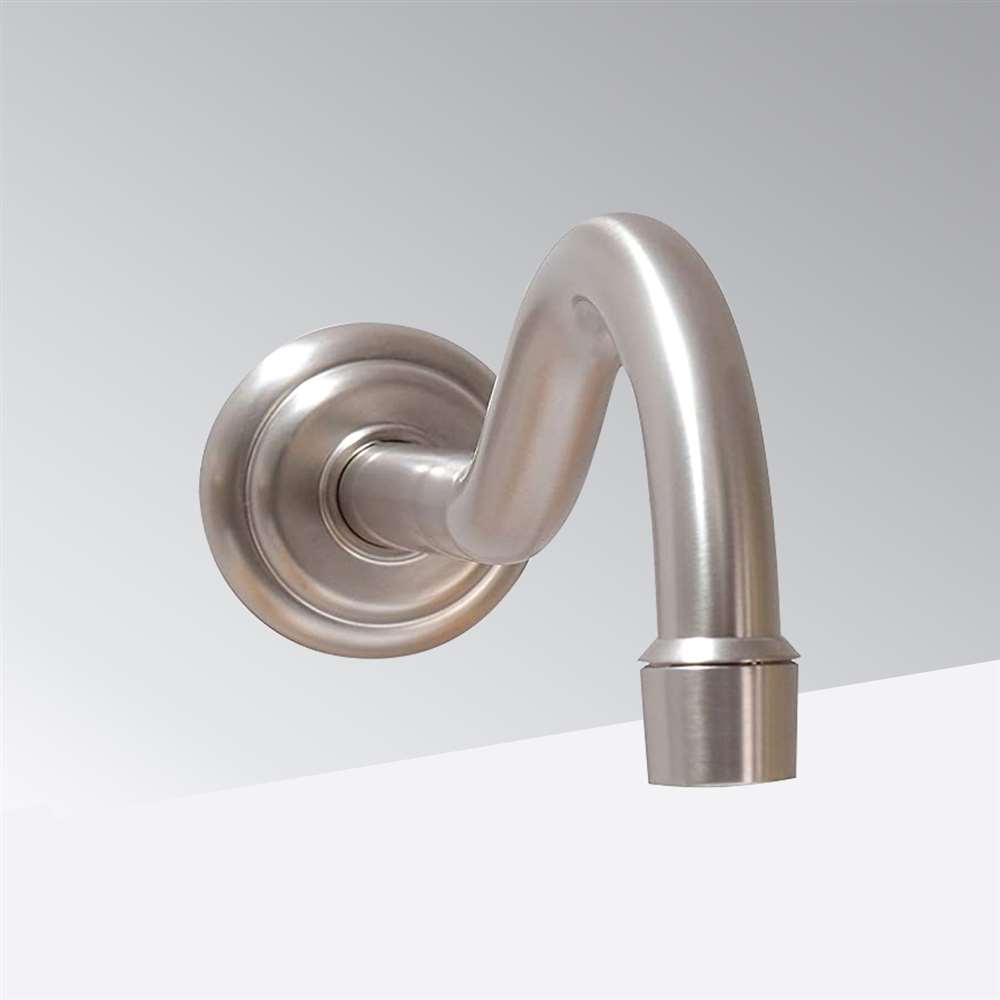
Fontana Commercial Automatic Wall-Mount Brushed Nickel Sensor Bathroom Faucet
The Fontana Commercial Automatic Wall-Mount Brushed Nickel Sensor Faucet combines touchless operation with a more traditional curved architectural profile rather than the rectangular forms common in wall-mounted electronic fixtures.
Fontana specifies commercial wall mounting, brass construction, AC/DC power, ceramic valve architecture and standard G1/2-inch connections.
Wall mounting clears the countertop while retaining a familiar bathroom-faucet silhouette.
Confirm wall depth, spout elevation and basin centerline before finish installation.

BathSelect Geneva Satin Nickel Wall-Mount Commercial Sensor Faucet
BathSelect’s Geneva is designed specifically as a commercial wall-mounted touchless faucet with solid-brass construction, AC/DC power and an IP56-rated enclosure strategy.
Moving the faucet off the countertop reduces the number of fixture bases around which housekeeping must clean and can make continuous solid-surface or stone counters visually simpler.
Strong combination of architectural simplicity and adaptable commercial sensing.
Pressure-test concealed plumbing before closing the finished wall.
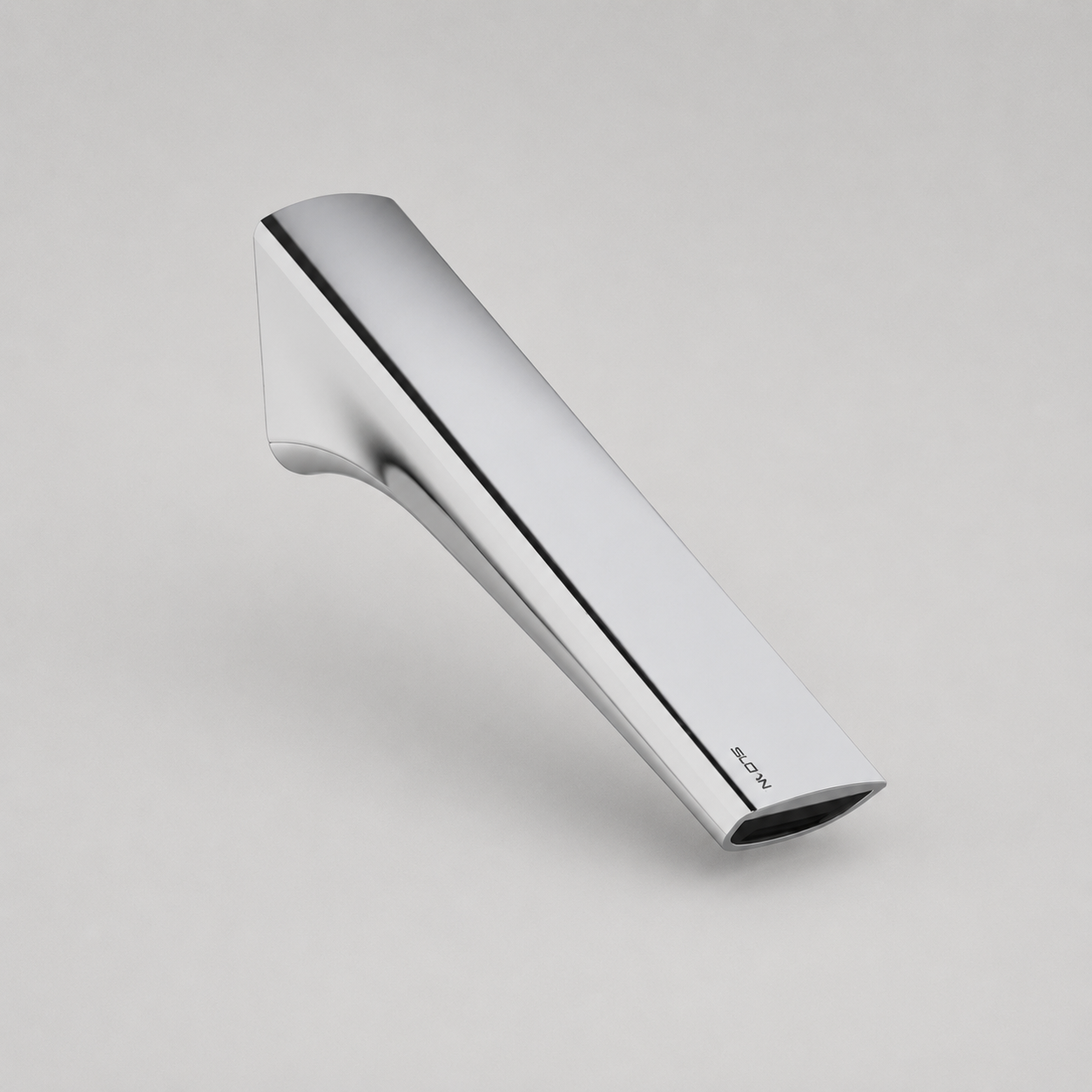
Sloan BASYS® EFX-850 Wall-Mounted Commercial Sensor Faucet
Sloan shows that wall-mounted design does not have to sacrifice maintenance access. The EFX-850 combines a wall-mounted body with one-tool servicing, integral shutoff, an above-deck serviceable strainer and diagnostic indicators.
Its selected configuration uses a 0.5 GPM multi-laminar outlet and automatic-setting dual infrared sensors.
Institutional service architecture reduces one of wall mounting’s typical disadvantages.
Coordinate the wall flange and control/service zone with finished-wall construction.
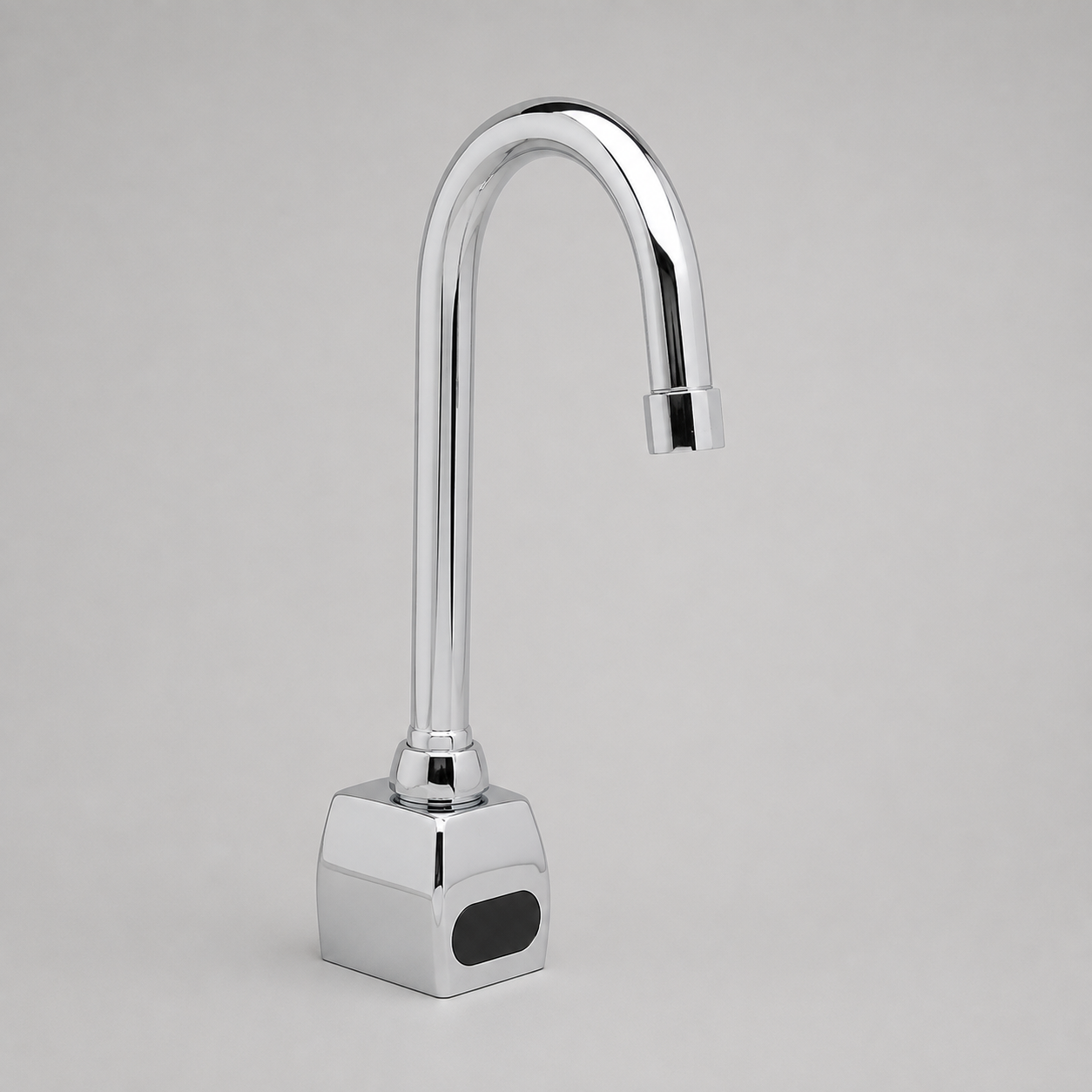
Zurn AquaSense® ZG6922 Wall-Mount Gooseneck Sensor Faucet
Zurn’s current ZG6922 combines a wall-mounted gooseneck with a defined 5-3/8-inch projection and a gear-driven ceramic cartridge that eliminates the conventional solenoid.
The standard high-efficiency configuration is 0.5 GPM, with Bluetooth adjustment for sensor sensitivity, timeout and automatic line flushing.
Published projection makes basin-coordination decisions more deliberate.
A longer gooseneck must still land the stream safely inside the basin working zone.
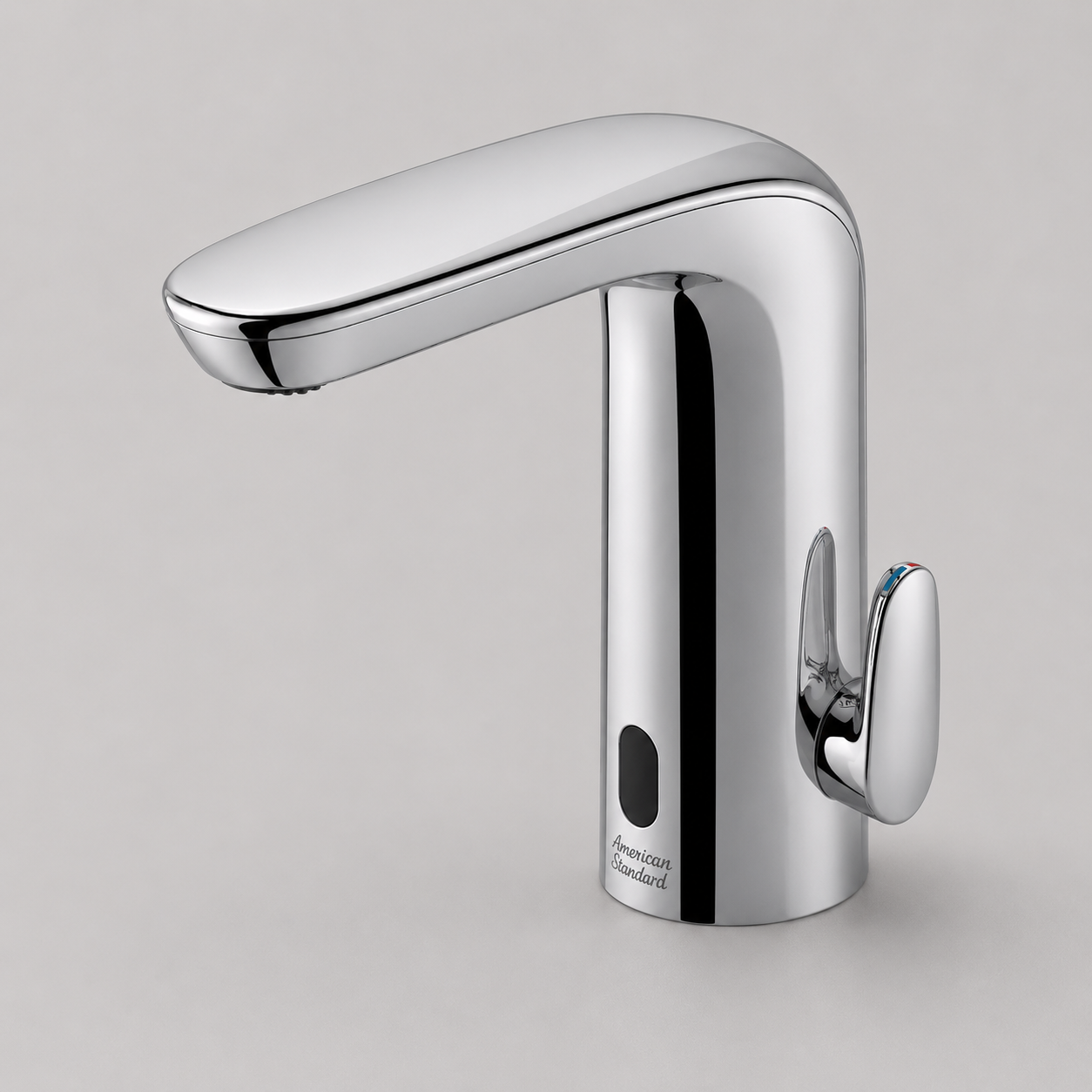
American Standard NextGen® Selectronic® Deck-Mount Touchless Faucet
NextGen provides the useful deck-mounted comparison. Its sensor, battery and solenoid are integrated into the faucet instead of requiring a large separate electronics box beneath the sink.
That makes it particularly attractive for renovations where opening finished walls for a wall-mounted fixture would be disruptive or expensive.
Strong retrofit flexibility with reduced below-counter electronic complexity.
Counter setback still determines where the water lands in the basin.
Projection Matters More Than “Wall-Mount”
A wall-mounted faucet can still perform poorly if its outlet is too short, too high or aligned directly with a drain that creates backsplash. The same is true of a deck-mounted faucet installed too far behind the basin.
Four Details to Resolve Before Closing the Wall
| Finished-wall thickness | Stone, tile, substrate and waterproofing all change final spout projection. |
| Vertical centerline | Coordinate from the finished basin rim, not simply floor elevation. |
| Leak testing | Pressure-test concealed connections before wall closure. |
| Service access | Valves, electronics and filters should not become permanently inaccessible. |
Why Designers Like Wall-Mount Faucets
Removing the faucet base from the countertop leaves fewer edges around which water, soap residue and mineral deposits can accumulate. This can simplify daily cleaning and create a visually continuous stone or solid-surface vanity.
The trade-off is that concealed plumbing becomes more dependent on correct initial coordination.
Which Mounting Type Should You Choose?
Choose Wall-Mount
Luxury hotels, integrated vanities, vessel sinks, premium public bathrooms and projects prioritizing clean counters.
Choose Deck-Mount
Retrofits, conventional lavatories, standardized facilities and projects prioritizing future replacement flexibility.
Wall & Deck Touchless Bathroom Faucet Brands
Wall-Mount vs. Deck-Mount FAQ
Which is easier to retrofit?
Deck-mounted faucets usually require less wall reconstruction and can often use existing sink or countertop openings.
Which is easier to clean around?
Wall mounting leaves the countertop clearer because there is no faucet base sitting on the wet deck.
Are wall-mounted faucets difficult to maintain?
They do not have to be, but control valves and electronics must remain accessible after construction.
Which works better with vessel sinks?
Wall mounting offers excellent flexibility because outlet elevation and reach can be coordinated independently from the countertop.
What causes splash with wall faucets?
Excessive outlet height, poor projection, high flow velocity and shallow basin geometry are common causes.
When should the mounting decision be made?
Before final wall rough-in and countertop fabrication, ideally during design development.
Professional Sources
U.S. DOJ — ADA Standards
Commercial lavatory accessibility and fixture-clearance requirements.
American Society of Plumbing Engineers
Commercial plumbing and fixture-coordination resources.
International Code Council
Model plumbing and building-code resources for concealed and exposed fixture installations.
U.S. EPA — Bathroom Faucet Efficiency
Public-lavatory water-efficiency guidance.
Whole Building Design Guide
Coordinated building-systems planning and design resources.
Wall-Mount Wins Design Freedom; Deck-Mount Wins Retrofit Flexibility
Wall-mounted touchless faucets create cleaner counters and allow architects to coordinate the faucet directly with vessel, integrated and custom basins. The trade-off is much tighter rough-in and service planning. Deck-mounted faucets remain easier to renovate, replace and standardize. For new premium bathrooms, wall mounting deserves serious consideration; for large retrofit programs, deck mounting often remains the more practical lifecycle choice.
Review Fontana Wall-Mount Commercial Faucet →Independent editorial disclosure: BathTouchlessFaucets.com provides independent engineering-oriented analysis. Verify exact spout dimensions, finished-wall tolerances, basin compatibility, power configuration, flow rate and service-access requirements before procurement.
