
Bathroom Design Showcase
10 Gorgeous Bathrooms Using Bath Touchless Faucets
Explore how touchless bathroom faucets can elevate hygiene, modernize restroom design, support water-conscious operation, and create a cleaner user experience in hotels, airports, corporate offices, healthcare buildings, universities, luxury residences, retail centers, and event venues.
Why Designers Select Touchless Fixtures
Touchless Faucets as a Design, Hygiene, and Performance Upgrade
Touchless bathroom faucets have become a defining element in modern restroom design because they combine clean visual lines with a more controlled handwashing experience. Instead of relying on handles that many users touch throughout the day, a sensor faucet activates water only when hands enter the sensing zone.
For hospitality, airport, office, university, healthcare, and luxury residential projects, the faucet is part of the user’s first impression of cleanliness, maintenance quality, and design intent. A well-specified touchless faucet should look intentional, respond consistently, avoid excessive splashing, and coordinate with the countertop, basin, mirror, lighting, soap dispenser, and restroom accessories.
Bath Touchless Faucets can be a practical option for projects where durability, sensor precision, water savings, and polished aesthetics all matter. Designers can use touchless fixtures to support a modern restroom identity while facility teams benefit from reduced handle wear, cleaner fixture surfaces, and more predictable water use.
The best installations begin with coordinated planning. Spout height, spout reach, basin depth, sensor range, power source, soap dispenser location, finish selection, and maintenance access should be evaluated together for a better finished result.
Cleaner User Flow
Touch-free activation supports a more intuitive handwashing sequence, especially in high-use environments where users expect fast operation, minimal contact, and easy movement from soap to rinse to hand drying.
Reduced Visual Clutter
Sensor faucets often remove the need for visible handles, helping designers create simpler vanity lines, cleaner countertops, and a more premium restroom presentation.
Water-Conscious Operation
Automatic shutoff helps limit wasted water by ending flow when hands leave the detection zone, which can support sustainability goals in commercial and residential settings.
Design Applications
10 Gorgeous Bathroom Applications Using Bath Touchless Faucets
This showcase groups touchless faucet applications by project type so readers can see how the same technology adapts to different design goals. Each example highlights a specific environment, the reason touchless fixtures are useful there, and the technical or aesthetic detail designers should consider.
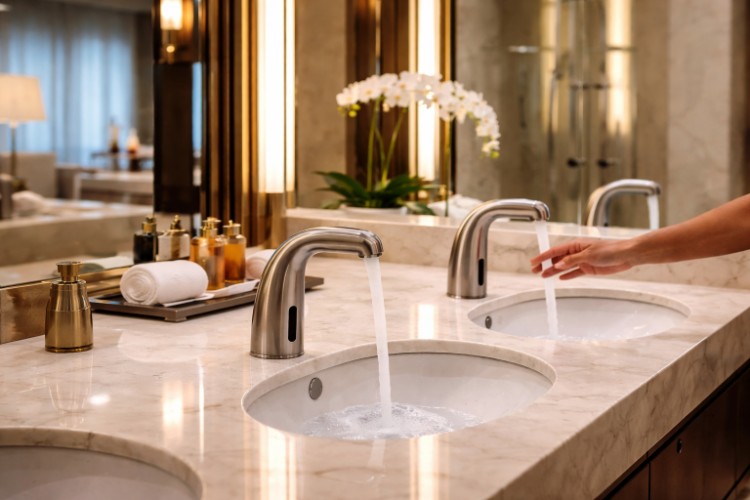
1. Luxury Hotel Bathroom — New York
In a five-star hotel restroom, touchless faucets help the vanity feel polished and carefully maintained. Marble counters, warm lighting, and wall-mounted sensor fixtures create a clean guest experience without adding visual clutter. This setting benefits from a faucet that activates quickly, limits splashing, and matches the surrounding hardware finish.
- Best for premium guest-facing restroom design.
- Coordinate faucet finish with mirror frames and accessories.
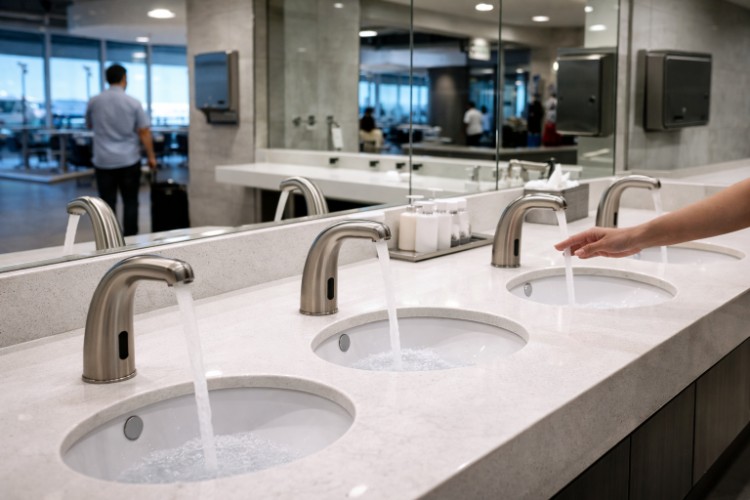
2. International Airport Lounge — Dubai
Airport restrooms operate under constant use, so fixtures must support fast handwashing, reduced surface contact, and dependable response. Touchless faucets are valuable here because users move quickly through the space and facility teams need fixtures that can handle long operating hours with simple maintenance routines.
- Prioritize durable finish and vandal-resistant components.
- Check service access for control boxes and power supply.
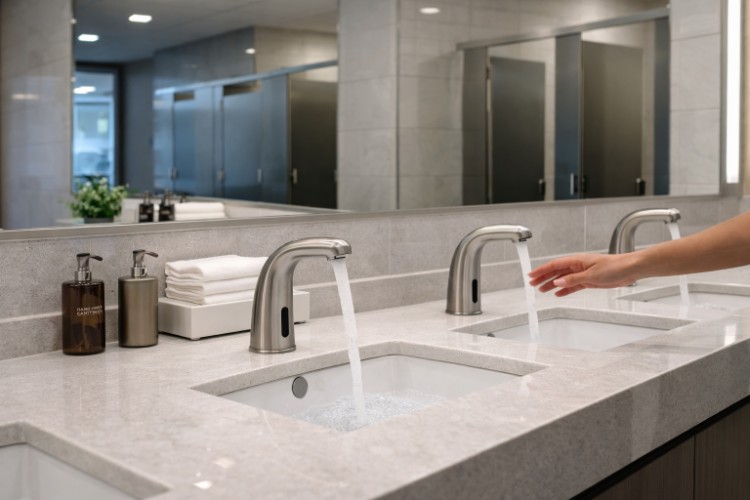
3. Corporate Office Headquarters — London
In corporate offices, touchless faucets reinforce a workplace image centered on technology, hygiene, and sustainability. Minimalist faucet profiles pair well with stone counters, large mirrors, and soft lighting while automatic shutoff helps reduce wasted water in employee and visitor restrooms.
- Match faucet profile with the office interior language.
- Use consistent fixtures across executive and public floors.
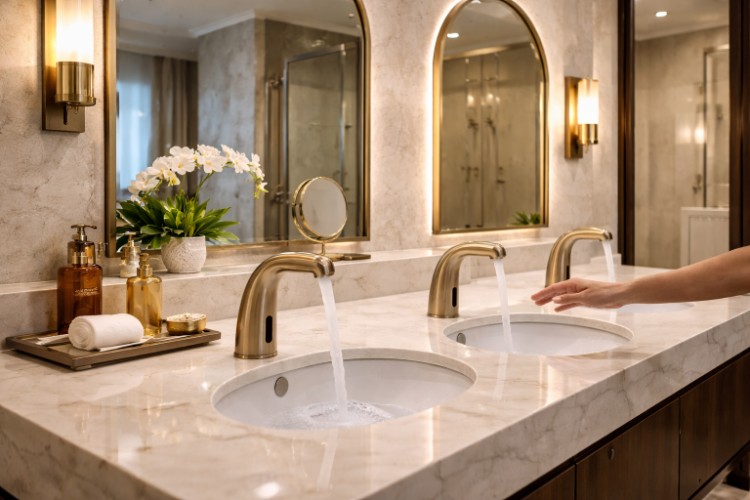
4. Boutique Hotel Bathroom — Paris
Boutique hotel bathrooms often rely on mood, material texture, and a memorable guest experience. Touchless fixtures work well in this setting when they are selected in matte black, brushed metal, brass, or other coordinated finishes that complement the design palette rather than interrupt it.
- Use warm finishes for intimate hospitality interiors.
- Confirm sensor placement under lower ambient lighting.
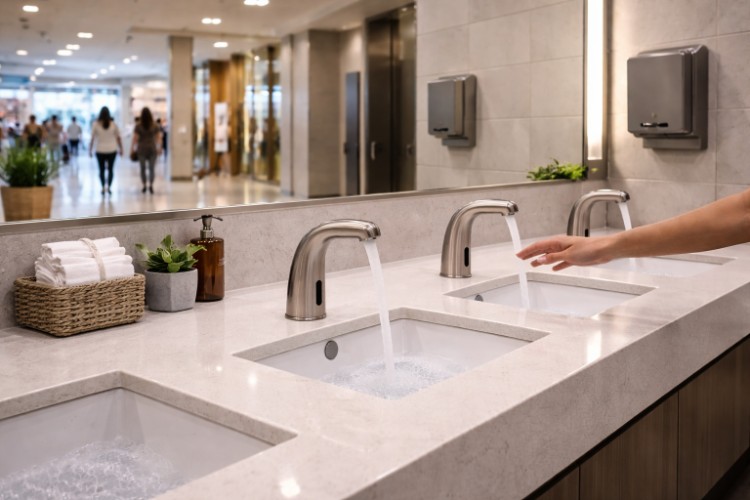
5. Luxury Shopping Mall — Singapore
Shopping mall restrooms must look attractive while handling heavy daily traffic. Touchless faucets help support a cleaner public environment and reduce wear from repeated handle use. The strongest layouts combine durable countertops, easy-to-clean surfaces, consistent faucet spacing, and strong lighting around mirrors.
- Plan for fast cleaning and accessible maintenance points.
- Use consistent spacing to improve user circulation.
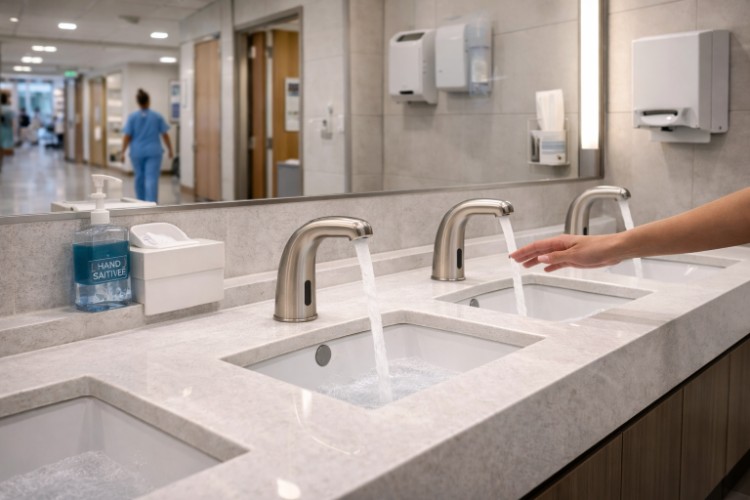
6. Hospital Public Restroom — Germany
Healthcare restrooms place a high priority on reducing unnecessary touchpoints. Touchless faucets support a more hygienic handwashing sequence in patient, visitor, and staff-access areas. For this type of project, performance consistency, easy cleaning, service access, and reliable sensor response are more important than decorative complexity.
- Specify fixtures that tolerate frequent cleaning routines.
- Coordinate soap, water, and drying zones clearly.
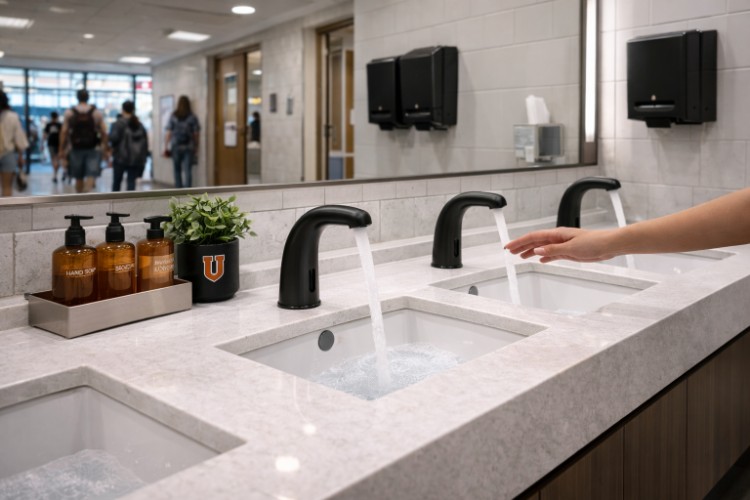
7. University Campus Bathroom — California
Campus restrooms require practical fixtures that can handle student traffic, long hours, and occasional misuse. Touchless faucets can reduce water waste and help discourage rough operation because no handles are needed. Designers should focus on rugged mounting, simple maintenance, and standard replacement parts.
- Prioritize vandal-resistant construction and easy access.
- Choose finishes that hide everyday wear and cleaning marks.
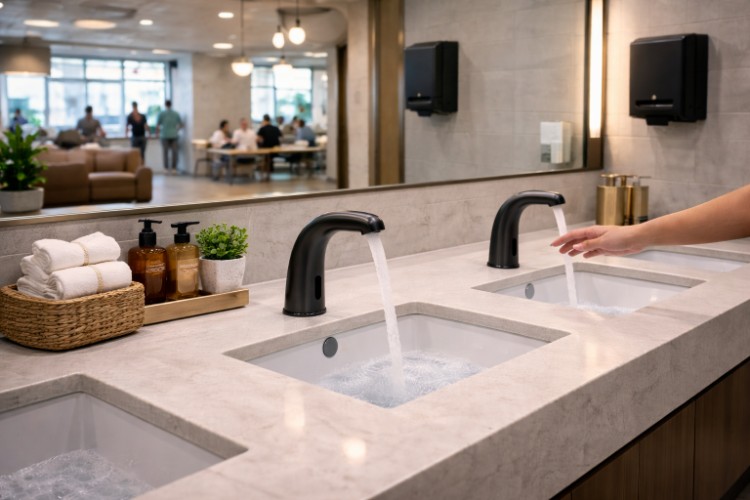
8. Co-Working Space — Berlin
Co-working interiors often use modern finishes and flexible space planning. Touchless faucets fit this design language because they feel current, efficient, and user-friendly. In smaller restroom footprints, a compact sensor faucet can keep the counter clean while supporting quick use between meetings and shared work sessions.
- Select compact profiles for limited counter depth.
- Use sensor fixtures to support a smart-building impression.
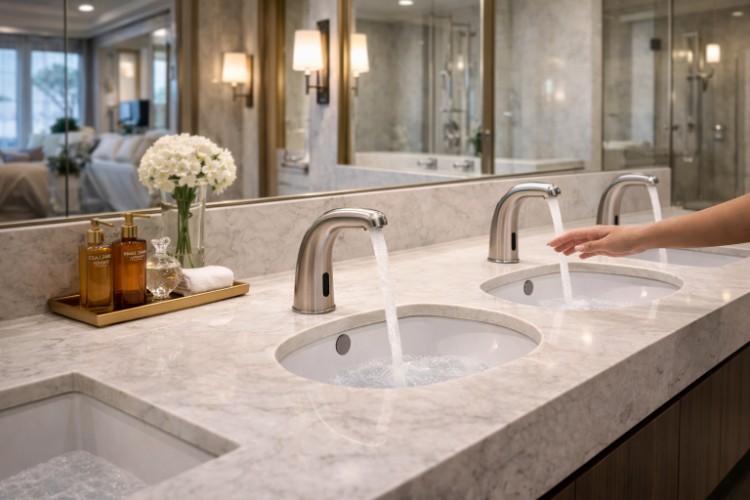
9. Luxury Residential Bathroom — Los Angeles
Touchless technology has moved beyond public restrooms and into luxury homes. In a residential bathroom, the appeal is convenience, cleanliness, and a sleek fixture appearance. Sensor faucets work especially well in powder rooms, guest baths, and primary suites where the owner wants a refined smart-home detail.
- Pair with stone counters and integrated lighting.
- Confirm manual override and power access for home use.
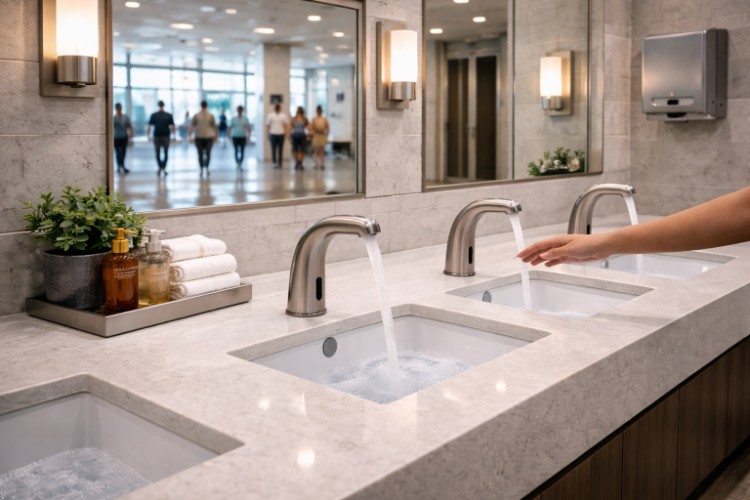
10. Convention Center Restroom — Tokyo
Large venues experience concentrated restroom use during event breaks. Touchless faucets help users move through the space faster and reduce shared surface contact. For this environment, fixture placement, clear circulation, strong flow control, and maintenance-friendly below-deck access are critical to dependable operation.
- Plan faucet banks for peak event traffic.
- Choose fixtures that facility teams can service quickly.
Technical Design Depth
What Makes a Touchless Restroom Perform Beyond Appearance?
A visually impressive restroom can still perform poorly if the faucet, basin, sensor, water delivery, power supply, and maintenance access are not coordinated as one system. For architects, designers, contractors, and facility teams, the strongest touchless restroom installations combine aesthetics with repeatable sensor response, controlled water impact, accessible use, durable finishes, and practical servicing.
Sensor Placement and Basin Geometry
Sensor performance should be reviewed together with basin depth, rim profile, faucet projection, counter geometry, and expected hand position. A poorly coordinated detection zone can produce delayed activation, false triggering, or awkward hand placement even when the faucet itself is technically capable. Reflective surfaces, dark finishes, and unusual basin forms may also affect sensing behavior depending on the selected technology.
Water Delivery and Splash Control
Spout reach, outlet angle, flow characteristics, and basin depth should direct water into the useful handwashing zone rather than toward the rim or front edge. In high-traffic restrooms, poor water impact can increase countertop wetting, cleaning demand, and floor slip risk. Faucet and basin selection should therefore be reviewed as a coordinated assembly rather than as separate decorative components.
Power and Service Strategy
Touchless faucets may rely on battery, hardwired, or other power arrangements depending on the model. High-use facilities benefit from clear access to batteries, transformers, controllers, solenoid valves, strainers, isolation valves, and wiring connections. Service components should remain reachable without unnecessary removal of finished countertops or wall construction.
Accessibility and User Experience
Automatic operation can reduce the need for gripping, twisting, or repetitive handle movement, but accessibility still depends on fixture location, reach, clearances, basin configuration, and the surrounding restroom layout. Review the 2010 ADA Standards and U.S. Access Board lavatory guidance when coordinating accessible restroom fixtures.
Finish Durability and Cleaning
Restroom appearance depends on more than the original finish color. Repeated cleaning, disinfectants, mineral deposits, abrasive wiping, and high-frequency use can affect finish retention over time. Designers should review manufacturer cleaning instructions, finish-system documentation, and expected maintenance practices before selecting polished, matte, plated, or coated surfaces for demanding commercial environments.
Water Efficiency and Commissioning
Automatic shutoff can reduce unnecessary run time, but water efficiency should be reviewed together with usable flow, rinse performance, sensor timing, shutoff behavior, and basin compatibility. Designers can reference current EPA WaterSense bathroom faucet guidance while still verifying the exact model’s published performance and applicable project requirements.
Specification Takeaway
The most successful touchless restroom is not simply the one with the most attractive faucet. It is the one in which sensing, basin geometry, water delivery, accessibility, power, maintenance, finish durability, and user circulation are coordinated before installation. That same approach improves long-term reliability and helps reduce avoidable service issues after the project is occupied.
Planning Matrix
Touchless Faucet Selection Criteria by Bathroom Type
Use this matrix to connect the design examples above with practical specification decisions. Each environment has different priorities, so the selected faucet should match the expected traffic level, maintenance model, visual finish, and user experience.
| Bathroom Type | Primary Design Goal | Technical Priority | Best Faucet Features | Specifier Note |
|---|---|---|---|---|
| Luxury Hotel | Premium guest impression | Finish coordination and quiet operation | Wall-mounted or refined deck-mounted sensor faucet | Coordinate with countertop material, mirror lighting, and accessory finish. |
| Airport Lounge | Fast, hygienic user flow | High-use durability and maintenance access | Commercial sensor faucet with robust body and automatic shutoff | Confirm access to batteries, transformers, control boxes, and shutoff valves. |
| Corporate Office | Modern workplace presentation | Water-saving performance and clean appearance | Minimalist touchless faucet with matching soap dispenser | Use consistent fixture families across public and staff restrooms. |
| Hospital | Reduced touchpoints and easy cleaning | Reliable activation and sanitation support | Hands-free faucet with simple serviceable components | Keep soap, water, and drying zones intuitive and close together. |
| University | Long-term use under heavy traffic | Vandal resistance and low maintenance | Durable sensor faucet with secure mounting | Select finishes and components that tolerate frequent cleaning and repeated use. |
| Luxury Home | Smart-home convenience | Comfort, finish quality, and simple override | Designer touchless faucet with coordinated hardware | Confirm power access and user controls for residential maintenance. |
Explore Bath Touchless Faucets
Discover Touchless Bathroom Faucet Options
Explore sensor-operated bathroom faucets suitable for commercial properties, public restrooms, hospitality interiors, luxury residences, and smart home upgrades. The best choice should match the basin, counter depth, desired finish, power plan, and expected traffic level.
Helpful Resources
References for Restroom Planning and Product Evaluation
These resources may be useful during accessibility review, water efficiency planning, product evaluation, code coordination, and hygiene-focused restroom design.
