
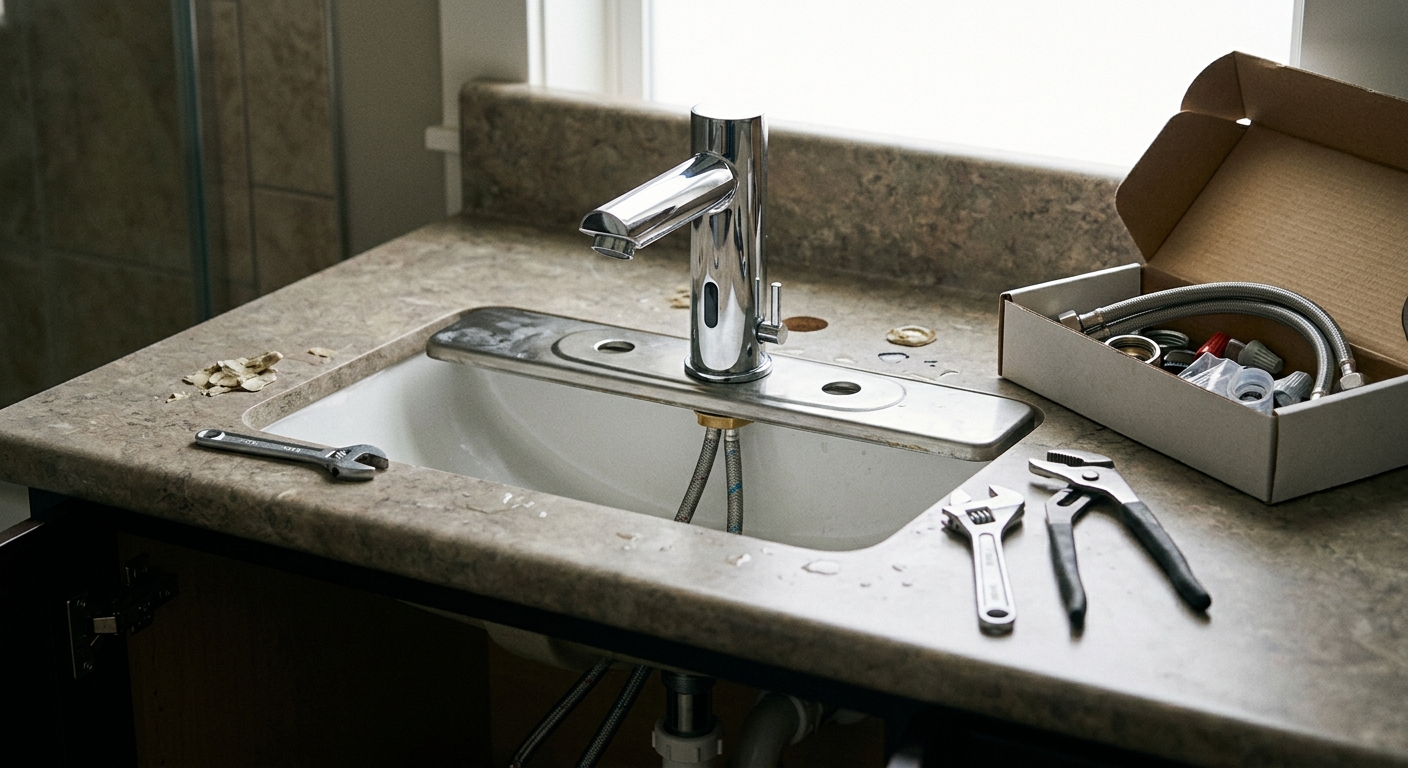
Yes, in most cases. Touchless faucets are sold in the same hole configurations as standard faucets, so the deciding factor is your existing deck plate spacing and hole count, not the sensor technology itself. The retrofit fails when someone buys a single-hole touchless unit for a 3-hole 8-inch spread, or ignores the transformer and battery pack that now has to live under the sink.
Measuring Your Deck Plate Before Buying
Pull out a tape measure before you open any product page. Deck plate hole spacing is standardized in two common widths: 4-inch centers (sometimes called “mini-spread”) and 8-inch centers (the widescreen or standard spread most builder-grade bathroom sinks use). Measure center to center on the outer holes, not edge to edge. If you have a single center hole, you’re looking at a single-hole faucet, and the sensor faucet you buy needs to say “single-hole” explicitly, not just “compatible with single or multi-hole” in marketing copy that doesn’t match the spec sheet.
Also check the deck plate thickness and the diameter of the existing holes. Most standard holes run 1.25 to 1.5 inches, which fits nearly all residential faucet bodies, but older cast iron or enameled steel sinks occasionally have nonstandard hole sizes that will need a plumber’s judgment call, not a return-and-reorder cycle.
3-Hole vs Single-Hole Retrofit Options
If your existing setup is 3-hole at 8-inch centers, you have two paths: buy a 3-hole touchless faucet where the sensor module sits in the center hole and the side holes hold the base plate and handle (if it has one), or buy a single-hole touchless faucet with a deck plate escutcheon that covers the outer two holes. The escutcheon route is more common because most touchless residential faucets are single-hole by design, with the sensor eliminating the need for a separate handle.
For single-hole decks, this is the simpler retrofit. You’re matching one hole to one faucet body, no escutcheon plate needed, and the wiring or battery compartment drops straight through the existing hole into the cabinet below.
- 4-inch center, single hole: widest compatibility, least retrofit friction.
- 8-inch center, 3-hole: requires either a 3-hole touchless faucet or a single-hole faucet with a matching deck plate/escutcheon.
- Nonstandard spacing: measure twice, and expect to special-order or call a plumber for a plate swap.
Battery, AC Adapter, or Hybrid Power
Touchless faucets need power for the solenoid valve and the IR sensor, and you’ll choose between battery packs, a 6V AC adapter (transformer), or a hybrid unit that runs on AC with battery backup. Each has real tradeoffs, not just cost differences.
| Power Type | Typical Lifespan | Install Complexity | Best For |
|---|---|---|---|
| AA Battery Pack (4-6 cells) | 6-12 months, family use | Low, no outlet needed | Sinks far from an outlet |
| 6V AC Adapter | Continuous, no replacement | Medium, needs nearby GFCI outlet | Vanities with accessible outlet under sink |
| Hybrid (AC + battery backup) | Continuous with fallback | Medium-high, more parts | Households wanting no interruption during outages |
Battery packs are the default for most homeowner retrofits because they don’t require an electrician or a nearby outlet. In a family bathroom with two or three daily users, expect to change batteries every six months to a year depending on usage frequency and sensor sensitivity settings. The AC adapter avoids that maintenance but means running a low-voltage cord through the cabinet wall or back panel to a GFCI-protected outlet, which not every vanity has.
Sensor Range and Family Bathroom False Triggers
Most residential IR sensor faucets are tuned for a 4 to 6 inch detection range, meaning the faucet activates when an object (a hand) breaks the infrared beam within that zone in front of the spout. This range is deliberately short compared to commercial restroom units, which often need to detect from farther away in higher-traffic settings.
In a family bathroom, the practical issue isn’t sensor failure, it’s sensor success at the wrong time. Kids leaning over the sink to look in the mirror, toothbrushes propped against the spout, or a washcloth draped over the faucet neck can all sit inside that 4 to 6 inch zone and trigger unwanted activation. Look for models with adjustable sensor range or a “sensitivity” dial, which lets you narrow the detection zone to reduce false triggers from lean-over behavior. Some manufacturers list this adjustment in the spec sheet as a range in inches; if it’s not listed, assume it’s fixed.
If you’re comparing units before buying, checking a current catalog like the motion sensor faucets lineup gives you a sense of how sensor range and power options are typically listed side by side, which is useful for matching against your deck plate measurements before you commit to a purchase.
Under-Sink Space Needed for Solenoid Valves
The solenoid valve, the battery pack or transformer, and the control box all need physical space under the sink, not just electrical or plumbing access. This is the part retrofit guides skip. A solenoid valve body is roughly the size of a small fist, and it sits inline on the water supply, typically requiring 4 to 6 inches of clearance between the shutoff valve and the faucet’s flexible supply line.
Supply line connections on touchless faucets are almost universally 1/2-inch or 3/8-inch compression fittings, matching standard angle stop valves. If your existing angle stops are already 1/2-inch compression, you’re set. If they’re older sweat-fitting valves without compression threads, you’ll need to swap the stop valve first, which is a small job but one worth flagging before you assume the faucet swap alone will work.
Measure your cabinet depth and check for obstructions like a garbage disposal, P-trap, or vertical support brace that might block the solenoid body or battery pack placement.
When to Call a Plumber Instead
Call a plumber if any of the following apply:
- Your deck plate hole spacing doesn’t match 4-inch or 8-inch standards and you need a plate swap or sink modification.
- Your angle stops are old sweat-fitting valves without compression threads.
- You want an AC adapter setup and there’s no GFCI outlet within reach under the sink.
- The solenoid valve or control box doesn’t physically fit in your existing cabinet without relocating the P-trap or disposal.
If your deck plate is standard spacing, your angle stops are already compression-style, and you’re comfortable running a battery pack, this is a faucet swap you can do with basic hand tools in an afternoon. Measure first, match the hole count and spacing to the product listing, and decide on power source before you buy so you’re not stuck returning a unit that needs an outlet you don’t have.