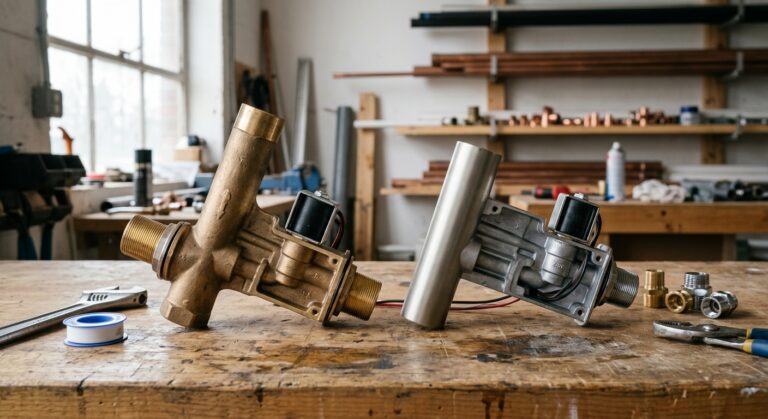
If there is no angle stop under the sink, the faucet was plumbed directly to the branch line, which means your only shutoff right now is the main. That is not a code-compliant installation and it is not a safe long-term setup for a touchless faucet, which has a solenoid valve and wiring in addition to the water line. The fix is a 3/8-inch compression angle stop, and it is a reasonable DIY job if the supply line gives you a few inches of working room.
Why a touchless faucet still needs a local stop valve
A sensor faucet does not remove the need for isolation, it adds a second system that can fail. The solenoid valve that opens and closes the water path is electrically controlled, and if it sticks open, fails wet, or the sensor board glitches during a power blip, you want to kill water at the fixture, not walk to the basement or crawlspace to find the main. Every minute spent locating a whole-house shutoff during a stuck-open solenoid is water on the floor.
This is also a code issue, not just a convenience one. Both the Uniform Plumbing Code and the International Plumbing Code require an accessible shutoff valve for each fixture, and “accessible” means reachable without removing drywall or a cabinet back panel. A sink with no stop is technically out of compliance, and if you ever sell the house or pull a permit for other bathroom work, an inspector can flag it.
Finding the main shutoff when there is no local stop
Until you retrofit a stop, you need to know where your interim shutoff is. In most houses this is one of the following:
- A main house shutoff valve where the service line enters, typically near the water meter, in a basement, crawlspace, or utility closet.
- A branch shutoff for the bathroom group, sometimes installed where a remodel added new supply lines, often behind an access panel in a closet backing the bathroom wall.
- In manifold (PEX) systems, a labeled port at the manifold panel, which is the fastest shutoff if your plumbing was done this way.
Test this now, before you have a leak. Shut it, run the faucet to confirm no flow, then reopen. If you cannot find any valve other than the street-side curb stop, that is a sign the house was never fitted with a main interior shutoff either, which is a separate problem worth having a plumber address.
Solenoid valve vs. water supply: what to isolate first
With a touchless faucet, you actually have two things that can be shut down independently, and they fail differently.
| Component | Location | What shutting it off does |
|---|---|---|
| Solenoid valve | Inside the cabinet, usually mounted to the faucet’s flex supply line, or behind the deck plate on some countertop-mount models | Stops water flow at the electronic valve, but only if it is functioning. A failed solenoid may not respond to power loss at all. |
| Angle stop (if present) | Where the supply line meets the wall or floor stub-out, upstream of everything else | Mechanically isolates water regardless of what the electronics are doing. This is the only shutoff you should trust during an active leak. |
The practical rule: if the faucet is leaking or won’t stop running, isolate water at the angle stop first, not by cutting power to the solenoid. A solenoid valve defaults to closed when powered off in most residential designs, but “most” is not a guarantee you want to bet a ceiling on. Mechanical shutoff is the reliable one. Treat the solenoid as the normal on/off for daily use and the angle stop as the emergency isolation.
Installing a 3/8-inch compression angle stop retrofit
This is the actual fix, and it is a contained job if the stub-out is copper or CPVC with enough exposed pipe to work with.
- Shut the main, open the faucet to bleed pressure and confirm the line is dead.
- Cut the stub-out cleanly, square to the pipe, leaving enough length for the compression fitting to seat.
- Deburr the cut edge. A rough edge will cut the compression ferrule and you will get a weeping fitting that shows up weeks later.
- Slide on the compression nut and ferrule, dry-fit the valve, then tighten per the manufacturer’s torque guidance, typically hand-tight plus a specified fraction of a turn with a wrench, not “as tight as you can get it.”
- Use a quarter-turn ball-type stop, not a multi-turn compression stop. Ball valves give you a positive open/closed position you can confirm by feel, which matters when someone else in the house needs to shut it off in a hurry.
- Restore main water, check the new joint under pressure, and recheck it again after 24 hours since compression fittings on CPVC in particular can show slow seepage after initial installation.
If the stub-out is too short to give the ferrule a clean bite, or if you are dealing with galvanized pipe, that is where a plumber earns the call rather than a second trip to the hardware store.
Battery pack and AC transformer shutoff basics
The two power options for a touchless faucet do not behave the same way when you cut power, and that matters for troubleshooting.
- Battery pack (typically AA or a dedicated lithium pack in the cabinet): Pulling the batteries kills the sensor immediately and the solenoid returns to its default closed state. This is the simplest isolation for electronics and safe for anyone in the house to do without tools.
- AC transformer (plugged into a GFCI outlet under the sink, stepping down to the faucet’s low-voltage input): Unplugging the transformer has the same electrical effect as pulling batteries, but only if the outlet is accessible. If the transformer is hardwired into a junction box rather than plugged in, you are shutting off a circuit breaker, not unplugging a cord, which is a slower and less obvious step for a non-plumber to take under pressure.
If you are specifying a new faucet for a family bathroom and shutoff simplicity matters to you, that is worth factoring into the choice between battery and AC models at purchase time, not after it’s installed. A battery-powered unit gives any adult in the house a tool-free way to deaden the electronics in seconds. Manufacturers list this detail on the spec sheet, and it is one of several things worth comparing across a sensor faucet range before deciding between battery, hardwired, or dual-power models for a household with kids.
When to call a plumber instead of DIY
Cutting and fitting a compression stop on accessible copper or CPVC is reasonable for someone comfortable with basic tools. Call a plumber if any of the following apply:
- The stub-out is galvanized, severely corroded, or too short to leave room for a clean ferrule seat.
- You have no main shutoff at all, only a street-side curb stop requiring a meter key or utility involvement.
- The solenoid valve itself is leaking at its body or fittings rather than at the supply line, since that is a warranty and part-replacement issue, not a stop-valve issue.
- The faucet is wired into household AC rather than running off a plug-in transformer, since that crosses into electrical work.
Once the angle stop is in, test it twice a year: close it, confirm no flow, reopen. A stop valve that has not moved in a year can seize, and the worst time to discover that is during an actual leak.