
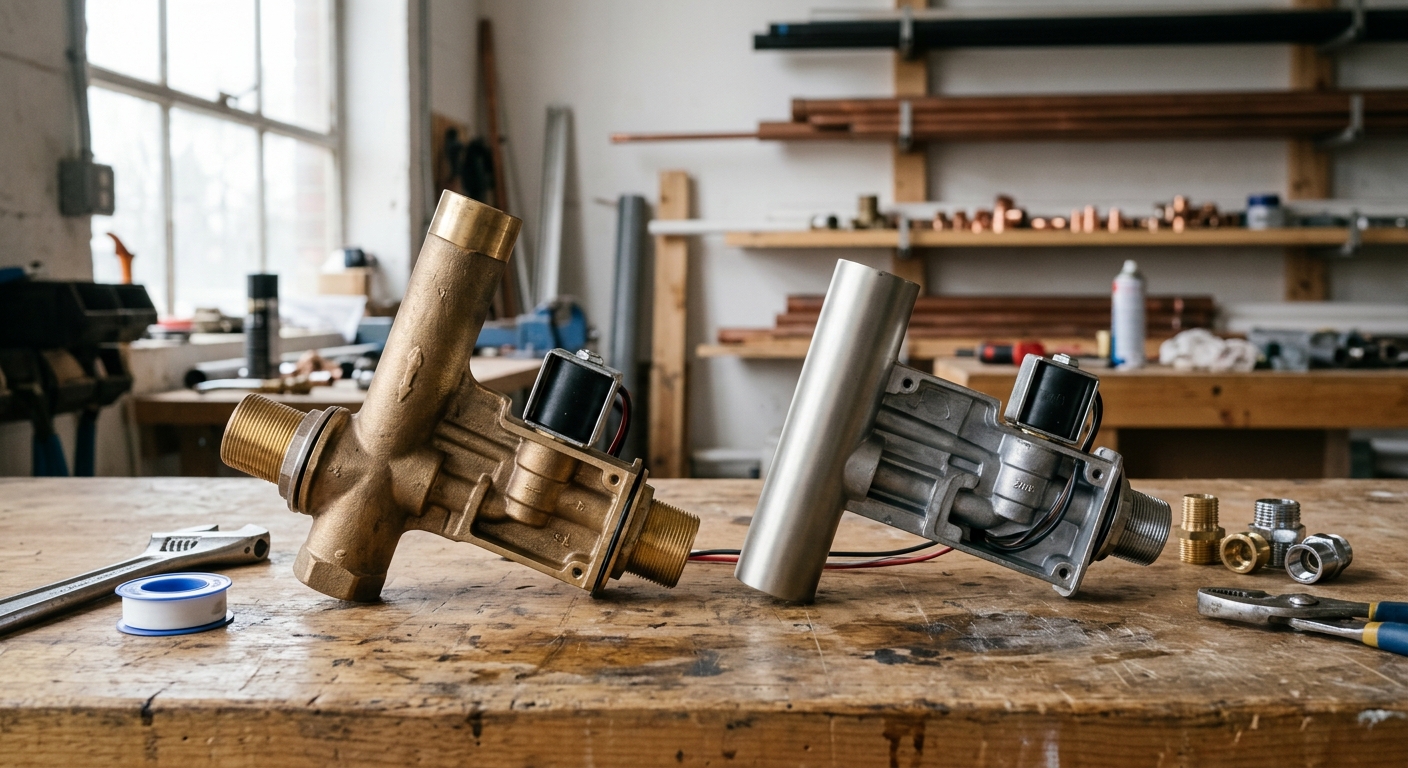
Solid brass is the better choice for a family bathroom touchless faucet, but not for the reason most buyers assume. The difference that matters isn’t abstract “durability,” it’s how each material interacts with the sensor electronics and battery housing mounted inside the body. Brass gives you more consistent grounding and better corrosion resistance at the valve seats; zinc alloy gives you a lighter body that can simplify how the power pack mounts, which matters if you’re running on AA batteries rather than an AC transformer.
Why Body Material Affects Sensor Housings
A touchless faucet isn’t just a valve with a spout bolted on. The sensor, the solenoid, and in most residential models a battery compartment or DC transformer jack all live inside or directly behind the faucet body. That body is the mounting surface and, in many designs, part of the electrical reference path. Material choice affects three things a homeowner actually experiences: how reliably the sensor ignores ambient interference, how the battery pack sits and seals against moisture, and how the unit holds up to repeated contact with soap residue and hard water deposits around the base.
Brass Alloys and Grounding Against False Triggers
Most solid brass faucet bodies run 58 to 85 percent copper content (CuZn alloys), with the remainder zinc and trace lead or bismuth depending on the manufacturer’s lead-free formulation. Copper’s conductivity is relevant here because the sensor’s infrared or capacitive circuit needs a stable electrical reference to avoid false triggers when a hand passes at the edge of detection range, typically 4 to 6 inches. A brass body with higher copper content dissipates static charge and minor electrical noise more evenly than zinc alloy, which is a poor conductor by comparison. In practice this means fewer phantom activations caused by static buildup from towels, dry air, or a kid’s hand brushing the faucet neck without triggering intentional use.
This isn’t a dramatic difference in everyday operation, most touchless faucets on either material work fine out of the box. But in bathrooms with forced-air heating, low humidity, or synthetic bath mats near the sink, the grounding behavior of brass gives the sensor a more stable baseline to measure against.
Zinc Alloy Weight Savings for Battery Packs
Zinc alloy (commonly zinc-aluminum die-cast, sometimes labeled ZAMAK) weighs noticeably less than brass for the same body geometry. That weight savings isn’t marketing fluff, it changes how the manufacturer can mount the battery compartment and solenoid valve. Lighter bodies let the battery pack sit lower and closer to the counter without needing additional bracket support, which simplifies installation for AA-battery models that homeowners service themselves. If your household plans to run the faucet on four AA batteries rather than hardwiring an AC transformer, a zinc alloy body is not a downgrade, it’s simply the more common pairing because the manufacturer isn’t fighting the weight of a solid brass casting against a plastic battery tray.
The tradeoff is that zinc alloy is more prone to long-term fatigue at threaded connections and more reactive to sustained moisture exposure, which shows up as pitting or white oxidation at the base over several years, especially where the body meets the deck plate.
Corrosion Risk From Kids’ Soap and Hard Water
Family bathrooms see more soap contact than any other room in the house, and most kids’ soap formulations are mildly alkaline with added fragrance oils and dyes. Combined with hard water mineral deposits, this creates a chemical environment that favors brass. Brass fixtures develop a protective patina that slows further corrosion, while zinc alloy bodies rely entirely on their plating (chrome, nickel, or brushed finish) for protection. Once that plating is scratched or worn through, typically from abrasive cleaning pads kids’ hands and parents alike tend to use on stubborn mineral stains, the underlying zinc corrodes faster than brass would at an equivalent scratch.
- Brass body: plating scratch exposes base metal that still resists corrosion on its own
- Zinc alloy body: plating scratch exposes base metal that corrodes faster, especially with standing water or soap film
- Either body: corrosion at the base can eventually affect the sensor’s ground reference, leading to erratic triggering over time
If your water supply is hard (above roughly 7 grains per gallon) and you’re not softening it, brass is the more forgiving choice for a fixture that will see five or more years of daily family use before replacement.
Solenoid Valve Fit in Each Body Type
Touchless faucets use a solenoid valve to open and close water flow electronically, and that valve has to seat into the faucet body with a reliable seal. Brass takes machining tolerances for solenoid ports more consistently than zinc alloy, because brass doesn’t have zinc’s tendency to develop micro-porosity during casting. In high-cycle environments like commercial touchless faucets, where solenoid valves may cycle hundreds of times a day, this porosity difference matters enough that most commercial-grade units specify brass bodies as standard. In a residential family bathroom with far lower cycle counts, zinc alloy solenoid seats generally hold up fine, but it’s still the weaker link if the faucet will see heavy use from multiple kids over several years.
Both body types use standard 1/2-inch NPS or NPT threaded connections for supply lines, so thread compatibility isn’t a differentiator, any reputable sensor faucet in either material will connect to standard braided supply lines without an adapter.
Choosing by Power Source and Household Use
The decision comes down to two practical questions: how you want to power the faucet, and how hard your household is on bathroom fixtures.
| Factor | Favors Brass | Favors Zinc Alloy |
|---|---|---|
| Power source | AC transformer (hardwired, less sensitive to body weight) | AA battery pack (lighter body simplifies mounting) |
| Water hardness | Hard water, no softener | Soft or treated water |
| Household use | Multiple kids, heavy daily cycles | Lower-traffic guest or secondary bathroom |
| Sensor stability priority | Higher, due to copper grounding | Adequate for most residential ranges |
If you’re wiring the faucet to an AC transformer anyway, the weight advantage of zinc alloy disappears as a reason to choose it, and brass becomes the straightforward pick for grounding stability and corrosion resistance. If you want a battery-only install with no wiring, zinc alloy is a reasonable compromise as long as you’re prepared to replace the batteries and watch the base finish for wear.
Before you buy, check the spec sheet for body material explicitly (don’t assume “solid brass” from marketing copy, look for the CuZn percentage or a “lead-free brass” certification mark), confirm whether the unit ships with a battery pack, transformer, or both, and ask the manufacturer what the rated sensor range is in inches, not just “touchless.” If you’re retrofitting into an existing 1/2-inch supply line, confirm thread type (NPS vs NPT) before ordering, since mismatched threads are the most common installation delay. For anything beyond a straightforward swap, like running new low-voltage wiring for an AC transformer, have a licensed plumber or electrician handle the connection.