
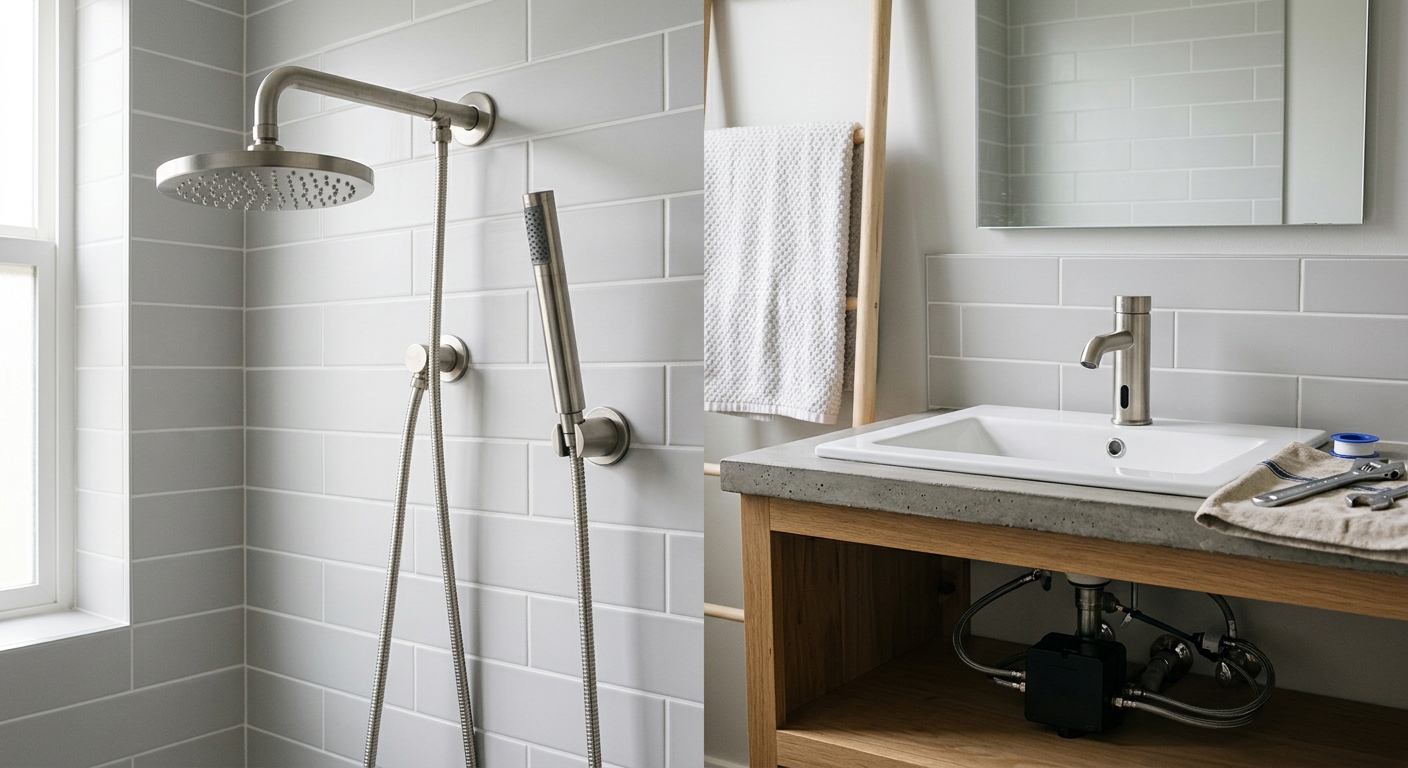
Get an aerating low-flow shower head rated around 1.75 GPM, not a venturi or “high-pressure” style head that restricts flow further to create spray force. If your touchless faucet runs on a solenoid valve, it needs roughly 20-30 psi (0.14-0.2 MPa) at the valve to actuate, and a shower head that chokes flow too hard on a shared supply line can pull the whole branch below that threshold. The two fixtures are not independent purchases. They’re drawing from the same pressure budget.
Why Low Pressure Hits Faucets and Showers Differently
A standard faucet doesn’t care much about pressure as long as water comes out. A solenoid-valve touchless faucet does care, because the solenoid needs a minimum differential pressure to open and seat reliably. Drop below that minimum and you get faucets that hesitate, trigger late, or fail to shut off cleanly. A shower head has no such electronic threshold. It just produces a weaker spray as pressure drops. That means a shower head will tolerate low pressure gracefully while a sensor faucet will not, which is why the shower head you pick can end up being the thing that breaks the faucet’s reliability, not the municipal supply itself.
The Minimum PSI Sensor Valves Actually Need
Most residential solenoid valves used in touchless bath faucets are spec’d for a 20 to 30 psi (0.14 to 0.2 MPa) minimum dynamic pressure, with 45 to 60 psi considered comfortable operating range. Static pressure at the meter means nothing here. What matters is dynamic pressure at the faucet while water is flowing elsewhere in the house, because that’s when the pressure actually drops. If you’re already near the low end of that range, any additional restriction downstream, including a shower head with a tight flow restrictor, can pull the branch line below the solenoid’s actuation point during simultaneous use.
Check your current dynamic pressure before buying anything. A $15 pressure gauge that threads onto a hose bib or washing machine valve will tell you more than any spec sheet. Run another fixture in the house, then read the gauge. If you’re seeing 25 psi or less under load, you’re already working with a thin margin and need to be deliberate about what else goes on that line.
Aerating vs Venturi Shower Head Cartridges
Low-flow shower heads achieve their flow reduction one of two ways, and the mechanism matters more than the GPM number on the box.
- Aerating cartridges mix air into the water stream through a small chamber, which makes the spray feel fuller at lower actual flow. They work well on low-pressure lines because they don’t need much force to function, and the air injection compensates for weak flow by bulking up the spray volume perceptually.
- Venturi (non-aerating) cartridges use pressure differentials to concentrate water into pulsing or forceful streams, which is the mechanism behind most “high-pressure” low-flow heads. These need a reasonable amount of incoming pressure to create that pulse effect. On an already-marginal line, a venturi head can feel weak and gives you no compensating benefit the way aerating does.
For a low-pressure shared line, aerating is the better default. It’s also worth knowing that rain shower heads tend to use wide-pattern aerating designs rather than venturi, since the spray pattern depends on even distribution across a large face rather than concentrated force, which happens to suit low-pressure installations even though that’s not why most people buy them.
GPM Math for Shared Bathroom Supply Lines
Federal law caps standard shower heads at 2.5 GPM, and WaterSense-certified heads cap at 1.75 GPM. A touchless bath faucet typically flows at 1.5 GPM or less, often closer to 0.5 to 1.0 GPM on aerator-restricted models. On paper, a 1.75 GPM shower head and a 1 GPM faucet should coexist fine on a 1/2 inch line, which is rated to carry roughly 3 to 5 GPM depending on length, material, and fittings. The problem isn’t total capacity. It’s what happens to pressure, not flow, when both draws hit the line at once, especially on older copper or galvanized runs with scale buildup that’s already narrowing the effective diameter.
Here’s the practical comparison for a typical family bathroom branch:
| Fixture | Typical Flow (GPM) | Pressure Sensitivity |
|---|---|---|
| Touchless faucet (solenoid) | 0.5 – 1.5 | High – needs 20-30 psi minimum to trigger |
| WaterSense shower head | Up to 1.75 | Low – functions across a wide pressure range |
| Standard shower head | Up to 2.5 | Low, but draws more flow, increasing pressure drop |
The shower head’s own pressure tolerance isn’t the issue. It’s the pressure drop it causes elsewhere on the branch when it’s running. A WaterSense head at 1.75 GPM pulls less total flow than a 2.5 GPM standard head, which means less pressure drop across the branch and more headroom left for the faucet’s solenoid to actuate reliably if someone’s washing hands while the shower runs.
Balancing Both Fixtures in a Family Bathroom
In a household with kids, simultaneous use is the normal case, not the edge case. Someone’s brushing teeth while someone else showers. That’s exactly the scenario where marginal pressure causes touchless faucet failures, so the fixture selection has to account for worst-case simultaneous draw, not just each fixture’s individual spec sheet.
Three things actually fix this, independently or combined:
- Choose a WaterSense aerating shower head over a standard or venturi high-pressure model. The lower flow rate reduces pressure drop on the shared line during simultaneous use.
- Verify the faucet’s minimum pressure spec before buying, not after installation. Manufacturers list this number; if the sheet says 30 psi minimum and your dynamic pressure tests at 28, that faucet is a poor match for your house regardless of how good the shower head is.
- Consider a pressure booster pump on the branch line if your whole-house dynamic pressure is below 40 psi. This addresses the root cause rather than just minimizing downstream restriction, and it’s the more reliable fix if you’ve already got low pressure throughout the house rather than just at this one bathroom.
What to Check Before You Buy
Test dynamic pressure at the bathroom’s supply line with another fixture running, not just static pressure at rest. Pull the spec sheet for any touchless faucet you’re considering and confirm its minimum actuation pressure in writing, not from marketing copy. If your tested pressure is within 10 psi of the faucet’s minimum, choose a WaterSense aerating shower head and skip anything marketed as high-pressure or massage-pattern, since those rely on venturi restriction that will work against you. If dynamic pressure is below 25 psi anywhere in the house, call a plumber about a pressure booster before buying either fixture, because no shower head choice will fix a supply-side pressure problem that originates upstream of the bathroom.