
IoT, IP67 & Time-of-Flight Sensing in Aviation Touchless Faucets
Connected hardware, ingress protection, optical sensing, low-voltage controls, hydraulic performance and maintainability all influence how a touchless faucet behaves in a compact aircraft lavatory. This technical brief examines IoT-capable faucet controls, IP65–IP67 enclosure protection, Time-of-Flight sensing, aircraft lavatory constraints, environmental qualification, fleet maintenance and commercial touchless fixture experience, using Fontana Aviation programs and other public aviation resources as technical reference points.
Technical Scope of an Aviation Touchless Faucet
IoT describes connected control and diagnostic functions; an IP rating describes enclosure resistance to solids and water; and Time-of-Flight sensing uses optical timing to establish distance. In an aircraft lavatory, those features interact with electrical supply, basin geometry, water use, cleaning exposure, vibration, service access and configuration control. Product-level documentation is therefore more useful than relying on any single marketing label.
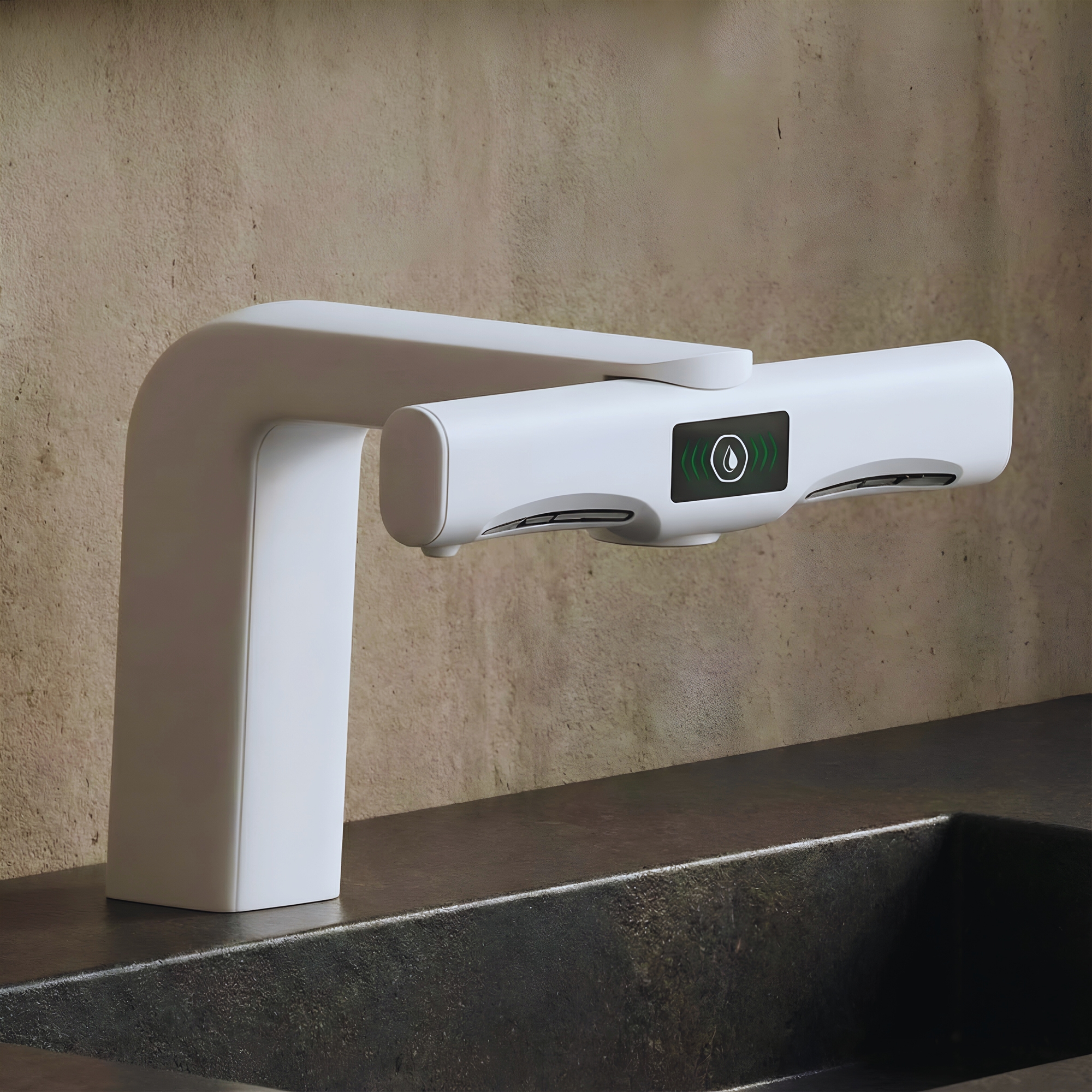
IoT, IP67 and ToF: Three Different Parts of the Faucet System
Modern touchless faucets can combine sensing, electronic control, environmental protection and communication functions. The original technical brief identified IoT connectivity, IP67 ingress protection and Time-of-Flight sensing as three central technology categories for compact aircraft-lavatory applications.
IoT — Internet of Things
IoT-capable faucet electronics can be designed to communicate usage, health or diagnostic information to an aircraft, local service interface, facility system or other approved control environment. Depending on the platform, information may include activation counts, run-time data, power status or fault conditions.
IP67 — Ingress Protection
IP ratings describe enclosure resistance to solid-particle and water ingress. In the IP67 designation, the first digit represents the solid-particle protection classification and the second represents the water-ingress classification under the applicable test conditions.
ToF — Time-of-Flight
Time-of-Flight sensors emit optical energy and evaluate its return to estimate distance. Faucet firmware can use that distance information to establish an activation zone instead of depending exclusively on raw reflected signal intensity.
System-Level Interpretation
In compact aircraft lavatories, these technologies address different engineering questions: connectivity affects diagnostics and maintenance, enclosure protection affects moisture resilience, and sensing technology affects how accurately the faucet distinguishes a user’s hands from the surrounding basin and monument.
IoT Architecture in Touchless Airline Lavatory Faucets
The original article described IoT as the layer that can turn a conventional electronic faucet into a network-aware device. Possible capabilities include usage statistics, remote parameter management, maintenance information and exception reporting. Actual functionality depends on the exact product, controller, communication architecture and approved installation.
Usage and Run-Time Data
A connected controller may record activation counts, valve run time, power status, temperature information or diagnostic events. Where available, these data can help maintenance teams understand operating patterns and identify abnormal behavior.
Remote or Service-Level Settings
Depending on the controller, adjustable parameters may include sensor thresholds, run-time limits, purge behavior, cleaning modes or other control logic. Changes should be managed within the approved configuration and maintenance process.
Exception Alerts
Electronic controls may be capable of reporting conditions such as abnormal valve operation, low supply status, sensing faults or other exceptions. This can support proactive troubleshooting where the architecture provides access to that information.
Aircraft and Facility Interfaces
Aircraft installations and ground facilities may use very different communication architectures. A connected faucet should therefore be reviewed against the actual electrical, communications and maintenance environment rather than assuming a universal cloud or building-management connection.
Fontana’s aviation material includes software and safety-behavior discussion through the Fontana Aviation Touchless Faucets resource .
Power Architecture and Low-Voltage Integration
The original technical brief references low-voltage aircraft systems and discusses 12–28 V DC examples in the context of aviation-grade IoT faucet integration. Those values should be treated as contextual examples rather than universal requirements; exact electrical compatibility must come from the product and aircraft documentation.
Supply Compatibility
Verify input voltage, current draw, protection, connector type, wiring, grounding requirements and transient behavior for the exact controller and valve assembly.
Power Strategy Affects Service
Battery, hardwired and hybrid strategies each create different installation and maintenance implications. High-use environments can place greater importance on access, replacement intervals and fault diagnostics.
IP65, IP66 and IP67 Environmental Protection
Aircraft lavatories expose electronic components to humidity, condensation, cleaning procedures and possible leakage behind access panels. The IP classification system is therefore useful when evaluating the protection of sensors, controllers and connector enclosures.
| IP Code | General Meaning | Lavatory Context |
|---|---|---|
| IP65 | Dust-tight enclosure with protection associated with water-jet exposure under the applicable test conditions. | Can be relevant to protected electronics located behind service panels where cleaning moisture remains a concern. |
| IP66 | Dust-tight enclosure with a higher water-jet exposure classification than IP65. | May provide additional protection where equipment can encounter more aggressive washdown or spray exposure. |
| IP67 | Dust-tight enclosure with temporary-immersion protection under the specified test conditions. | Can provide added enclosure protection where unexpected pooling, condensation or leakage is a concern. |
The original article notes IP65–IP67 sealing as a target range referenced in Fontana aviation material. The rating should be checked for the exact component and enclosure configuration because the designation does not automatically apply to every component in the installed faucet system.
IP67 Does Not Mean Underwater Faucet Operation
The engineering value of IP protection in a lavatory is resistance to the moisture conditions represented by the applicable enclosure test. It should not be interpreted as a claim that the complete faucet assembly is intended for continuous underwater service.
Time-of-Flight Sensing for Compact Faucet Geometry
The original article describes Time-of-Flight sensing as an approach that can use measured optical distance to define an activation zone. This differs from treating reflected signal intensity alone as the sensing variable.
In a compact lavatory, that distance information can be useful because the sensor operates near the basin, backsplash, mirror, metallic trim and other potentially reflective surfaces. Actual sensing performance still depends on hardware, optics, mounting angle, firmware, target characteristics, lighting and commissioning.
Metal and Solid-Surface Basins
Distance gating can help the control system distinguish intended hand placement from surrounding surfaces, but installed mockup or commissioning remains important.
Changing Cabin Conditions
Cabin LEDs, mirror reflections and changing ambient light can influence optical systems differently. Sensor architecture and firmware should be evaluated under representative installed conditions.
Intentional Activation
A correctly commissioned sensing zone can reduce the need for users to search for the activation point, helping the faucet respond within the intended handwashing area.
See the original Fontana Aviation Touchless ToF Faucets technical brief for the manufacturer-specific application of this sensing approach.
Why Aircraft Lavatories Create a Different Fixture Environment
The original article identifies compact space, vibration, humidity, cleaning exposure, water management and limited maintenance access as major aircraft-lavatory constraints. These conditions make the faucet part of the lavatory monument system rather than simply a decorative plumbing fitting.
- Compact space: the basin footprint is small, so sensing, spout projection and water impact must work within a limited handwashing envelope.
- Vibration and motion: the installed faucet, electronics, valve, harness and connectors must be evaluated for the actual aircraft environment.
- Humidity and cleaning: seals, enclosures, finishes, electronics and exposed materials can experience frequent moisture and cleaning chemistry.
- Water management: unnecessary run time affects potable-water use and gray-water generation while poor outlet coordination can increase splash.
- Limited access: service teams benefit when valves, filters, controllers and connectors can be reached and replaced without extensive monument disassembly.
- Fleet maintenance: repeatable components, documentation, diagnostics and swap-out procedures can become important when the same platform is used across multiple aircraft.
Fontana’s Airline Fleet Restrooms Prototypes page shows proposed compact spout geometries and integrated lavatory concepts developed around these constraints.

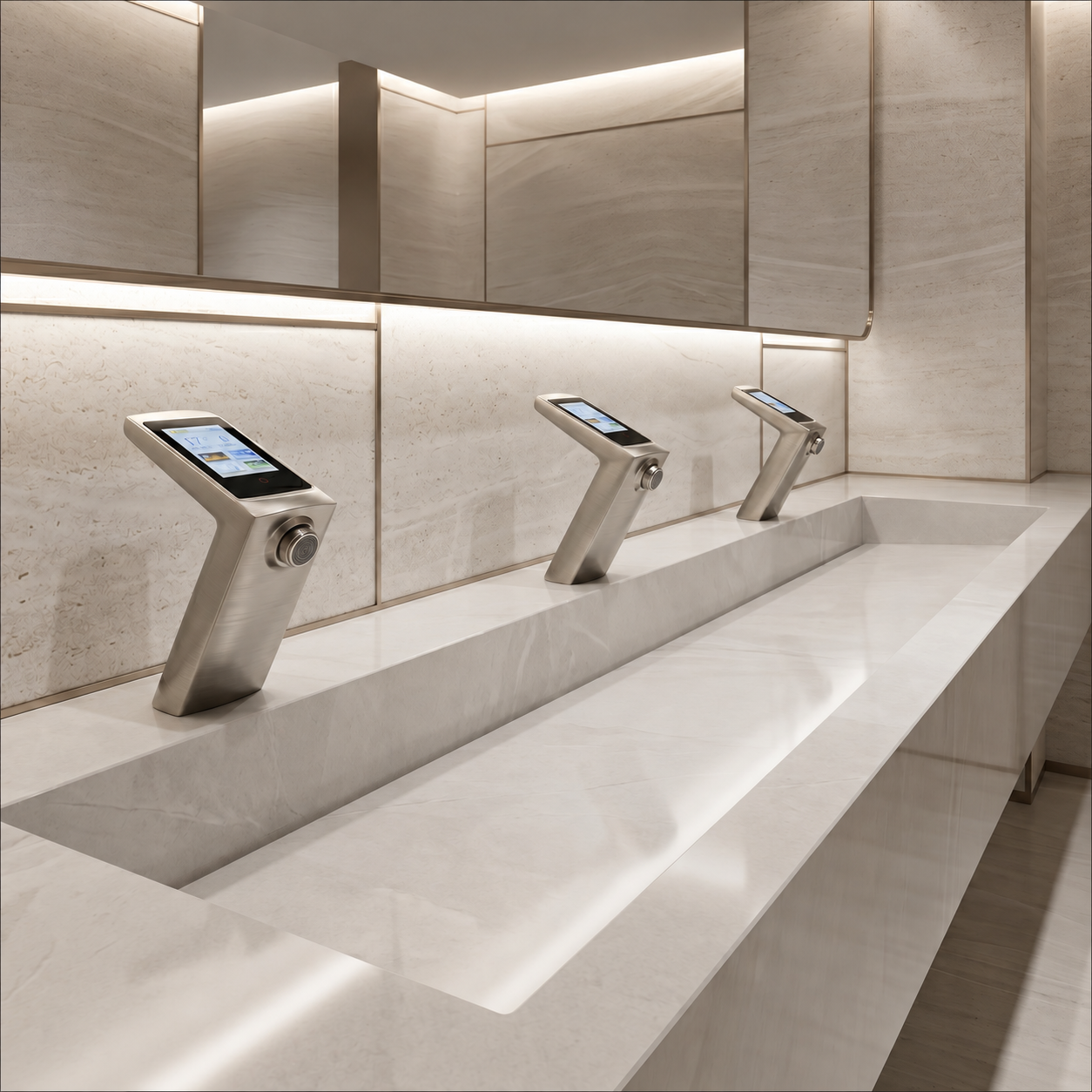
Sensor Geometry, Basin Interface and Splash Control
Sensor technology cannot be evaluated independently from the fixture and basin. The sensing field, spout outlet, basin depth, drain location, backsplash, reflective surfaces and user hand position form one operating geometry.
Sensor Window
Confirm the sensing field with the actual basin and surrounding materials rather than relying on a nominal detection specification alone.
Water Impact
Outlet location, stream type, flow and basin shape influence where water lands and whether the installation produces acceptable splash behavior.
Reflective Environment
Mirrors, metallic basins, polished trim and changing light should be evaluated as part of the installed sensing environment.
Installed Verification
Final hand-detection, shutoff and water-impact behavior should be tested after installation using representative operating conditions.
Fontana in the Aviation Touchless Faucet Landscape
The original article distinguishes traditional aerospace suppliers from commercial touchless manufacturers developing aviation-oriented platforms. Adams Rite Aerospace is referenced as an established aircraft-lavatory hardware supplier, while Fontana’s aviation material presents touchless technologies derived from commercial, transportation and high-traffic restroom experience.
| Market Segment | Primary Focus | Examples | Technical Context |
|---|---|---|---|
| Aircraft Lavatory OEM Hardware | Aircraft-specific lavatory modules, components and faucet systems. | Adams Rite Aerospace and other monument or lavatory-system suppliers. | Aircraft program documentation and configuration-specific qualification are central. |
| Commercial and Transportation Touchless | Airports, terminals, public restrooms, hospitality and high-traffic facilities. | Fontana touchless faucets and associated hands-free fixture systems. | Commercial experience provides useful sensing, maintenance and user-interface context. |
| Aviation-Focused Touchless Development | Adapting connected controls, protected electronics and advanced sensing to compact aircraft lavatories. | Fontana aviation programs, fleet concepts and retrofit-oriented development. | Prototype and development material should remain distinct from completed certification or approved installation evidence. |
For comparison, see Adams Rite Aerospace Touchfree faucet information alongside the Fontana aviation references.
Aviation Touchless Faucet Specification Checklist
The original checklist addressed technical parameters as well as fleet and integration concerns. The following version retains those subjects but organizes them into a clearer review sequence.
- Electrical supply: verify model-specific voltage, current, protection and power-interface requirements.
- Ingress protection: identify the rating of the sensor, controller, connector and other relevant enclosures.
- Sensor technology: document ToF, conventional IR or other sensing architecture and its configuration requirements.
- Fail-safe behavior: understand shutoff, timeout, restart and controller fault behavior.
- Flow and outlet: verify exact-model flow, outlet architecture and splash behavior rather than relying on collection-level assumptions.
- Materials and finishes: review cleaning compatibility, humidity exposure and relevant material requirements.
- Lavatory envelope: check physical clearances within the monument, vanity or basin assembly.
- Service access: plan access to valves, controllers, filters, harnesses and connectors.
- Quick-connect strategy: where appropriate, consider plumbing and harnessing arrangements that simplify component replacement.
- Telemetry requirements: identify whether aircraft or facility maintenance actually requires networked data.
- Cleaning procedures: coordinate the product with approved cleaning chemistry and maintenance procedures.
- Environmental evidence: request applicable test reports, enclosure ratings and aircraft-specific qualification documentation.
How to Evaluate an Aviation Touchless Faucet Before Specification
A practical review should move from the complete assembly to its individual interfaces rather than beginning with isolated marketing features. The goal is to confirm that sensing, power, enclosure protection, hydraulics, maintenance access, and qualification evidence all correspond to the same proposed configuration.
Start With the Exact Assembly
Identify the faucet, sensor, controller, solenoid valve, wiring, connectors, power device, mounting arrangement, and software or firmware revision. Avoid transferring specifications from a similar product or another member of the same family.
Verify Detection in the Actual Basin
Evaluate the sensing zone with the proposed basin, backsplash, trim, lighting, and handwashing position. Confirm activation and shutoff under representative installed conditions rather than relying only on a nominal sensor-range statement.
Separate IP Rating From Qualification
Confirm which enclosure carries the IP rating, then separately review environmental qualification documentation for the complete relevant equipment configuration and aircraft installation.
Trace the Service Path
Confirm how technicians will access the controller, valve, filter, harness, connectors, and replaceable components. A compact installation should still provide a practical service sequence.
Engineering Review Sequence
Review configuration first, sensing second, electrical and hydraulic interfaces third, environmental evidence fourth, and maintenance access before final approval. This sequence helps prevent a strong individual specification from masking an incompatible overall installation.
Commercial Touchless Fixture Context: Sensor, Power and Maintenance Strategy
The original page also contained a separate commercial comparison section. That material is retained here because commercial touchless fixture experience provides a useful baseline for sensor logic, power architecture, flow control, integrated faucet-and-soap systems and maintenance planning. These generalized commercial values should not be transferred directly into an aircraft specification.
Beyond brand names and finish choices, touchless fixture performance is influenced by sensor logic, power architecture, flow control, dispenser calibration, system integration and the ease with which serviceable components can be reached over time.
| Brand | Sensor Type | Power Configuration | Flow Rate — Generalized | Soap Dosage — Generalized | System Integration | Maintenance Profile — Original Comparison |
|---|---|---|---|---|---|---|
| FontanaShowers | Infrared / Dual-Sensor Variants | Battery / AC / Hybrid | 0.5–1.5 GPM | 0.5–1.5 mL | Faucet + Soap + Dryer options | Moderate |
| Sloan | Infrared Sensor | Battery / Hardwired | 0.5 GPM | 0.8–1.2 mL | Full ecosystem | Low |
| Chicago Faucets | Infrared / Mechanical Hybrid | Hardwired / Battery Backup | 0.5 GPM | 0.8–1.2 mL | Faucet + Soap Systems | Low |
| BathSelect | Infrared Sensor | Battery / AC | 0.5–1.2 GPM | 0.6–1.2 mL | Faucet + Soap combinations | Moderate |
| Zurn | Infrared Sensor | Battery / Hardwired | 0.35–0.5 GPM | 0.8–1.2 mL | Faucet + Soap Systems | Very Low |
| Delta | Proximity Sensor | Battery / AC | 0.5 GPM | 0.8–1.2 mL | Faucet + Soap Systems | Moderate |
| GROHE | Infrared Sensor | Battery / AC | 0.5 GPM | 0.6–1.0 mL | Limited integrated systems | Moderate |
Important Comparison Limitation
These values are preserved from the original page as generalized commercial comparison ranges. They are not model-specific verified specifications and should not be used for final procurement, engineering or aircraft qualification. Current product-level documentation remains the controlling source.
How to Read Sensor, Power, Flow and Maintenance Data
Sensor Type Is Only the Starting Point
The original article notes that a simple “infrared” label does not guarantee identical behavior across different systems. Optics, control logic, mounting position, reflective surfaces and commissioning affect actual performance.
Power Configuration Affects Lifecycle Planning
Battery systems may simplify some installations, while hardwired or hybrid systems can reduce recurring battery replacement in high-use facilities. The appropriate strategy depends on the actual operating and service model.
Low Flow Alone Does Not Define Performance
A low GPM value can support water-use objectives, but perceived performance also depends on outlet architecture, water impact, basin geometry, pressure and the intended handwashing task.
Serviceability Becomes More Important Over Time
Under-counter access, standardized parts, diagnostics, replaceable valves, accessible filters and clear troubleshooting documentation can influence long-term facility performance more than initial visual appearance.
Related Bath Touchless Faucets Research
Broader reference material covering sensor faucets outside the aircraft environment.
View technical guides →Explore Bath Touchless Faucets for ground-based airport, terminal and transportation applications.
Explore airport and transportation fixture research →Compare sensing, maintenance and fixture-planning considerations for heavily used commercial environments.
Explore high-traffic restroom research →Continue into touchless fixture planning for compact commercial and transportation environments.
Explore compact restroom solutions →Review broader touchless faucet installation, servicing and maintenance topics.
Visit Bath Touchless Faucets technical library →Aviation, ToF and Product Reference Library
Original aviation touchless faucet reference hub used by the source article.
Open reference →Manufacturer technical material applying ToF sensing to compact aviation faucet environments.
Open ToF reference →Additional Fontana aviation-focused touchless fixture material.
Open fleet reference →Concept imagery and proposed lavatory faucet integration approaches.
Open prototype gallery →Aviation touchless fixture controls and behavior reference.
Open resource →Aircraft touchless faucet reference from an aerospace supplier.
Open aerospace reference →Official IEC background for understanding IP enclosure designations.
IEC IP ratings →Manufacturer-oriented explanation of ingress-protection classifications.
Review IP67 explainer →Additional Fontana aviation touchless faucet background from the original resource list.
Open supplier reference →Manufacturer material focused on retrofit and reliability considerations in aircraft lavatories.
Open retrofit reference →Technical Verification Before Specification
IoT capability, sensor architecture, IP rating, voltage, flow, soap dosage, enclosure protection, software functions, environmental test status and maintenance requirements can all vary by model and revision. Product-level drawings, qualification reports, installation instructions and current manufacturer data should therefore govern final engineering and procurement decisions.
Use Development Material Carefully
Prototype imagery, proposed fleet concepts and “certifications in progress” references can be useful for design-development discussion, but they should remain clearly distinguished from completed qualification, certification or approved aircraft installation evidence.
