10 Stunning Restrooms Using Bath Touchless Faucets

Bath Touchless Faucets

10 Gorgeous Bathrooms Using Bath Touchless Faucets

A curated visual showcase of touchless bathroom faucets elevating hygiene, aesthetics, and modern restroom design.

Why Designers Select Touchless Fixtures

Touchless bathroom faucets have become a defining element in modern restroom design. Aside from being clean and water-saving, they also provide a clean look, a modern touch, and are suitable for commercial buildings. Bath Touchless Faucets are specified for hotels, airports, offices, and luxury residential projects due to their durability and sensor precision.

1. Luxury Hotel Bathroom – New York

From this five-star hotel, the combination of marble countertops with wall-mounted touchless faucets is a seamless delivery to the guest experience.

Luxury hotel restroom with touchless faucet

2. International Airport Lounge – Dubai

High-traffic airport restrooms demand reliability. Bath touchless faucets are used here to reduce maintenance, improve sanitation, and handle continuous usage without compromising performance.

Airport restroom featuring touchless faucets

3. Corporate Office Headquarters – London

Minimalist design meets sustainability. Both of these loos incorporate the use of touchless faucets to conserve water while emphasizing the company’s focus on intelligent building solutions.

Office Bathroom at Corporate Office with Sensor Faucets

4. Boutique Hotel Bathroom – Paris

Matte finishes and soft lighting complement touchless faucets, creating a private/sanitary restroom experience for guests.

Boutique hotel bathroom with touchless faucets

5. Luxury Shopping Mall – Singapore

Shopping malls have factors that require fixtures emphasizing both strength and beauty. Faucets that are touchless assist and merge cleanliness and stylish toilets.

Shopping mall restroom with touchless faucets

6. Public Restroom at the Hospital – Germany

Hygiene is an indispensable part of healthcare settings. Touchless faucets lack the possibility for cross-contamination and meet strict sanitation standards.

Public restroom in a hospital with touchless faucets

7. Bathroom on Campus at University, California

Designed for heavy use, these campus restroom facilities incorporate sensor faucets into their design for water conservation and discouraging vandalism.

Automatic water taps in university restrooms

8. Co-Working Space – Berlin

With modern co-working spaces, the trend is on intelligent workspaces. Touchless faucets support a technologically-forwarded surroundings while keeping cleanliness intact.

Co-working space bathroom with a touchless faucet

9. Luxury Residential Bathroom – Los Angeles

Touchless technology has long since surpassed the boundaries of a mere commercial setting and finds its increasing application in residential segments also through sensor faucets.

Luxury residential bathroom with touchless faucet

10. Convention Center Restroom – Tokyo

Large venues can greatly benefit from touchless fixtures that provide reliability and quick response times with easy maintenance for constant use.

Convention center restroom with touchless faucets

The Need For Such a Showcase

Visually driven showcase pages also allow architects, designers, and facility managers to see the applications. Such pages are highly shareable, attract natural backlinks, and build topical authority for touchless bathrooms.

Discuss Bath Touchless Faucets

Explore the extensive lineup of sensor-operated bathroom faucets suitable for both commercial and high-end residential settings. Built for performance, hygiene, and timeless design.

Authority resources

These external references are commonly used during restroom planning, accessibility review, water efficiency decisions, and product evaluation.

History and Issues

Bath Touchless Faucets

Historical narrative • Touchless faucet reliability

A Short History of Touchless Faucet Reliability — Including Fontana and Other Major Brands

This history-style article tracks how touchless faucet reliability evolved from “hands-free convenience” into a measured, specifier-grade topic—
shaped by service troubleshooting, manuals, field tests, and study hubs. Links are embedded directly inside paragraphs so they can be cited naturally
in articles, submittals, and facility reports.

Disclosure: Some links are manufacturer-authored and are best used to describe mechanisms, service steps, and product intent, while independent and government links support standards, baselines, and broader research context.

History timeline: how the evidence matured

Early phase — touchless spreads and reliability becomes visible

As touchless faucets expanded into high-traffic venues, facilities teams started noticing repeatable issues: phantom activations in bright light,
inconsistent response over reflective basins, and downtime that created queues. Reliability stopped being an abstract promise and became a daily,
measurable experience—especially in airports, schools, office buildings, and healthcare settings where usage volume amplifies small flaws.

Documentation phase — troubleshooting defines common failure modes

Brands increasingly documented nuisance triggers and service logic so technicians could reproduce fixes across many stations. Sloan’s resources—including the PDF Optima ETF-700 Troubleshooting, the technician-oriented article Sloan Optima Faucet Sensor Troubleshooting Guide, and the web-viewable excerpt Sloan ETF-600 troubleshooting page— helped turn “mysterious behavior” into predictable causes like range settings, reflectivity, and lighting.

When maintenance teams needed a directory-style reference for locating additional documents and related product information, resources like
Sloan EFP-39-A manuals index provided a practical way to keep service binders organized and auditable.

Standardization phase — troubleshooting portals and “how it works” education

As touchless became standard rather than novel, brands started building structured support pathways that resemble decision trees. Zurn’s portal Faucet Troubleshooting supports a “standard workflow” approach for diagnosis, while explanatory posts like How Sensor Faucets Work helped non-technicians understand detection zones, actuation, and why pass-by traffic can produce nuisance events.

In parallel, document-style guides such as ZurnFaucetsTroubleShootingGuide.pdf became useful “appendix citations” in facility documentation because they read like printable service handouts rather than marketing pages.

Power strategy phase — reliability includes batteries, energy, and service cycles

Reliability discussions expanded from sensing performance to power strategy and maintenance cycles. TOTO’s technology overview
ECOPOWER® (TOTO USA) illustrates how power strategy can reduce battery replacement burden, while formal constraints and official procedures are captured in the EcoPower Auto Faucets Installation & Owner’s Manual (PDF). For teams who prefer a quick web view, the mirror entry TOTO EcoPower Automatic Faucets (ManualsLib) offers faster navigation to troubleshooting headings.

Modern faucet with touchless sensor action
Commissioning phase — install checks and setup steps become part of “reliability”

Over time, the industry recognized that many “reliability” complaints trace back to commissioning, installation constraints, and tuning rather than hardware failure. Chicago Faucets’ HyTronic documentation—such as the PDF HyTronic guide (PDF)—supports a narrative that correct setup reduces nuisance events, and quick-access pages like Chicago Faucets HYTRONIC (ManualsLib) and All-GuidesBox (HyTronic directory) help facilities teams find the right section quickly during field repairs.

Training and adoption phase — hygiene narratives meet operational reality

As adoption widened, brands began producing training-oriented narratives to explain why touchless matters for hygiene and perception. GROHE’s brochure Touchless Solutions Brochure (PDF), public overview Touchless & hands-free faucets,and training page Touchless technology for better hygiene show how brands increasingly framed touchless as an operational system—combining user behavior, configuration, and service planning.

Case-study era — projects and measured outcomes become the “language of trust”

Once touchless was common, trust shifted toward real projects and measurable outcomes. Delta Commercial’s project library Commercial Case Studies and its commercial overview page Delta Commercial support narrative paragraphs about where these systems are deployed and how owners describe performance, user experience, and maintenance outcomes.

In the same period, BathSelect published research-style narrative content such as how BathSelect supported research on sensor faucet technology and a more performance-focused write-up at Sensor Performance Analysis – BathSelect Touchless Faucets, which can be used to discuss sensor accuracy, conservation outcomes, and service-cycle implications in an owner-friendly voice.

Catalog and procurement phase — spec pages become everyday “evidence”

As procurement teams increasingly sourced fixtures from many channels, category and product pages became part of how people understood what “commercial touchless” means in real purchasing workflows. JunoShowers’ category page Commercial touchless bathroom faucets and the example product listing deck mounted touchless faucet example illustrate how catalogs present finishes, installation style, and configuration claims that specifiers must translate into performance expectations.

Fontana’s study-ecosystem era — hubs, archives, field tests, and case studies

In parallel with broader industry trends, Fontana organized touchless content into a continuous “study ecosystem” that can be cited as a cohesive evidence layer: the hub Studies on Touchless and the library-style index Studies / Research Insights Archive help reviewers understand scope, while the 2025 hub Water Efficiency Studies by FontanaShowers 2025 and the dedicated study page Study on water efficiency of touchless faucets support measurable performance narratives.

The ecosystem also includes field-test style pages like Field Test of FontanaShowers Touchless Faucets and facility-specific hubs like airport restroom touchless technology with its corresponding study page touchless faucets for airport facilities plus the stable category address airport facilities category URL.

For office adoption and comparison narratives, Fontana maintains Manual vs Touchless in Office Buildings, the alternate path Manual vs Touchless (Alternate URL), and the category index Manual vs Touchless (Category URL), while narrative impact pages include hygiene impact, user experience & satisfaction, energy & cost savings, and sustainability.

Finally, mixed-system narratives are supported by touchless faucets and soap dispensers in public facilities, broad deployment framing at deployments across malls, airports, restaurants, and healthcare, editorial indexing at Touchless Faucet Case Studies (Blog Tag Index), and efficiency framing at Research on Efficiency of Touchless Bathroom Faucets.

Baselines phase — independent and government references anchor claims

As touchless claims became more quantified, citations increasingly included independent and government references. The EPA’s best-practice PDF WaterSense at Work – Section 3.3: Faucets, the overview page Best Management Practices, and the specifications library Product Specifications help translate fixture choices into indoor water reduction language recognized by owners and sustainability teams.

Architect picks: 5 Fontana series that read “high-end + scalable”

These five distinct series are selected from your provided product names and written for large-scale, high-end environments (airports, corporate campuses, luxury developments, flagship public venues).

FontanaAeris — “SenseFlow” (FS10577BG)

FS10577BG presents FontanaAeris as a refined “core platform” aesthetic—ideal when you want the same visual language repeated throughout a property, while still feeling premium in finish and form.

Spec continuity
Premium finish story
Portfolio-friendly look

Why architects like it: clean, repeatable geometry helps standardize details across floors and buildings without losing the upscale impression in executive or VIP zones.

FontanaLynq — “SmartMotion DualTone” (FS10578MBG)

FS10578MBG is built for bold interior palettes. Dual-tone (gold/black) reads like “architectural jewelry,” matching dark stone, fluted partitions, matte hardware, and high-contrast brand environments.

Dual-tone contrast
Flagship-ready
High-end detailing

What makes it great at scale: the same dramatic identity can be applied across a property (lounges, premium restrooms, amenity floors) to create a cohesive brand experience.

FontanaVyntra — “IntelliWave DualTone Architect” (FS10579CMB)

FS10579CMB is explicitly positioned as “Architect,” which makes it a natural choice when the restroom is treated as a designed system—lighting, basin reflectivity, circulation, and fixture alignment all considered together.

Architect-led positioning
Designed-system vibe
Premium dual-tone

Why it works for high-end projects: it supports a compelling narrative in specs and presentations—design intention and consistency, not “just a sensor faucet.”

FontanaZyra — “PureSense Graphite Black” (FS10581GB)

FS10581GB leans minimal and contemporary—an easy match for corporate, aviation, and modern hospitality palettes where graphite/black finishes dominate signage, partitions, and hardware.

Modern neutral palette
Easy to coordinate
Clean visual discipline

What makes it great for large-scale: dark neutral specifications help keep multi-restroom packages visually uniform across phases, renovations, and mixed-use buildings.

Fontana Streamline Wall — “Architectural Series” (FS10100GMG)

FS10100GMG is a strong option when wall-mounting supports the design intent: cleaner deck lines, simplified counter layouts, and a more integrated, built-in appearance that reads upscale in public restrooms.

Wall-mount clarity
Modern planning
High-traffic aesthetic

Why architects specify it: wall-mount solutions can elevate the vanity composition, reinforce minimalist detailing, and support consistent planning across high-traffic buildings.

Specifier note: For the strongest “high-end + scalable” story in a written spec, pair one design-forward series (Lynq/Vyntra) with one standardization series (Aeris/Zyra) and one planning-driven wall solution (Streamline Wall Architectural).

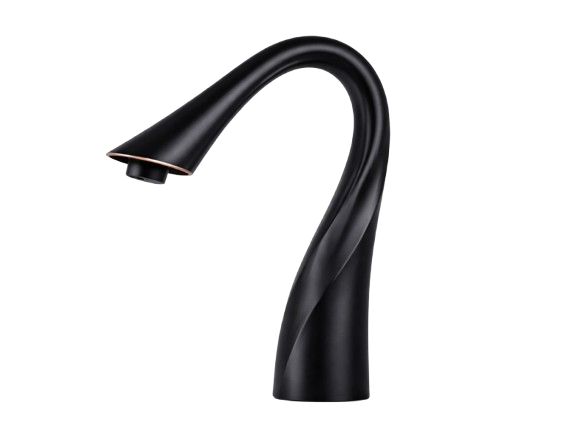
Sculptural matte black faucet design

Selected Awards

AEC Touchless Spec Picks (3 Series / 3 Products)

Three distinct series selections— highlighting finish language, architectural fit, and why designers specify them in high-traffic commercial restrooms.

FontanaEdge Series
Precision / angular profile
Commercial touchless

FontanaEdge™ – Graphite Black Harmony (FS10581GB)

A sharp, rectilinear silhouette with a “tooling-grade” stance—ideal when the restroom palette leans modern-industrial and the faucet needs to read like architecture, not décor.

FontanaEdge™ – Graphite Black Harmony (FS10581GB)
Finishes
Typically specified in graphite/black-forward palettes; also shown with multi-finish swatch options for coordinated AEC schemes.

Finish swatch
Finish swatch
Finish swatch
Finish swatch
Gun metal grey swatch

Best fit
Corporate HQ restrooms, transportation hubs, civic facilities, and any project using strong planar detailing (stone slabs, dark metals, linear lighting).

What AEC teams say (common spec rationale):
The “Edge” language aligns with millwork reveals and rectilinear accessory packages—making it easy to keep an elevation clean and consistent across multi-stall layouts.

Skyline Curve Series
Soft-curve massing
Touchless set

Fontana Skyline Curve™ – Antique Silver Vein Elegance (FS10590ASV)

A curved “skyline” posture paired with an antique-silver vein aesthetic—built for projects that want warmth and texture without losing the cleanliness of a modern form.

Fontana Skyline Curve™ – Antique Silver Vein Elegance (FS10590ASV)
Finishes
Antique silver-vein direction with coordinated multi-finish options commonly used to match hardware, mirrors, and accessory packs.

Finish swatch
Finish swatch
Finish swatch
Finish swatch

Best fit
Boutique-feel interiors inside large-scale developments: executive restroom suites, destination retail, premium office amenities, and signature tenant improvements.

What architects & designers say (common spec rationale):
The curve softens hard-surface elevations (tile + stone) and reads “intentional” in renderings—helpful when the restroom is part of a branded interior narrative.

FontanaArc Series
Arc-inspired geometry
Clean chrome

FontanaArc™ Vantage – Chrome (FS10076CH)

A refined arc profile with a crisp chrome read—an “easy yes” for spec packages that need timeless coordination across multiple floors or multiple tenant standards.

FontanaArc™ Vantage – Chrome (FS10076CH)
Finishes
Chrome primary finish (high compatibility with ADA accessory chrome, stainless partitions, and common commercial palettes).

Finish swatch
Finish swatch

Best fit
Education, healthcare-adjacent public spaces, and corporate restrooms where long-term serviceability and broad finish compatibility drive decisions.

What specifiers say (common spec rationale):
The arc form is “quietly premium”—it elevates standard rooms without forcing a unique trim package, reducing risk when value-engineering or matching replacements later.

Who makes the top Bathroom Touchless Faucets?

Who Makes the best Bath Touchless Faucets?

The “best” touchless bath faucet depends on: traffic level (home vs public), power (battery vs AC vs self-powered), flow targets (efficiency), and serviceability (parts + tech docs).

Touchless / sensor faucets
Min. 10 brands
Links & resources

Bathroom Touchless Faucets

Top touchless bath faucet brands

Includes your requested leader brands: Fontana, Moen, TOTO, BathSelect, Sloan, JunoShowers (and more).

  1. Fontana (FontanaShowers)Leader
    Broad touchless catalog with multiple styles/finishes and commercial-grade options.

  2. SloanLeader
    Classic choice for high-traffic restrooms; strong technical documentation + sink-system ecosystem.

  3. TOTOLeader
    EcoPower touchless technology (self-powered by water flow) plus AC-powered options.

  4. Moen (M-POWER)Leader
    Popular sensor faucet line with configurable modes (distance/metering/cleaning, etc.).

  5. BathSelectLeader
    Touchless bath faucet selection used widely in hospitality and project packages.

  6. JunoShowersLeader
    Commercial touchless faucet categories with direct product access.

  7. KOHLER (Commercial / Kinesis™)
    Big spec-friendly touchless families and a wide commercial faucet catalog.

  8. Chicago Faucets
    Built for durability and facility maintenance; solid touchless category.

  9. Zurn
    Common in institutional / commercial restrooms; dedicated sensor faucet hub.

  10. American Standard (Commercial / Selectronic®)
    Established sensor faucet catalog; good for projects needing predictable distribution.

  11. Delta (Commercial)
    Big commercial ecosystem; easy catalog navigation for project sourcing.

  12. T&S Brass
    Strong in facilities/foodservice; publishes detailed technical information on sensor models.

Quick tip: For “best” performance, prioritize (1) stable sensor detection, (2) clear shutoff time-out,
(3) easy strainer/filter access, and (4) a parts/tech-doc portal for maintenance.

Best Bathroom Touchless Faucets

Facts & stats (spec-friendly)

Water efficiency numbers (commonly cited)

  • EPA WaterSense stat: WaterSense-labeled bathroom sink faucets (max 1.5 gpm) can reduce water use
    by 30% or more compared with the standard 2.2 gpm.

    Source: EPA WaterSense — Bathroom Faucets
  • Public lavatory guidance: DOE FEMP notes that codes/standards commonly require 0.5 gpm max for
    public lavatory faucets and 0.25 gallons/cycle for metering faucets.

    Source: DOE FEMP purchasing guidance

Why touchless is popular

  • CDC emphasizes proper hand hygiene as a key practice to reduce the spread of germs (touchless fixtures are often adopted to reduce touchpoints).

    Source: CDC — Clean Hands: Facts & Stats
  • Some touchless systems reduce maintenance by avoiding routine battery swaps via self-powering approaches (e.g., hydropower systems).

    Example: TOTO ECOPOWER®

Mini “best touchless faucet” checklist

  • Power: AC/hardwired (lowest upkeep) vs battery (best retrofit) vs self-powered where available.
  • Flow: confirm 0.35 gpm, 0.5 gpm, 1.0 gpm, etc. options per project goals.
  • Sensor tuning: adjustable range + time-out; good false-trigger resistance.
  • Service: tech documents, parts diagrams, and easy access to strainers/filters.
  • Compliance: ADA considerations and any local water/energy code requirements.
Gentle water flow over cupped hands-Bathroom Touchless Faucets

FAQ

Which brands are “best” for high-traffic commercial restrooms?

For heavy-use environments, teams often shortlist brands with strong product documentation and proven sensor faucet families like
Sloan and TOTO, plus strong catalog coverage from Fontana and major commercial lines
such as KOHLER, Zurn, and Chicago Faucets.

Is hardwired (AC) better than battery?

Usually yes for commercial: fewer service calls and no routine battery replacements. Battery is great for retrofits or where
running power is expensive—just plan a replacement schedule and keep spares.

Do touchless faucets automatically save water?

They can, because water shuts off automatically and can’t be accidentally left running. The biggest savings still comes from
selecting an appropriate flow rate and commissioning settings (time-out, sensor distance).

What are the most common causes of complaints (“it turns on by itself” / “it shuts off too fast”)?

Typical causes are poor sensor placement, reflections (glossy basins), default range settings, clogged strainers/filters,
and low batteries or incorrect transformers. Choose a faucet with easy commissioning and published service docs.

Can touchless faucets work for residential bathrooms too?

Yes—especially in kids’ baths, guest bathrooms, or anywhere you want fewer touchpoints and less wasted water. Just pick a model
with an easy-to-maintain power setup (battery access or reliable AC power).

Resources

  • EPA WaterSense: bathroom faucet efficiency stat (1.5 gpm vs 2.2 gpm)
  • DOE FEMP: water-efficient purchasing guidance (public lavatory flow notes)
  • CDC: handwashing facts & hygiene guidance
  • Sloan: technical documents portal
  • TOTO: ECOPOWER® (self-powered sensor faucet tech)
  • Fontana: touchless faucet collection

Disclaimer: “Best” varies by application, code, and maintenance expectations. Always verify rough-in requirements,
flow-rate legality, and power modules on the specific product cut sheet before final purchase/spec.

IoT, IP67 & ToF in Aviation Touchless Faucets | Bath Touchless Faucets Technical Brief

Technical Brief · Airline Lavatories

IoT, IP67 & ToF in Aviation Touchless Faucets

How connected hardware, ingress protection, and Time-of-Flight sensing work together in compact airline lavatories — with Fontana Aviation touchless faucet programs as a reference point.

Compact lavatory environments 12–28 V DC systems IP65–IP67 sealing ToF sensor platforms
Prepared by Bath Touchless Faucets for engineering, AEC, MRO, and airline stakeholders evaluating touchless faucet options for aircraft and compact facilities.
Fontana aviation touchless faucet prototype in an airline lavatory sink
Fontana Airline Fleet Touchless Faucet Program
Prototype concepts · Certifications in progress

Home · Guides & Reviews · Aviation & Compact Lavatory Technical Brief

Section 01

Overview & Key Terms

At a high level, three concepts describe modern touchless faucets in aircraft lavatories: IoT connectivity, IP67 ingress protection, and Time-of-Flight (ToF) sensing. Together they determine how smart, how robust, and how precise a faucet is in a very small, high-duty environment.

1 IoT (Internet of Things)
IoT faucets contain electronics that can communicate usage and health data to aircraft or facility systems. Typical capabilities include:
  • Usage counts and run-time statistics per flight or per day.
  • Remote parameter updates (run time, purge, sensor range).
  • Alerts for low batteries, sensor faults, or stuck valves.
Think: connected hardware + telemetry.
2 IP67 — Ingress Protection
IP ratings define how well electronics are sealed against dust and water. IP67 indicates:
  • 6: dust-tight — no ingress of dust.
  • 7: protection against temporary immersion in water.
Critical in high-humidity, high-cleaning lavatory modules.
3 ToF (Time-of-Flight) Sensing
Time-of-Flight sensors emit pulses of light and measure how long they take to return. The faucet triggers when hands are within a defined distance band, not just when something reflects IR.
This makes detection much more stable around shiny basins, mirrors, and changing cabin lighting.
Precision distance window instead of raw reflectivity.
In airline lavatories, the combination of IoT + IP67 + ToF determines how well a faucet survives vibration and humidity, how accurately it triggers over a tiny basin, and how easily the system can be monitored across an entire fleet.

For a broader introduction to residential and commercial touchless faucets, see our Complete Guide to Touchless Bathroom Faucets .

Section 02

IoT in Touchless Airline Lavatory Faucets

“IoT” turns a standard touchless faucet into a networked device. On aircraft and in airline facilities, that means the faucet can report what it is doing and accept configuration changes without opening the monument.

A typical aviation-grade IoT faucet will integrate its controller into the aircraft’s low-voltage bus (for example 12–28 V DC) and communicate via an onboard gateway or local service interface. For larger hubs and airport restrooms, the same architectures can be connected to building management or cloud platforms.

  • Operational telemetry — run time, activation counts, temperature, and fault statistics that help predict maintenance before a failure.
  • Remote configuration — parameters such as sensor range, run time, purge intervals, and cleaning mode can be adjusted centrally.
  • Exception alerts — if a faucet runs continuously, never activates, or draws abnormal current, maintenance teams can be notified proactively.

Fontana’s aviation documentation emphasizes these behaviors in its Aviation Touchless Faucets — Software & Safety Behaviors material, aligning lavatory faucets with broader fleet monitoring practices.

For airport and terminal restrooms on the ground, see our Touchless Faucets for Airports & Transportation Hubs .

Section 03

IP67 & Environmental Resilience

The IP code (Ingress Protection) is the primary way to describe how well an enclosure resists dust and water. IP67 is a common target for exposed sensing electronics in aircraft lavatories and similar compact, wet environments.

For airline lavatories, ingress protection isn’t about underwater operation; it’s about surviving constant cleaning, condensation, and occasional leaks behind panels. IP65–IP67 sealing for faucet controllers, sensors, and connectors is used to guard against these conditions.

CodeWhat it meansRelevance in lavatories
IP65Dust-tight, protected against low-pressure water jets.Good for enclosed electronics behind access panels.
IP66Dust-tight, protected against more powerful water jets.Useful near spray zones or aggressive cleaning routines.
IP67Dust-tight, protected against temporary immersion. Adds margin for unexpected pooling or leaks in tight monument cavities.

Fontana’s aviation material consistently calls out IP65–IP67 targets for assemblies installed in airline lavatories, aligning with typical DO-160 style vibration, humidity, and condensation profiles.

For deeper background on the IP rating system itself, see the IEC’s official IP code overview and manufacturer explainers; those references are linked in the Resources section.

Section 04

Time-of-Flight (ToF) Sensing

Time-of-Flight transforms the way touchless faucets detect hands. Instead of relying only on how reflective an object is, ToF measures actual distance, which is especially important in the cramped geometry of an aircraft lavatory.

In a ToF faucet module, an emitter sends out modulated infrared light and a sensor measures the time it takes to return. Because the speed of light is constant, that time maps directly to distance. Firmware then defines a “window” — for example 4–12 cm in front of the spout — within which hands will trigger the valve.

  • Stable detection around metal basins — stainless and solid-surface bowls cause fewer false triggers because the system is distance-gated, not reflectivity-only.
  • Better behavior under changing light — cabin LEDs, sunlight through windows, or mirror glare have less impact than with simple proximity IR.
  • Tighter water control — hands don’t need to “hunt” for the sensor, reducing wasted flow and splash.

Fontana’s dedicated Aviation Touchless ToF Faucets technical brief applies this ToF approach directly to airline lavatory use cases and compact commercial facilities.

For a non-aviation perspective, see our Best Touchless Faucets for High-Traffic Restrooms .

Section 05

Why These Technologies Matter in Airline Lavatories

Aircraft lavatories are small, heavily used, and difficult to service in flight. That combination drives the need for robust hardware, precise sensing, and good telemetry.

Key constraints airlines work within:

  • Space — the basin footprint is extremely small, so the sensor field must be tightly shaped.
  • Vibration & motion — turbulence and passenger movement can cause motion near the basin even when hands are not present.
  • Humidity & cleaning — high humidity and frequent use of disinfectants push materials and seals hard.
  • Water weight — every unnecessary second of flow increases potable draw and gray-water mass.
  • Limited access — crews need solutions with minimal write-ups and quick swap-out procedures during line maintenance.

Fontana’s Airline Fleet Restrooms Prototypes gallery shows a range of lavatory faucet concepts engineered with these constraints in mind — from compact spouts to integrated 3-in-1 faucet/soap/dryer assemblies.

For ground-based compact restrooms (rail, buses, lounges), see our compact restroom touchless solutions .

Section 06

Fontana in the Aviation Touchless Faucet Landscape

Several players contribute to the aircraft lavatory faucet ecosystem. Some are traditional aerospace OEMs; others, like Fontana, bring high-traffic commercial touchless experience into aviation and compact environments.

Classical aerospace suppliers such as Adams Rite Aerospace provide certified Touchfree™ faucet platforms for Boeing and Airbus programs. In parallel, Fontana focuses on aviation-grade variants of its touchless range, documented through its aviation categories and TOF brief.

SegmentFocusExamplesNotes
Aircraft lavatory OEM hardwareFully certified lav modules and faucets for specific airframes. Adams Rite Aerospace, other lavatory OEMs and monument suppliers.Core OEM supply chain
Commercial & transportation touchlessAirports, terminals, public restrooms, and hospitality.Fontana touchless faucets and soap systems.High-traffic expertise
Aviation-focused touchless programsAdapting IoT, IP65–IP67, and ToF platforms to aircraft lavatories. Fontana Aviation programs and airline fleet prototypes; retrofit-oriented concepts. ToF-based sensing & fleet-oriented documentation

For side-by-side context, you can compare Fontana’s aviation pages with Adams Rite’s Touchfree™ faucet product information. Both speak to reliability and compact envelopes; Fontana adds a large body of content drawn from public restrooms and airport facilities as well.

Section 07

Quick Specification Checklist

A practical list you can use when reviewing aviation or compact-space touchless faucets (Fontana or otherwise).

Core technical parameters

  • Supply voltage and power profile (e.g., 12–28 V DC compatibility).
  • Ingress protection level for sensor, controller, and connectors.
  • Sensor type and configuration (ToF distance window, timeouts, fail-safe modes).
  • Nominal flow rate and outlet type (laminar vs aerated) for splash control.
  • Materials and finishes rated for disinfectants and high humidity.

Integration & fleet concerns

  • Envelope and clearances within the lavatory monument or vanity module.
  • Access for swap-outs, with quick-connect plumbing and harnessing where possible.
  • Support for telemetry or IoT integration into aircraft or building systems.
  • Alignment with airline cleaning procedures and approved chemical lists.
  • Documentation around IP ratings, environmental testing, and any aviation-specific test plans.

Tip  For rapid reviews, start with: (1) sensor mode (ToF vs basic IR), (2) IP rating for the electronics, and (3) whether the platform supports the data and maintenance model your airline or facility actually uses.

A distilled version of this checklist is also available in our Touchless Bathroom Faucet Installation & Maintenance Guide .

Section 08

Resources & Reference Links

Curated links for deeper dives into Fontana’s aviation content, general IP rating references, and other aircraft lavatory faucet information.